


Work rarely happens in isolation. We interact daily with peers, managers, customers, and senior leadership, and each group sees our work differently.
That’s the benefit of 360-degree reviews. While traditional performance reviews typically rely on just manager feedback, 360 reviews go full circle, gathering input from various groups and uncovering insights that make a real difference for employee development and manager effectiveness.
To gain actionable data from 360 feedback, however, you must match the right questions to the right reviewers. In this article, we cover exactly how to do that, including what makes a good 360-degree feedback survey question, how to write your own survey questions, and best practices for designing and formatting surveys. We also share example questions, explain how to analyze survey feedback, and offer tips for acting on it after the fact.
What is 360 feedback?
As its name suggests, 360-degree feedback is commentary that comes from every angle, including colleagues, managers, customers, and the individual themselves. 360 feedback is often collected during 360-degree performance reviews and can be part of a company’s continuous feedback model.
360 feedback serves a dual purpose: to provide a balanced evaluation of employee performance and identify the strengths and weaknesses that support an individual’s personal and professional growth.
“They want that consistent communication and feedback,” said Stephanie Bilderback, PhD, an assistant professor of management at Austin Peay State University. She explained that employees — especially younger ones — are seeking out feedback about their work. “They want to know it from all the angles [and] want to see the follow-through.”
With honest commentary from every direction, 360 feedback helps employees discover how their performance and behavior are perceived, building self-awareness and aiding professional development. That honesty can also strengthen peer relationships and foster a culture of trust, transparency, and accountability. The more employees trust their coworkers, the more seriously they take their feedback.
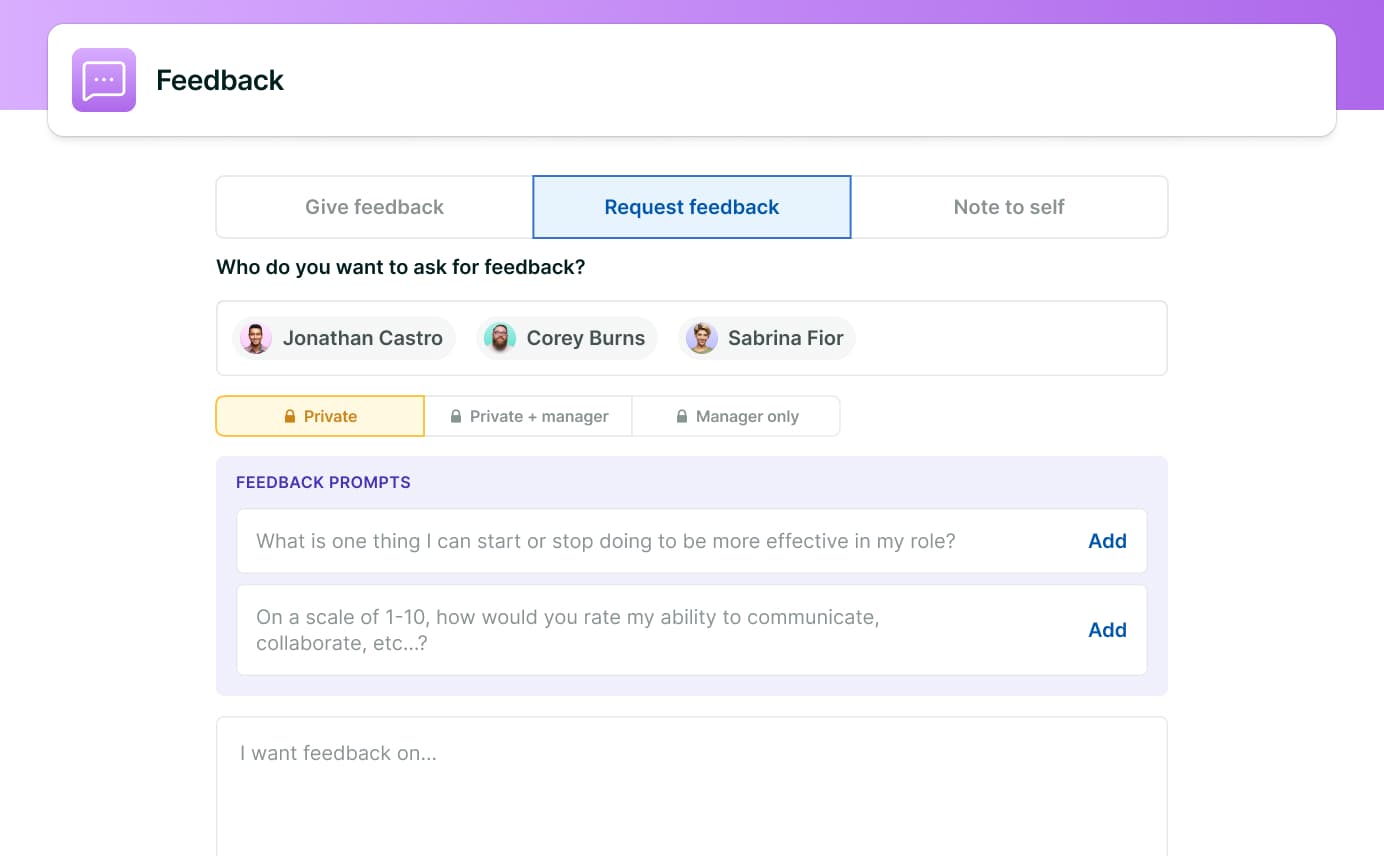
What makes a good 360 feedback question?
Good 360 questions share a few key traits. They balance open- and closed-ended formats, use neutral phrasing, drive toward action, and explore competencies that are relevant to specific roles.
Open- vs. closed-ended: A mix is best. Open-ended questions let respondents answer in their own words, surfacing qualitative feedback that’s useful for evaluating soft skills such as adaptability, critical thinking, and communication. Closed-ended questions — best structured with a Likert rating scale, which rates agreement from “strongly disagree” to “strongly agree” — provide quantitative data that’s easier to track over time and better suited to measuring hard skills like coding or copywriting.
Neutral phrasing: Avoid leading questions that direct respondents toward a specific answer. Rather, phrase queries so a reviewer’s true perceptions can surface. Keep language simple and jargon-free, so all 360 feedback participants clearly understand the questions, regardless of their role or background.
Actionable framing: Questions should elicit constructive, actionable insights, not vague or all-positive feedback that leaves employees nothing to work with. Each answer should tell the employee whether to stop, start, continue, or replace a specific behavior, explained Megan Leasher, PhD, director and strategic talent leader at Cincinnati Children’s. “A good 360-degree review question helps the person receiving feedback know what action to take.”
Role-relevant competencies: It’s not just hitting performance metrics like KPIs or OKRs that make an employee successful. Depending on the role, competencies like conflict resolution, teamwork, and adaptability can be just as critical, so evaluate those as well. Responses to these questions help HR gauge the strength of an employee’s role-relevant competencies while surfacing key areas for growth.
How to Organize 360 Questions by Reviewer Relationship
The strength of 360 feedback lies in drawing insights from people in different roles, who each have their own unique experience with the individual being reviewed and are therefore suited to evaluate different capacities.
The following four question banks are built on this framework, designed to ask reviewers the questions that they are most qualified to answer.
Questions for Peers
Because they work side by side daily, peers are uniquely positioned to evaluate how well someone collaborates and communicates. Questions for peers should focus on communication, teamwork, reliability, and interpersonal skills.
Closed-ended:
- This person communicates clearly and effectively with other colleagues and me.
- This person has strong interpersonal skills and helps everyone feel welcome on the team.
- This person works effectively as part of a team.
- This person values diverse perspectives, even if they are different from their own.
- I can rely on this person to follow through on commitments to the team.
Open-ended:
- What would you say are this person’s strengths?
- What are three or four words you would use to describe this employee?
- Share an example of a company value this person has brought to life.
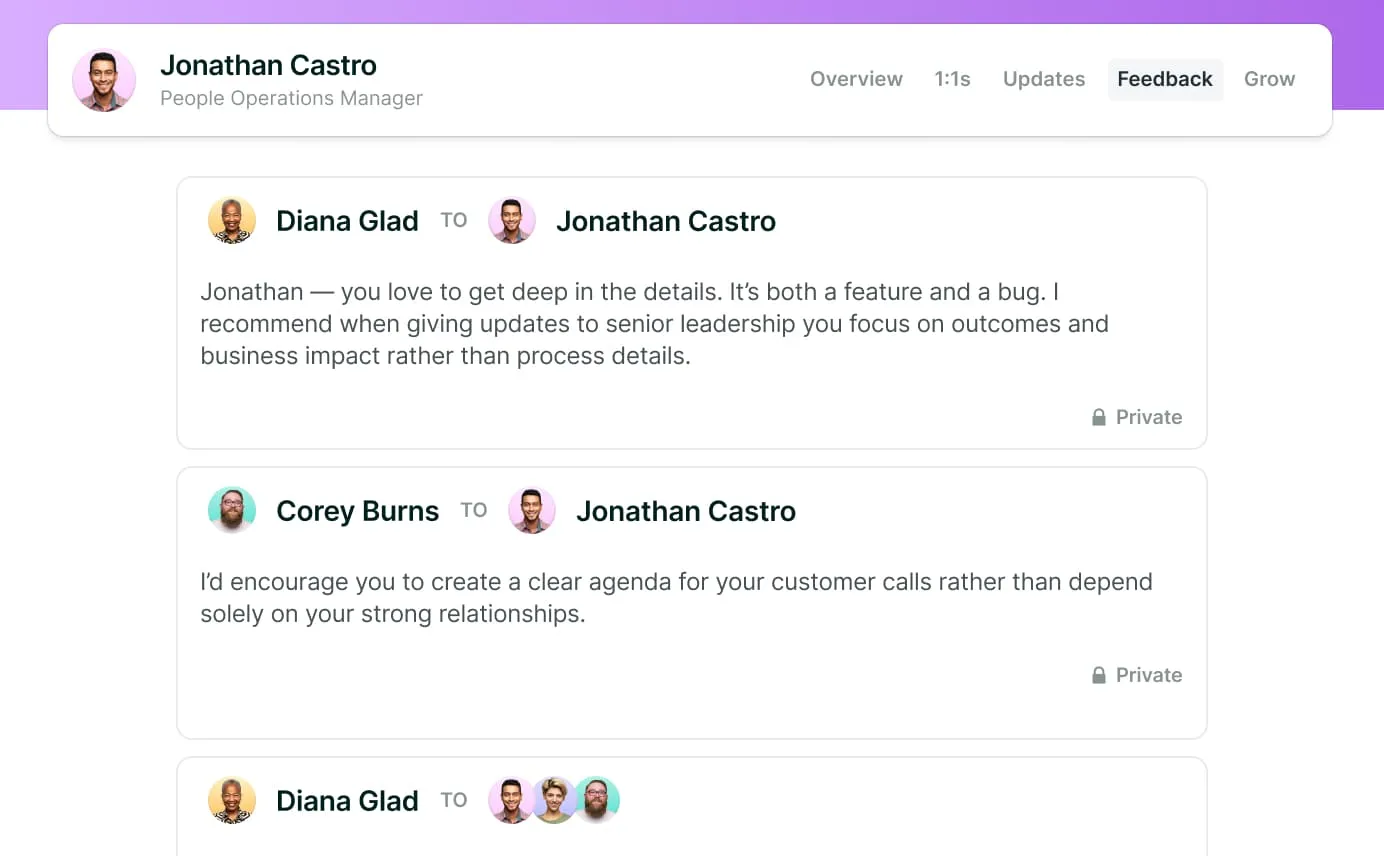
Questions for Managers
Managers track their direct reports’ progress on goals, so they’re best suited to judge performance and role proficiency. Questions for managers evaluating direct reports should focus on their performance outcomes, goal progress, demonstration of core competencies, and areas for growth.
Closed-ended:
- This person prioritizes their workload effectively and meets deadlines.
- This person finds creative solutions and takes initiative when problem-solving.
- This person responds constructively to feedback.
- This person demonstrates the competencies required for their role.
- This person effectively manages multiple projects at once.
Open-ended:
- What are three soft skills this person excels at?
- What skills could help this person become better at decision-making?
- What’s an area you’d like to see this person improve?
Questions for Direct Reports
Direct reports experience their managers’ leadership skills firsthand. For that reason, questions for direct reports evaluating their manager should focus on coaching, decision-making, psychological safety, and communication skills.
Closed-ended:
- This person is a good leader who sets a clear direction for the team.
- This person provides feedback promptly so we can meet deadlines.
- This person makes me feel safe when I raise concerns or disagree with them.
- This person nurtures strong working relationships.
- This person supports my growth and development.
Open-ended:
- What is one thing this manager should start doing?
- What is one thing this manager should stop doing?
- If you were this leader, what would be the first action you would take?
- Describe a time when this manager helped you navigate a difficult situation or decision.
Self-Assessment Questions
Self-awareness is a core input to the 360 review process. Regular self-evaluation fosters that awareness by prompting employees to think deeply about what they’re doing well and where they can improve. Self-assessment questions should help employees consider their own performance, strengths, and opportunities for growth.
Closed-ended:
- I manage my time and workload effectively.
- I adapt well to changing priorities.
- I work effectively with my team members.
- I seek out feedback and actively use it to improve my performance.
Open-ended:
- What is one thing you’d like to start doing?
- What is one thing you’d like to stop doing?
- What’s a skill you’d like to build or strengthen?
Sample Questions by Core Competency
Most 360-degree performance appraisals should also include questions that evaluate how well employees are delivering on core competencies, which are the skills and qualities that all employees need to succeed in their roles. Common core competencies include communication, leadership, collaboration, adaptability, problem-solving, and time management.
Below are sample closed- and open-ended questions for each.
Communication
- This person shares information that’s easy to understand.
- This person is an active listener who considers all viewpoints before responding.
- This person is transparent about decisions that impact a team or project.
- What are three or four words you would use to describe how this person communicates?
Leadership
- This person connects team goals to the organization’s larger mission.
- This person effectively delegates tasks.
- What is one thing this person is doing that other leaders in the organization should copy?
- What is one thing this person should be doing differently as a leader?
Collaboration
- This employee works well with other departments to remove obstacles.
- This employee welcomes constructive debate and different perspectives.
- Share an example of a time this person helped resolve a disagreement within the team.
- Share an example of a company value this person has brought to life.
Adaptability
- This person adapts well to changing priorities.
- This person stays effective even when plans change unexpectedly.
- This person welcomes opportunities to develop new skills.
- Share an example of a time when this individual adjusted plans because priorities shifted.
Problem-Solving
- This person finds creative ways to solve problems.
- This employee follows through on solutions instead of just identifying challenges.
- Share an example of a time when this person effectively responded to a difficult problem.
Time Management
- This employee consistently meets deadlines.
- This employee adjusts their schedule when priorities change.
- Share an example of a time when this employee balanced a major project with day-to-day responsibilities.
{{rich-highlight-2}}
How to Write Your Own 360 Feedback Questions
Once you’ve determined the right kinds of questions to include, it’s time to craft the questions themselves. To do so, first determine your goals. Then, write specific, intentional questions aligned with those goals.
Determine your goals. If you’re using a 360-degree review to evaluate an employee’s overall performance, opt for a universal set of questions that apply to every employee at a specific job level or managerial role, so you can accurately rate employees and compare competencies. If you’re using a 360 review for employee development, tailor questions to the individual, such as leadership and strategy questions for managers and time management and technical skills for individual contributors.
Write specific, intentional questions. Tailor some questions to an employee’s well-known strengths and weaknesses, but include others so respondents can identify blind spots as well. Every question should be specific, clear, and intentional. Answers to open-ended questions can dig into how or why respondents feel a certain way to collect more effective feedback.
Best Practices for Designing a 360 Questionnaire
Create an effective survey that’s optimized for users with these best practices:
- Hit the question count sweet spot. Keep your questionnaires long enough to collect actionable feedback, but short enough that raters don’t abandon the survey before completion. Seven to 10 questions per review is a good range, said Elise Cangemi, HR professional at media-buying agency Good Apple. “Any fewer and you won’t get enough feedback on the employee, and any more you start to see the quality of responses slip.”
- Optimize for mobile devices. Ensure the survey is accessible and easy to complete on various devices, including smartphones and tablets. Mobile-friendly surveys will support participation rates and help you get responses from as many people as possible.
- Place questions strategically. Start with closed-ended questions first to warm up participants, then include open-ended questions at key moments to allow respondents to add context to their previous answers. Encourage reviewers to use the open-ended questions to clarify particularly high or low ratings.
- Give clear instructions. Be sure to define any technical terms or less familiar concepts. This helps respondents understand how to answer effectively and reduces confusion. When presenting closed-ended questions, it’s also important to explain the response options. For example, you might lead with: “Using the following options from the Likert scale — strongly disagree, disagree, neutral, agree, and strongly agree — indicate your level of agreement or disagreement with the following statements.”
How to Turn 360 Feedback Into Action
With any workplace feedback request, what happens after the survey often matters more than the survey itself. When employees see feedback being addressed and acted on, they’re more likely to participate authentically and adjust their own behavior to build a better work environment.
Here’s how to turn 360 feedback into action:
- Take a mixed-methods approach to analysis. Combine quantitative analysis of closed-ended 360 review questions with qualitative analysis of open-ended responses, capturing both trackable numerical data and detailed insights. Look for patterns across surveys to identify an individual’s strengths, weaknesses, and growth areas, and weigh input from direct reports, managers, and peers for a well-rounded view that helps combat bias.
- Set development goals. Partner with the employee to set SMART goals based on areas that need improvement. Lattice Habits can help with the follow-through, bringing together one-on-ones, weekly updates, feedback, and more, so managers and employees remain aligned and consistently make progress on their goals.
- Prioritize post-feedback conversations. Follow up with learning resources, training sessions, and mentoring to support the employee’s development plan. Establish regular check-ins to adjust goals as necessary and provide ongoing support and motivation. Train managers to check in on employee progress at informal touch points throughout the year, helping them to stay on track.
Technology and 360 Feedback
If you’re gathering 360-degree feedback, you should be leveraging technology. The right tech streamlines the process, making it easier to collect, store, and analyze feedback. It also helps protect employee anonymity and confidentiality, which are essential for obtaining honest, useful insights. But what does the “right” technology actually look like?
For 360-degree reviews, it’s a connected talent suite where feedback flows into the places managers and employees already work, rather than sitting inside a standalone survey tool that’s disconnected from day-to-day workflows.
Lattice provides that level of support. Lattice Performance automates the entire feedback process — from requesting feedback to aggregating results — reducing manual data entry, minimizing human error, and keeping the process timely and organized. Its mobile-friendly interface lets employees share their feedback when and where they like, and extensive customization lets organizations tailor questionnaires to different roles, competencies, and feedback goals.
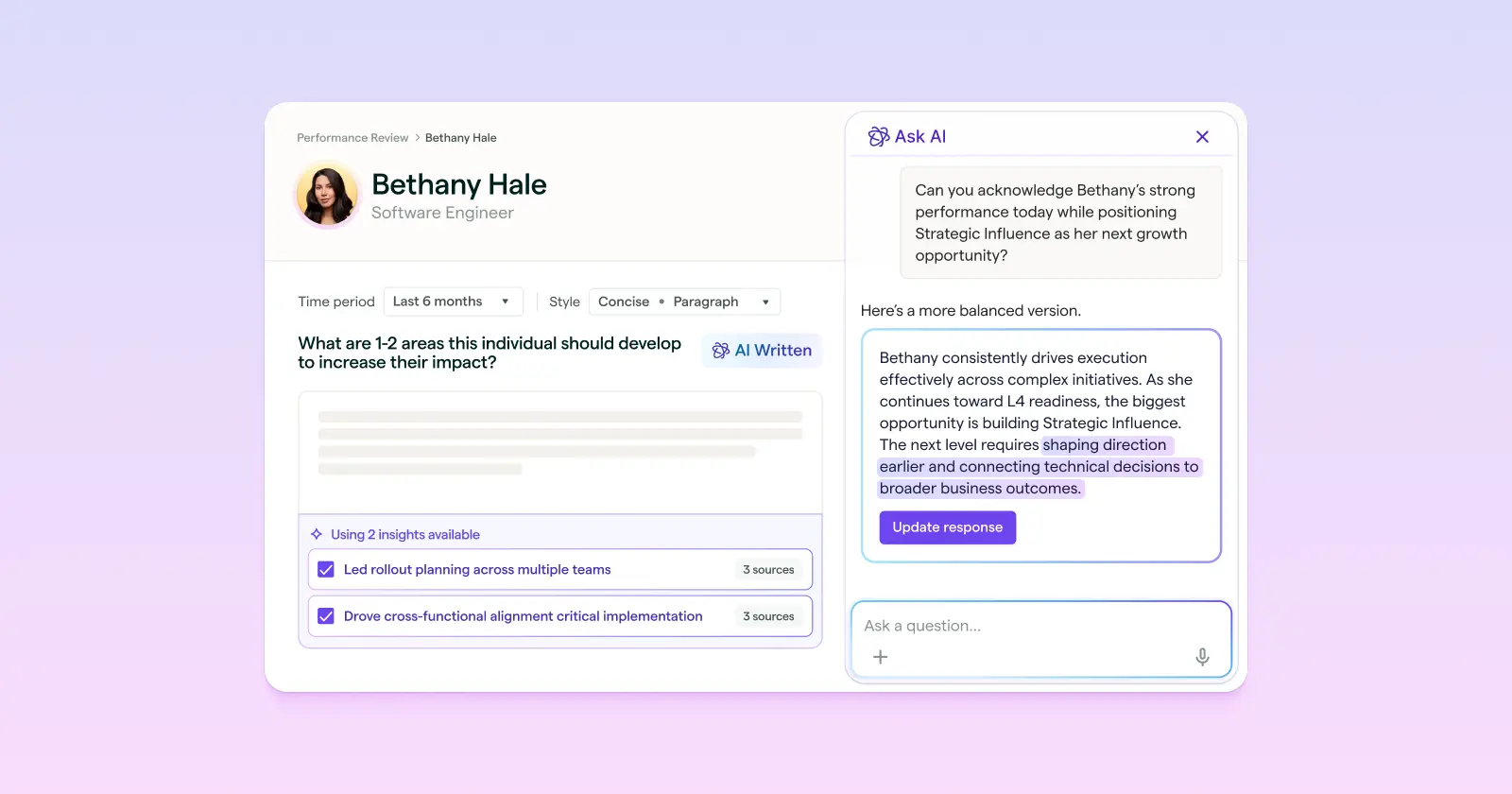
The Lattice AI Agent adds a supportive layer, helping summarize and organize feedback for manager review. At a manager’s request, the Agent will pull together signals from reviews, feedback, goals, growth, employee engagement, and one-on-ones — helping managers see the full picture, walk into conversations better prepared, and identify next steps.
{{rich-highlight-1}}
FAQs:
How many questions should a 360 feedback survey include?
360-degree feedback surveys should be relatively short and sweet, experts say, ideally no more than 10 questions per survey. “If you go any higher than that, you’ll lose them,” said Lori Golden, an HR and talent leader and founder of The Rebel HR community. Keeping the question count low also leaves room for a few open-ended questions, which take longer to answer. Golden said she’d rather have fewer questions answered more thoroughly with concrete examples and explanations.
Should 360 feedback questions be anonymous?
360 feedback is typically anonymous. A 2025 survey of 1,000 US workers by LiveCareer found that 62% of respondents believe anonymous feedback in 360 surveys encourages honesty, though 28% argued that it can promote vague or unhelpful comments. Anonymous feedback can also be less effective if teams are too small to truly conceal who said what.
Some teams prefer identifiable feedback. When feedback is attributed and includes qualitative comments, people can make better sense of it because they know who’s speaking and what that person values, said Lisa Sansom, a leadership and executive coach and founder of LVS Consulting.
How often should you run 360 feedback reviews?
Experts generally recommend that 360 feedback reviews occur annually or every other year. Sansom cautioned against running full-scale 360 reviews too frequently. “It’s going to take six to 12 months for anybody to see any sort of changes that would get reflected in a 360,” she noted. But, Sansom added, pulse surveys that home in on a couple of competencies each quarter or every six months allow organizations to track how the individual is progressing while reducing survey fatigue.
Can you use the same 360 questions for every employee?
You can use the same 360 questions across employees, as long as they’re written broadly enough to apply to any role or function, Golden said. The real variation should come with the direction of the feedback — upward, downward, or peer — not the person’s job.
Questions for a direct report about a manager might focus on leadership, support, and clarity. Questions asking a manager about a direct report could focus on performance, delivery, and growth. And peer-to-peer questions might emphasize collaboration and teamwork. Standardizing questions is critical, Golden noted, because once every review is customized, it’s nearly impossible to aggregate results and uncover organization-wide patterns.
How do you get honest answers in a 360 review?
Getting honest answers requires a multi-pronged approach.
Don’t tie 360 review outcomes directly to pay or promotions, Bilderback advised. Make it clear that these reviews are for growth and improving the work environment. Explain upfront why you’re doing them, how often they’ll happen, and who will see the results. Emphasize that feedback will be used to shape concrete actions such as targeted training, and be sure to follow through. If employees don’t see visible changes based on what they’ve shared, they’ll quickly lose trust in the process and be less candid next time.
And, while online surveys are useful, Bilderback noted face-to-face conversations remain critical for encouraging honest answers and thoughtfulness around growth and career development. “You’re able to see the facial expressions and the body language of the individual that you’re having a conversation with, and you can know whether or not they’re actually engaged,” she added.
What’s the difference between a 360 review and a traditional performance review?
A 360 review gathers employee feedback from multiple perspectives — managers, peers, and direct reports — to understand how someone leads and collaborates. It’s meant primarily as a developmental tool, not a compensation lever. Traditional performance reviews are usually top-down, conducted by a single manager, and focus on business outcomes, goals, and job-specific metrics that are tied directly to pay, bonuses, and promotions.
Build stronger review cycles with Lattice.
Great 360-degree feedback questions are only the starting point. The real impact comes when that feedback drives ongoing coaching, not just a one-time review.
With Lattice Performance and Lattice Habits working together, 360 feedback flows straight into one-on-ones, goals, and manager follow-through, turning good questions into great conversations and lasting performance gains.
Check out our 360 performance review template for more sample questions you can use for peer, direct report, and manager reviews, as well as self-evaluations. For even more support with your performance management processes, book a Lattice product demo today.

Ready to implement your own 360 review cycle?
360 reviews are crucial for providing employees with insight into how their work is valued by the company as a whole. Our free template has all the right questions you need for your next review cycle.