


Performance has taken the crown as HR’s top priority for 2026: Lattice’s 2026 State of People Strategy Report found that 40% of HR professionals are doubling down on performance management. That’s because performance management is a key driver of engagement and productivity — but only when it’s done right.
For many organisations, performance appraisals and one-to-ones live in separate places. So feedback gets scattered, context gets lost, and reviews end up feeling like a confusing surprise. A better way is to lean into the “no surprises” principle, which uses reviews to synthesise feedback employees have already heard.
By connecting one-to-ones with performance appraisals, managers can provide ongoing feedback, track progress in real time, and make sure that appraisals reinforce growth. In this article, we’ll explore how that connection can also reduce prep time, eliminate surprise feedback, and improve employee performance.
How Performance Appraisals Support Employee Engagement
Gallup’s State of the Global Workplace: 2026 Report found that only 22% of managers felt engaged at work in 2025, compared to 27% the year before. That decline matters because 70% of the variance in team engagement can be attributed to the manager.
When managers mentally clock out, their teams often follow. In fact, the same report found that global employee engagement is at its lowest since 2020, which Gallup estimated cost businesses about $10 trillion in lost productivity in 2025.
Halting this trend starts with effective support. Gallup research published in 2025 found that strong manager development, particularly ongoing training and coaching, boosts manager performance. And managers who receive best-practice training see a substantial rise in their own engagement, and that of their teams.
One area that can make a real difference is creating constructive feedback systems that enable managers to connect with their direct reports and shape their growth. High-performing organisations often rely on:
- Regular one-to-ones that act as real-time coaching moments, remove roadblocks, and clarify priorities.
- Performance appraisals that act as structured reflection points, reinforcing purpose and growth.
Both conversations are essential, but they’re not interchangeable.
{{rich-highlight-4}}
One-to-ones and performance appraisals: What’s the difference?
One-to-ones and performance appraisals are both feedback-driven processes with similar overall goals. They both aim to support employee career development, foster connection and alignment between managers and employees, and provide an opportunity for feedback and praise. Both should rely on two-way feedback to build trust and psychological safety, so while employees share context, managers can remove roadblocks, coach, and align expectations.
Both should also aim to boost employee retention by identifying and addressing issues, discussing optimal performance, and providing employees with opportunities for professional development and career growth.
Despite these similarities, they also have notable differences in tone and focus.
Tim Reitsma, head of HR at Linus Media Group, explained: “One-to-ones are less about getting tasks checked off, and more about ‘How are things going?’ and ‘How can I support you to do your best work?’ These meetings serve as a gateway to connect, learn about each other, clarify responsibilities and accountabilities, and provide feedback.”
He added that great performance appraisals “include a mechanism on how well someone is doing, what might need to improve, and a conversation about the future. Using this time as a way to give and receive feedback is key.”
Here are the main ways one-to-ones and performance appraisals differ across frequency, tone, scope, and more.
When these processes don’t work together, gaps start to appear. Without regular one-to-ones, performance appraisals can feel like a surprise. And without regular performance appraisals, employees can lack long-term direction and accountability.
But maintaining both can be a lot. One solution is for managers to use structured agendas and templates as a way to maintain consistency across both conversations and build a continuous feedback loop that supports trust, engagement, and performance.
How One-to-Ones and Performance Appraisals Fit Together
One-to-ones and appraisals shouldn’t exist in isolation. “The value of one-to-ones is in their frequency and recurrence,” explained Michelle Rakshys, vice president of learning and development at Cadence Leadership + Communication.
“Where annual performance appraisals give overarching performance feedback, one-to-ones give space for feedback using recent examples. This gives an employee something tangible to anchor against and alter behaviours in the moment,” added Rakshys.

This kind of approach means that over time, one-to-ones create a running record of employee progress, challenges, and growth, including:
- Career goals and growth direction
- Roadblocks, risks, and resourcing needs
- Key outcomes and impact (not just activities)
- Goal progress, changes in priority, and tradeoffs
- Commitments and follow-ups (who owns what by when)
- Feedback patterns, including strengths to amplify and gaps to close
- Skills employees are building, and the opportunities to develop them
This record becomes the foundation for well-informed performance evaluations. Instead of discussing past performance from memory, managers have a complete overview of how team members have evolved over the review period.
When one-to-one notes, updates, goals, and feedback are connected through a platform like Lattice, managers can run performance appraisals more accurately and efficiently. But that’s not the only advantage of linking one-to-ones and appraisals.
Benefits of Linking One-to-Ones With Appraisals
When one-to-ones and appraisals are part of the same, connected system, performance management becomes more than an occasional conversation. It becomes part of how work happens every day.
Lattice Habits brings together all the necessary manager tools — including 1:1s, Updates, Feedback, and Q&A boards — in one place. The result is a workplace culture where feedback, alignment, and development happen continuously, helping make high performance a habit.
The right tools also make it easy for managers to translate one-to-one insights into meaningful long-term plans when performance appraisal season rolls around. And this can produce some significant benefits.
1. Reduce rater bias.
Performance appraisals are vulnerable to bias, especially recency bias. If documentation is inconsistent, managers can rely on the most recent win or misstep, because earlier context is harder to remember.
“Recency bias is something to always beware of when writing a performance review,” said Rakshys. “Using documented notes from regular one-to-ones allows managers to remember specific examples throughout the year and see the big picture. Keeping organised notes about what you discuss in your one-to-ones means you can reflect on their work, track trends, and give more accurate feedback,” she added.
To help, Lattice AI quickly synthesises records and feedback across the entire performance cycle. AI-assisted theme detection uncovers meaningful patterns, while summarisation tools and performance insights help managers create better appraisals in less time.
{{rich-highlight-1}}
2. Give employees an overview of their progress.
When one-to-one conversations feed directly into performance appraisals, employees gain a visible, documented history of their progress. Instead of approaching appraisal season with uncertainty, they can clearly see how their work, skills, and impact have evolved over time.
This kind of transparency helps turn appraisals into motivating progress checkpoints rather than anxiety-inducing evaluations.
3. Stay focused on employee development.
Employees don’t just want to talk about what they’ve done; they also want to discuss where their career will go next. Linking one-to-ones with appraisals shifts performance conversations from backward-looking recaps to forward-looking growth planning. Managers can reinforce strengths, address gaps early, and adjust development plans in real time. The result is a performance culture centred on momentum and growth, not just evaluation.
4. Connect short-term individual goals to long-term company objectives.
Cascading goals play a crucial role in connecting day-to-day work to a company’s long-term priorities. When quarterly and individual goals are clearly connected to broader business objectives, it’s easier to ground one-to-one conversations in what “good” performance actually looks like. This alignment also helps employees see how their short-term efforts contribute to long-term impact.
Progress captured during regular one-to-ones can then also automatically inform goal status updates, giving managers and employees shared visibility without creating additional admin work.
5. Reduce appraisal stress.
Performance appraisals are most emotionally charged when feedback comes as a surprise. But regular one-to-ones change that dynamic. “Consistent and effective one-to-one feedback helps reduce stress and anxiety around appraisals because it removes the mystery,” explained Rakshys.
She added that one-to-ones help employees know where they stand and help keep them from feeling blindsided by new information in an appraisal. “Also, when one-to-ones are done properly, they build trust between the leader and report, and a culture of feedback, spurring increased sharing of feedback both ways.”
With this approach, appraisals don’t introduce new information. Rather, they become confirmation conversations that summarise themes employees have already discussed with their managers. When there are no surprises, trust increases, anxiety drops, and performance conversations can be more productive.
What Managers Need From HR to Improve One-to-Ones and Appraisals
Human resources teams play a critical role in ensuring managers have the structure, tools, and confidence to run effective, connected one-to-ones and appraisals. Without clear enablement, even the most well-intentioned managers can fall into inconsistent feedback habits.
Here’s how HR can make the biggest impact.
1. Provide the questions to ask.
As the focus of one-to-ones and performance appraisals differs, managers need intentional prompts for each conversation. Grouping questions by outcome helps managers steer discussions purposefully rather than relying on ad-hoc check-ins.
For effective one-to-ones, share these questions with managers.
For Alignment
- Are any priorities shifting this week?
- What are your top priorities right now?
- How have you been progressing on the actions we discussed last time?
For Development
- What skills are you currently working to build?
- Where would more support or stretch opportunities help?
- What are you most proud of since our last review period?
For Delivery
- What risks should we be aware of?
- Where are you with the X project / Y goal?
- Are you on track to meet upcoming deadlines?
For Wellbeing
- How is your current workload feeling?
- How can I better support you right now?
- What obstacles or barriers are getting in your way?
💡For more: 80 One-on-One Meeting Questions for Managers and Employees
{{rich-highlight-2}}
Performance appraisals may tread similar ground, but their focus is more strategic and less tactical. During these conversations, questions should invite employees to consider their own performance within the big-picture context, make a note of their progress, share overall career ambitions, and highlight what they would find motivating and engaging in the future.
It’s also important that employees feel they can give their managers feedback, too. “The only way to make a performance appraisal insightful is to have a two-way conversation,” Reitsma said. He recommended that managers ask these kinds of questions during a performance appraisal:
- What is motivating you these days?
- What could have gone better and why?
- How am I unintentionally getting in your way?
- Where do you think I am succeeding in my role?
- What aspect(s) of my job do you think I can be better at?
- What have you been most proud of over the past [time period]?
- What did you want to get done in the past [time period] but didn’t?
In addition to asking the right kinds of questions, structured templates like Lattice’s pre-built agenda template and performance review question bank help managers run consistent, high-quality conversations without starting from scratch each time.
💡For more: Performance Review Questions for Peers, Managers, and Direct Reports
2. Enable access to one-to-one notes and performance feedback.
One of the biggest barriers to fair appraisals is fragmented information. When notes are scattered across Google Docs, Notion pages, spreadsheets, or paper notebooks, managers can waste hours wading through their notes to reconstruct a performance narrative. And with multiple direct reports, that time flipping pages and changing tabs really adds up.
Lattice provides a single place for agendas, notes, action items, updates, goals, and feedback context so managers have a complete overview of performance.
Lattice’s AI Agent supports this process even more by surfacing themes and patterns across the review period. The Lattice Meeting Agent can capture structured notes during live one-to-one conversations, reducing manual admin and improving consistency.
3. Provide training on how to give feedback.
Even experienced managers struggle with difficult conversations, and most haven’t been trained to have them. According to our 2025 State of People Strategy Report, 46% of managers were asked to give tougher, more constructive feedback in performance reviews, but only 28% of managers said HR has met all their training needs in this area.
.webp)
This is where targeted enablement matters. Managers benefit from practical coaching on how to:
- Deliver feedback clearly and empathetically
- Reinforce strengths while addressing areas of improvement
- Focus conversations on future progress
Plus, tools like Lattice Writing Assist can support managers by improving the clarity, tone, and inclusivity of feedback, helping performance appraisals land as intended.
{{rich-highlight-3}}
FAQs
What should stay private in a one-to-one and not appear in a performance appraisal?
Personal or sensitive topics like health, family, or interpersonal issues should remain confidential unless relevant to an employee’s performance. Appraisals should focus only on observable outcomes, goals, and agreed-upon expectations. The key is to maintain trust while ensuring the appraisal reflects work performance, not private context.
What should managers do when an employee disagrees with documented one-to-one feedback?
Managers and employees should revisit the context together and clarify exactly where they disagree. Employees should then be asked to add their perspective to the record. This ensures the appraisal remains evidence-based, fosters psychological safety, and allows for constructive dialogue.
How should remote or hybrid teams adapt their 1:1-to-appraisal workflow?
Regular, structured one-to-ones are essential for maintaining visibility in distributed teams. Digital tools like Lattice ensure that everyone can access synced action items from their location, and shared goal tracking helps record accomplishments between appraisal meetings. Asynchronous updates, paired with live check-ins, also help keep feedback consistent and comprehensive, preventing important work from being overlooked.
How far in advance should employees receive their performance appraisal before the meeting?
Employees should receive written feedback at least 24 to 48 hours in advance. This gives them time to process the information, gather examples, and prepare questions. Advance notice supports productive conversations and reduces surprises for employees, reinforcing a fair and transparent review process.
How do you train new managers to connect one-to-ones to performance appraisals effectively?
Provide structured agendas, documentation standards, and examples of strong reviews. Shadowing experienced managers and using tools that highlight patterns in performance data helps new managers see the connection between ongoing one-to-ones and formal evaluations. The goal is to make one-to-ones a central input for evidence-based, fair, and developmental performance appraisals.
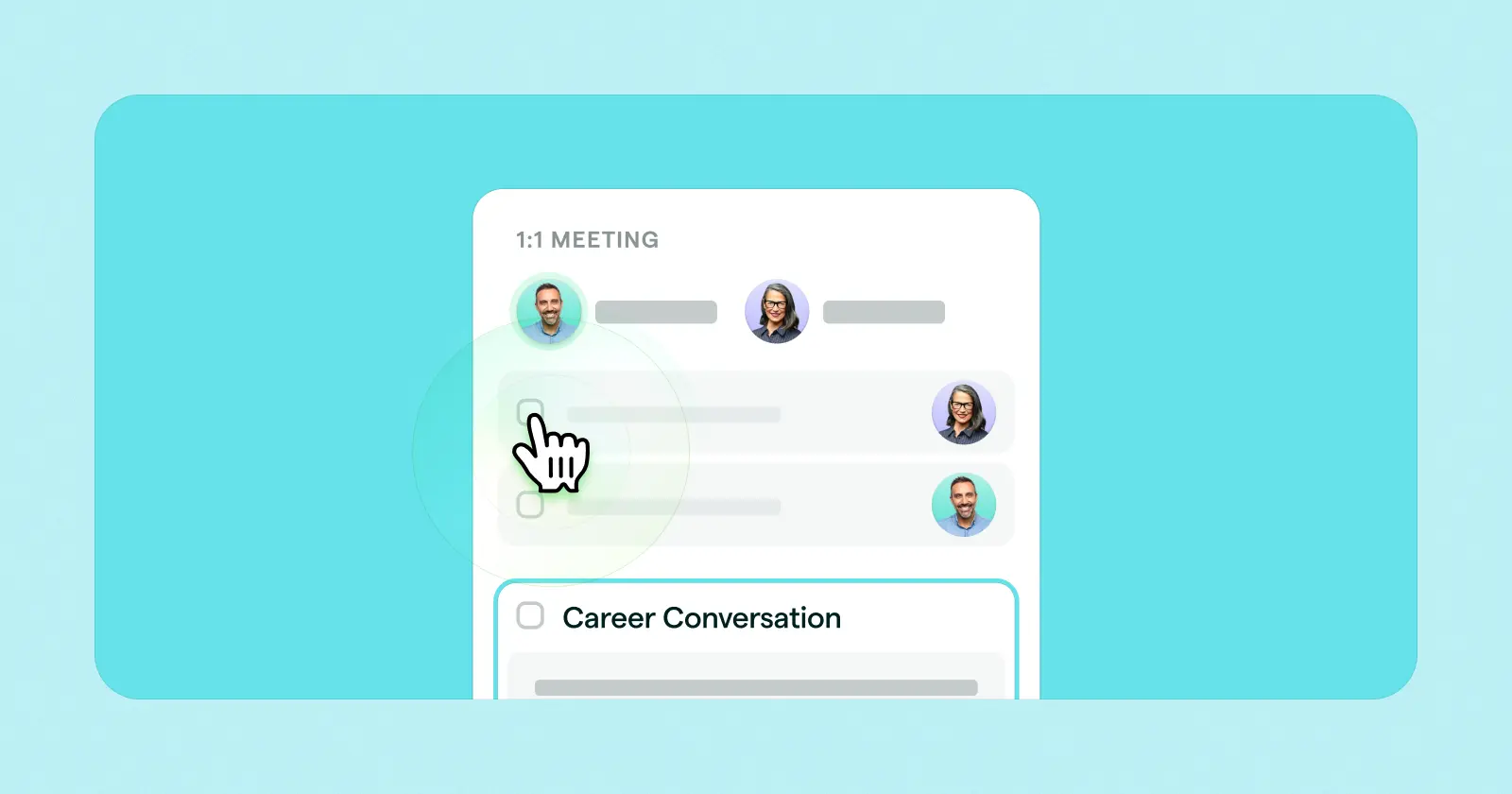
See how Lattice AI can transform your next one-to-one.
Save time, drive employee performance, and unlock manager insights with Lattice AI
Start running one-on-ones that actually drive performance.
One-to-ones should be more than a recurring event on your calendar — they should be your most powerful management tool. In this free guide, we break down how to lead conversations that strengthen relationships, unlock employee potential, and drive results.
Great one-to-ones lead to valuable performance appraisals.
At the heart of an effective performance management process is a simple principle: There should be no surprises in a performance appraisal.
Using a connected platform like Lattice means that one-to-one notes flow directly into the review process, goals provide measurable evidence of progress, and continuous feedback adds the context needed for fair evaluation and calibration. This keeps employees in the loop and lets managers move from preparation to insight in minutes.
The result is a holistic performance experience that feels transparent, developmental, and aligned with how work actually happens.
Ready to learn how it works? Request your free demo today.
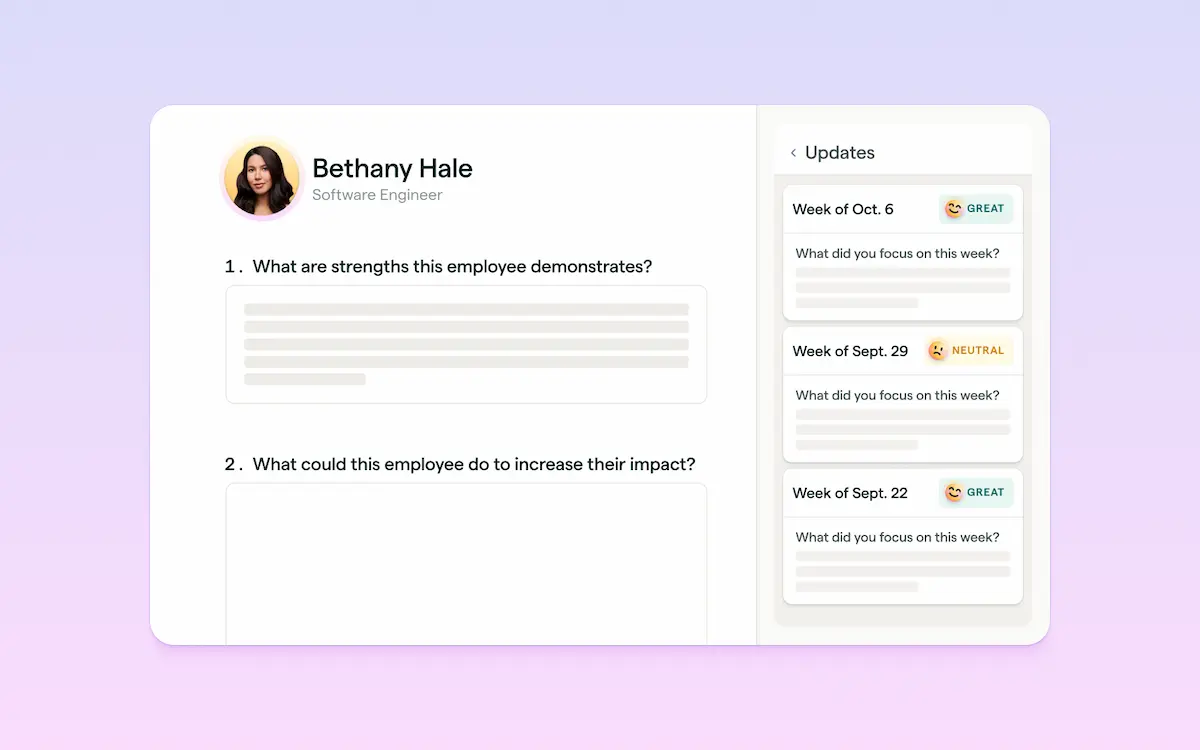
Drive performance when you need it most
Take a tour of Lattice's AI-powered talent tools that drive results and long-term growth.