Performance improvement plans get a bad rap. It’s easy to see why: For managers, scheduling a performance improvement plan (PIP) meeting feels like delivering a verdict rather than opening a conversation. For leaders, PIP symptoms include sweaty palms, indigestion, and second thoughts about the whole “people management” thing.
Direct reports have it even worse. On the receiving end, it can feel like the beginning of the end — like being asked to rearrange deck chairs on the Titanic.
But good PIP meetings offer structured, transparent coaching conversations that give everyone involved a clear path forward. This guide covers everything managers need to run an effective PIP meeting, whether it’s preparing for that first difficult conversation, structuring recurring check-ins, or tracking progress and documenting outcomes along the way.
{{rich-highlight-1}}
What Is a PIP Meeting?
A PIP meeting is a formal, time-bound coaching conversation between a manager and an employee who has been placed on a performance improvement plan. Unlike a regular one-on-one or informal feedback check-in, a PIP meeting has a defined structure: documented expectations, measurable goals, and a clear timeline for evaluating progress.
The point isn’t to build a paper trail before termination. The goal is to create shared clarity and offer the support the employee needs to improve.
No one wants to attend a PIP meeting, but the list of those expected in the room varies by organization. Most PIP meetings include only the manager and employee, though some companies involve an HR business partner (HRBP) as a neutral facilitator or documentation support. Your HR team can tell you what the standard playbook looks like at your company.
Types of PIP Meetings
A performance improvement plan isn't a one-time event (sorry). It's a process. Managers will typically run several different types of meetings across the PIP period.
The Initial PIP Meeting
This is the first conversation where the PIP is introduced. Its purpose is to establish shared understanding: what performance gaps exist, what success looks like, and what the support structure will be throughout the process. Getting this one right sets the tone for everything that follows. Don’t even think about winging it.
Weekly or Bi-Weekly Check-Ins
Regular touchpoints keep the process moving and give the employee consistent feedback on their progress. These meetings aren't just status updates. They're opportunities to remove blockers, reinforce momentum, and recalibrate support when something isn't clicking.
The Final Review Meeting
At the end of the PIP period, a closing conversation brings the process to a formal close. This meeting documents the outcome: whether the employee has met the goals, needs additional time, or hasn't made sufficient progress. It also outlines clear next steps for each scenario.
How To Run Your First PIP Meeting
The first PIP meeting is the hardest. Here's how to prepare for and navigate it effectively.
Before the Meeting
Prep separates a productive PIP conversation from a reactive one. Before meeting with the employee, gather examples of the performance gaps you'll be discussing. Vague concerns are harder to act on and easier to dispute. Concrete examples ("In Q3, three deliverables were submitted late without notice") are both fairer and more actionable. "Your work has been off" isn't going to cut it.
Write the PIP. It should include the employee’s goals, timeline (typically 30, 60, or 90 days), and check-in cadence. Share it with HR so there's alignment once the conversation happens.
Set up the meeting in a private space and block enough time to have the conversation without rushing. Ninety minutes is reasonable. This is not a meeting you want to squeeze between lunch and a product sync.
Starting the Conversation
State the meeting's purpose early. Employees who don't know why they've been called in will spend the first few minutes bracing for impact. Clarity upfront is a form of respect.
A straightforward opener might sound like: "I asked for this meeting because I want to talk with you about some patterns I've observed in your work, share what I'm concerned about, and agree on a path forward together." That framing, collaborative rather than accusatory, sets a more productive tone than leading with consequences.
Acknowledge that this is a difficult conversation. Naming the discomfort can actually reduce defensiveness and build trust. You don't have to pretend this is fun for anyone.
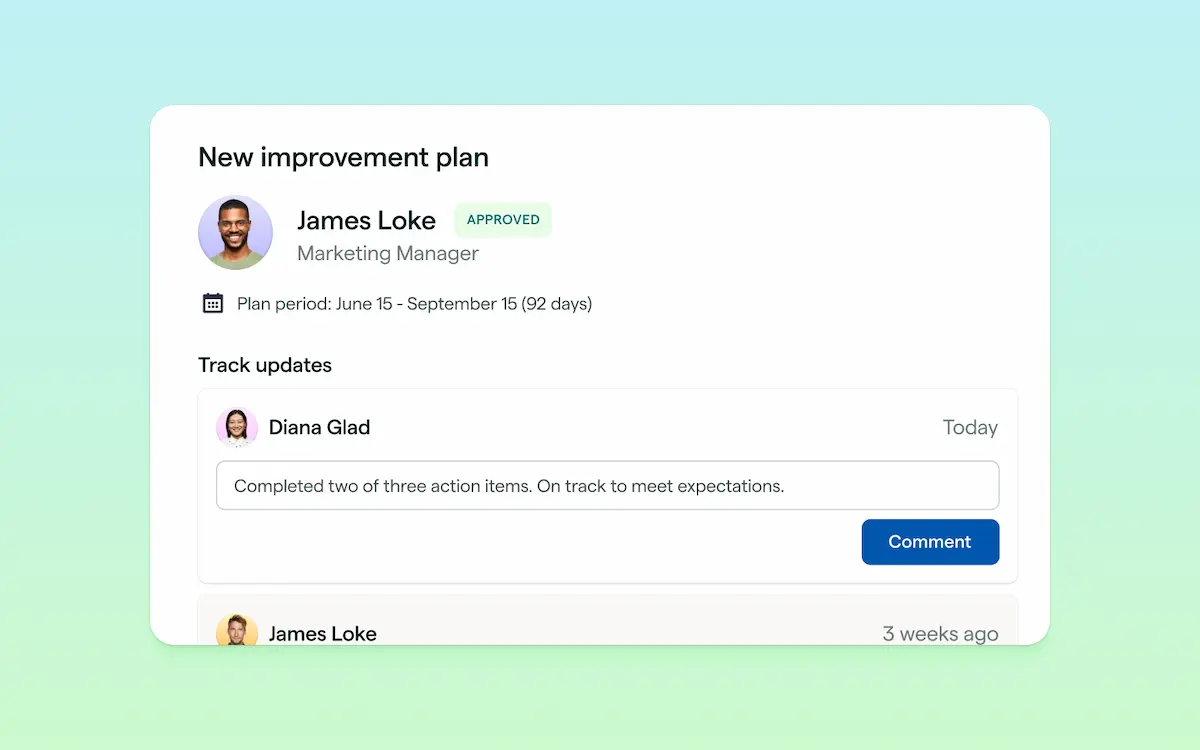
See Lattice's Performance Improvement Plans
Presenting the Performance Issues
Use specific, observable examples rather than character assessments. "The last three monthly reports contained data errors that required rework" is more useful than "your work has been sloppy." Stick to behaviors and outcomes, not personality or attitude.
Explain the business impact of the gaps you're describing. Employees are more likely to engage with feedback when they understand why it matters: not just that expectations weren't met, but how those gaps affect the team, the client, or the organization.
Lastly, give the employee space to respond. This isn't a monologue. Their perspective may reveal contributing factors (unclear expectations, resource constraints, a personal challenge) that change how you structure the support plan.
Reviewing Expectations and Goals
Define what success looks like with specificity. Vague goals like "improve communication" are hard to measure and hard to celebrate. Well-defined goals use the SMART framework (they’re specific, measurable, achievable, relevant, and time-bound).
Walk through the PIP timeline together: the duration (again, 30, 60, or 90 days), what will be assessed at each check-in, and what the final review will evaluate. Both of you should leave the meeting with the same understanding of what "done" looks like.
Discussing Support and Resources
A PIP without support isn't a fair process. Be explicit about what you'll provide: more frequent feedback, access to training, additional check-ins, or adjustments to workload that might remove obstacles.
Then ask what the employee needs. They may have context you don't (about skill gaps, tools, or team dynamics) that could shape a more effective plan. Inviting their input also signals that this is a genuine improvement effort, not a formality.
Addressing Consequences
Be honest about what happens if goals aren't met by the end of the PIP period. This isn't a threat. Employees deserve to know the stakes so they can make informed decisions about how to engage.
Frame it plainly: "If we're not seeing the progress we've outlined by [date], we'll need to discuss next steps, which could include a change in role or separation." Say it once, clearly, and move on. The majority of the conversation should be focused on the path forward, not the consequences of not taking it.
Closing and Next Steps
Before wrapping up, summarize the key points: what was discussed, what the goals are, what the support structure looks like, and when the first check-in will be. Invite the employee to ask any clarifying questions.
Send written documentation of the PIP (including goals, timeline, and signatures or acknowledgment) within 24 hours of the meeting. Set the next meeting date before you leave the room or call.
PIP Meeting Agenda Template
Use this agenda for your initial PIP meeting. Adjust timing to fit the complexity of the situation. The content below is editable.
Before the meeting:
- Draft the PIP document and have HR review it.
- Gather specific performance examples.
- Reserve a private space for a 90-minute block.
After the meeting:
- Send the documented PIP for acknowledgment within 24 hours
- Log notes in your one-on-one record
Weekly Check-In Agenda Template
Use this recurring structure for your ongoing PIP check-ins. Keep these meetings consistent, as the predictability is part of what makes them effective.
After each check-in:
- Document the meeting notes and any action items.
- Note any notable progress or setbacks for the final review record.
How To Track PIP Progress
Consistent documentation is what makes a PIP legally defensible and managerially useful. Without it, you're relying on memory, which is unreliable when a decision at the end of the PIP period is questioned. When in doubt, write it down.
What to track depends on the performance issue. For a salesperson, you might track pipeline activity, call volume, or closed revenue against quota. For a project manager, it might be on-time delivery rates and stakeholder feedback. Whatever the goals are, the tracking approach should map directly to them. Here's a simple check-in update format you can adapt:
Keep a running record of these updates. At the final review, you'll have a documented timeline of the employee's progress (or lack thereof) that's grounded in specifics rather than impressions or vibes.
PIP Meeting Best Practices
This isn’t the first time we’ve covered PIPs at Lattice, but a few basic principles are worth repeating. When conducting a PIP meeting, remember to:
- Document everything, right after it happens. Notes taken immediately after a meeting are more accurate and more credible than notes reconstructed later. Make it a habit.
- Keep the focus on outcomes, not character. "You missed three deadlines in October" is a documented fact. "You don't care about your work" is an interpretation, and one that's more likely to generate defensiveness or legal risk.
- Be consistent across check-ins. If you're rigorous in the first two weeks and then let things slide, you've undermined the process. The cadence and documentation standard you set in the first meeting should hold through the final review.
- Watch for signs of disengagement or distress. A PIP is stressful. Managers who ignore the human dimension, who focus only on metrics without acknowledging the emotional weight of the situation, will see performance worsen. Regular check-ins are a chance to notice if someone is struggling and connect them with employee assistance resources if needed.
What Happens After the PIP Period Ends?
The final review meeting brings the PIP to a formal close. Three outcomes are possible:
- Successful completion. The employee met the goals outlined in the PIP. Acknowledge the effort and improvement clearly and specifically. Transition back to regular one-on-ones, and document the outcome. Some managers find it useful to establish a brief "post-PIP" check-in cadence (perhaps monthly) to ensure sustained progress before fully returning to a standard rhythm.
- Extension. In some cases, progress is real but incomplete, and an extension of the PIP period is the appropriate next step. Be specific about what additional improvement is needed and in what timeframe. An extension shouldn't feel like a reprieve. It should come with updated goals and a clear understanding of what the final evaluation will look like.
- Unsuccessful completion. If goals weren't met, communicate the decision clearly, respectfully, and with full documentation. Work with your HR team on next steps, which may include a role change, a transition plan, or separation. The employee should hear the outcome from you, not through rumors or inference.
In all three scenarios, communication and documentation matter. The final review meeting is often the most referenced point in any future HR or legal conversation about the employee's tenure.
Streamline PIP Meetings with Lattice
The hardest part of running a PIP is keeping everything connected: the goals, the conversation notes, the action items, and the timeline. When those things live in different places, continuity suffers.
Lattice 1:1s and Performance Improvement Plans give managers a dedicated space to run PIP meetings and check-ins with shared agendas, private notes, and built-in follow-up tracking. Goals integration connects PIP objectives to trackable outcomes, so progress is visible and documented in the same place you're having the conversations. Weekly Updates automatically bring recent work into the meeting record, reducing the manual burden of pulling together context before each check-in.
The result is a cleaner, more consistent process that's better for managers, better for employees, and easier to defend if documentation ever matters. Request a Lattice demo to see how it works.
FAQs
How long should a PIP meeting last?
The initial PIP meeting typically runs 75-90 minutes. There's a lot of ground to cover, and rushing it undermines the seriousness of the conversation. Ongoing check-ins can be shorter, usually 30-45 minutes, since the structure is established and the focus is on progress updates and blockers.
Who should attend a PIP meeting?
In most cases, just the manager and employee. Some organizations include an HR business partner to provide support, ensure procedural consistency, or serve as a neutral documentation resource, particularly for complex situations or where there's a risk of dispute. Check your company's standard practices and involve HR early if you're unsure how to structure the plan.
How often should you meet during a PIP?
Weekly check-ins are the most common cadence, especially for 30- or 60-day plans where the window for improvement is short. Bi-weekly check-ins may be appropriate for longer plans where progress is expected to unfold more gradually. Whatever cadence you choose, stick to it. Inconsistent check-ins signal to the employee that the process wasn't being taken seriously.
What should you document after a PIP meeting?
Document every meeting: the date, who attended, what was discussed, what progress was observed, what concerns came up, and what action items were assigned to each person. Written documentation should reflect the conversation accurately (not just the positive moments). If you raise a concern verbally but don't document it, it effectively didn't happen from an HR and legal standpoint. Use a consistent format across all check-ins to make the final record coherent and easy to follow.
Can an employee refuse to sign a PIP?
Yes, and this comes up more often than managers expect. An employee's refusal to sign doesn't invalidate the PIP. Document the refusal itself and note that the PIP remains in effect. In most jurisdictions, a signature is an acknowledgment that the document was received and discussed, not an agreement with its contents. Many organizations add language to that effect directly on the PIP form. Consult your HR team or legal counsel for guidance specific to your situation and location.
⏩ Skip to the PIP Meeting Agenda Template or Weekly Check-In Agenda Template if you're looking for a ready-to-use resource.