

Performance improvement plans (PIPs) aren't exactly anyone's favorite management task. But they're also not something you can hand off and expect to magically fix performance issues. They need to be intentional, communicated clearly, and delivered with empathy to help employees get back on the right track.
Unfortunately, many PIPs are set up to fail before they even begin. Vague expectations, scattered documentation, and inconsistent processes can confuse employees, frustrate managers, and create more work for HR.
A successful performance improvement plan must do more than list a few goals. It requires a structured process that defines the employee behaviors that need to change and outlines performance targets, timelines, resources, and check-ins, so everyone understands what success looks like and how to achieve it. In this article, we'll walk through a successful PIP process step-by-step, explain what managers should document at each stage, and share tips for keeping everything organized, consistent, and easy to reference.
The Performance Improvement Plan Process: Step by Step
Performance improvement plans can be uncomfortable, but they don't have to be complicated. Follow these six workflow steps to adopt a consistent PIP process and learn what to document at each stage to keep you, your employee, and your HR team on the same page along the way.
1. Identify and document the performance gap.
A PIP should never be the first step in addressing underperformance. It should be used only after coaching conversations and other corrective actions haven't led to meaningful improvement.
During this period, document any ongoing performance issues so you're prepared if a PIP becomes necessary. Focus on objective facts: what happened (e.g., missed deadlines, attendance concerns, insubordination, or recurring quality issues), when it happened, and any feedback or support provided.
{{rich-highlight-1}}
Clear documentation ensures the PIP is based on observable behaviors and gives employees clear, specific opportunities to improve.
2. Draft the plan with measurable goals.
A PIP isn't meant to punish employees, it's an opportunity to help them get back on track. To be effective, the plan should clearly outline what must improve, how success will be measured, and by when.
A strong performance improvement plan is a formal document that should include:
- SMART goals that define clear performance metrics and expectations
- Performance milestones to track progress throughout the plan
- A timeline (typically 30, 60, or 90 days) that establishes how long the employee has to reach these goals
- Additional resources at the employee's disposal, like coaching opportunities or training and mentorship programs
- Potential outcomes so everyone understands what may happen if performance doesn't improve
The more specific the plan, the easier it is for the employee and manager to align on expectations and measure progress.
3. Route for approval.
Before sharing the PIP with your employee, send it to an HR professional for review and approval. Because HR oversees performance improvement plans across the organization, they can help ensure the plan is fair, compliant, and consistent with existing processes and expectations.
Using a performance improvement plan tool like Lattice can make this step easier by centralizing the review process, tracking revisions, and maintaining a clear record of approvals. That way, managers, HR, and leadership can all reference the same finalized version and move forward with confidence.
4. Deliver and obtain acknowledgment.
Once you've finalized the PIP, review it with your employee. These conversations can be difficult, so be empathetic and remind them that you're on their team and want them to succeed.
Walk through the plan, answer any questions, and make sure your direct report understands the performance expectations, the timeline, and the support available to them. Once you have their buy-in, have them sign to acknowledge understanding and receipt. Share the finalized document with HR so they can keep a detailed record of the delivery date, method, and proof of receipt.
5. Conduct regular check-ins.
Struggling employees shouldn't be left to navigate a PIP on their own. Throughout the plan, managers should hold regular check-ins — typically weekly or biweekly — to review progress, provide coaching, address obstacles, and answer questions.
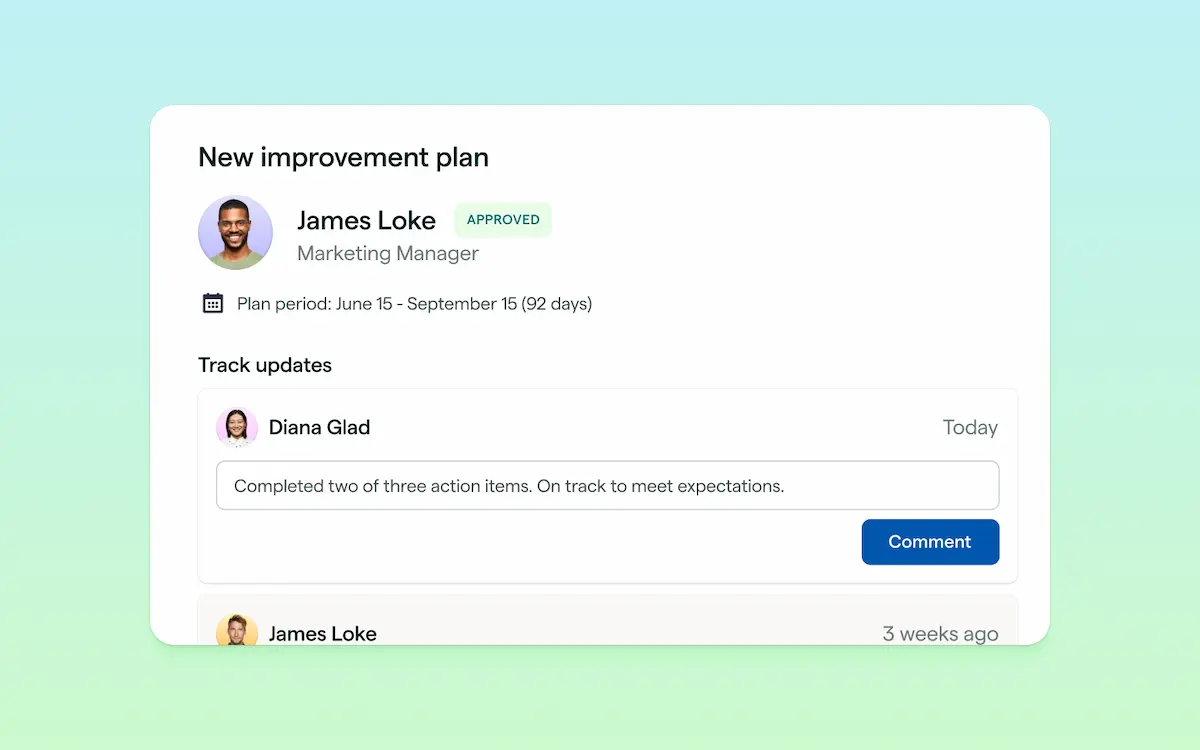
Document key discussion points, goal progress, and any agreed-upon next steps after each meeting. Consistent follow-up keeps employees accountable, ensures they get the support they need, and creates a clear record of progress throughout the PIP.
6. Close the PIP with a documented outcome.
Once the 30-, 60-, or 90-day period is up, evaluate the employee's progress against the goals outlined in the plan and document the final outcome. This may include successful completion of the PIP, an extension of the plan, or additional corrective action.
The final documentation should summarize the employee's progress, note whether expectations were met, and outline next steps. If performance has improved, clarify what's expected going forward. If it hasn't, follow your organization's policies regarding additional disciplinary action, reassignment, demotion, or termination.
Closing the PIP with clear documentation matters: it ensures everyone shares an understanding of the outcome and creates a record for future reference.
Controlling Visibility and Permissions
Performance improvement plans contain sensitive employee information, so access should be limited to the people directly involved in the process. Clear permissions help maintain employee privacy, encourage honest documentation, and ensure the right stakeholders have the appropriate level of visibility.
Who Should See What
Visibility policies vary by organization, but typically these three parties have access to PIPs:
- Managers have access to PIPs for their direct reports
- Employees can view their own plans and progress
- HR can review plans to ensure consistency and compliance
Additional stakeholders should only be granted access when they have a clear role in the process.
Risks of Poor Access Control
Be wary of giving too many people access to PIP documentation. When access is too broad, employees may lose trust in the process, and managers may feel less comfortable candidly documenting performance concerns. Unclear permissions can also create confusion around ownership, accountability, and decision-making, so it's best to limit access to only those directly involved.
With a system like Lattice, HR teams can enable and approve PIPs, give managers access to initiate plans for their direct reports, and share plans with the employee. This role-based security helps protect sensitive information while ensuring the right stakeholders have visibility into the process — creating greater consistency, accountability, and compliance across the organization.
How to Export a Complete PIP Packet
Keeping a complete, organized record of a PIP makes it easier for managers, HR, and leadership to review employee progress, make more informed decisions, and maintain consistent documentation. Here's how to create a consolidated PIP packet that ensures all parties are working from the same information.
What to Include in the Export
A complete PIP record should include:
- The original performance improvement plan
- All documented updates and revisions
- The employee's acknowledgment of the plan
- Coaching notes and progress check-ins
- The final outcome summary
Redaction Considerations
Before sharing a PIP packet, confirm that recipients have the appropriate level of access. If the documentation will be shared with a limited audience, remove or redact any information unrelated to the performance concerns being reviewed.
Format and Organization
Rather than piecing together document versions shared across emails, spreadsheets, and Google Docs, you can maintain a single, chronological record of the PIP from start to finish using performance management software. Lattice's PIP tool stores all your documentation in one place, making it easier to control access, search and find records, and review an employee's complete PIP history when needed.
Common PIP Process Mistakes to Avoid
PIPs can have a significant impact on an employee's career, so it's crucial you get them right. Here are a few common mistakes to avoid:
- Applying PIPs inconsistently across managers or teams. When managers follow different processes or hold employees to different standards, they can unintentionally undermine trust and expose the organization to unnecessary risk. Your HR team should use PIP templates and sign off on every plan to ensure consistency across the organization.
- Failing to document progress between check-ins. Launching a PIP is only the beginning. Managers should document coaching conversations, employee progress, obstacles, and agreed-upon next steps throughout the improvement period. Relying on verbal conversations alone creates gaps in the record and makes it difficult to evaluate outcomes fairly.
- Storing documentation across emails, spreadsheets, and personal drives. Scattered documentation makes it needlessly difficult to identify the latest version of the plan, track changes over time, and give employees a clear understanding of expectations and progress. Instead, use a centralized system to give your team a single, secure system of record.
- Failing to document plan delivery and employee acknowledgment. Organizations should maintain records showing when the PIP was delivered, how it was communicated, and whether the employee acknowledged receipt, so expectations are clearly documented from the start.
Run a consistent PIP process with Lattice.
Performance improvement plans are most effective when managers have a clear, repeatable process to follow and HR has visibility into how plans are being managed across the organization. To support that, Lattice PIPs provide a structured workflow that helps managers create, review, deliver, and track improvement plans while giving HR the oversight needed to ensure consistency and fairness.
With standardized templates, approval workflows, role-based access, progress tracking, and consolidated documentation, managers can spend less time chasing down misplaced paperwork and more time coaching employees. Because PIPs live alongside performance reviews, feedback, goals, and 1:1s in Lattice, managers have the context they need to support employees without piecing together information from multiple systems.
Ready to build a more consistent, transparent PIP process? Request a demo to see how Lattice helps HR teams and managers confidently guide employees from struggling to succeeding.
FAQs
What should you do if an employee refuses to acknowledge a PIP?
Even if an employee refuses to acknowledge a PIP, the process still moves forward. Document that they reviewed the PIP, note their refusal to acknowledge receipt, and maintain records of the conversation. Managers should continue following the PIP process and ensure the employee understands they're still being held to the outlined expectations, timeline, and potential outcomes.
Who should be involved in writing a PIP?
The employee's direct manager typically drafts the PIP, since they're closest to the performance issues and day-to-day expectations. HR should review and approve the plan before it's delivered to ensure it's fair, compliant, and consistent with how PIPs are handled elsewhere in the organization. In some cases, a skip-level manager or HR business partner may also weigh in, particularly for senior roles or plans that could lead to termination.
What's the difference between a PIP and progressive discipline?
A performance improvement plan is designed to help employees improve by providing clear goals, support, and time to demonstrate progress. Progressive discipline, on the other hand, addresses repeated policy violations, misconduct, or failure to meet expectations through increasingly serious corrective actions. A PIP focuses on development and improvement; progressive discipline focuses on accountability.
How long should a PIP last?
Most PIPs run 30, 60, or 90 days, depending on the role and the nature of the performance gap. Shorter timelines (30 days) tend to fit narrower, more tactical issues, while longer timelines (60–90 days) are better suited to complex behaviors or skills that take more time to build and demonstrate. Whatever the length, it should give the employee a realistic chance to improve without dragging the process out indefinitely.
When should a PIP be extended vs. closed?
A PIP may be worth extending if the employee has made meaningful progress against performance expectations but needs additional time to fully meet them. On the other hand, if there's been little improvement or the employee is nowhere near the goals, it may be appropriate to close the PIP and proceed with the next steps outlined in your organization's policies.
For example:
"The employee missed three project deadlines between April and June despite weekly coaching meetings and clear expectations regarding delivery timelines."