

In the past, companies were expected to stay neutral on politics. Their business was to provide their products and services and to maximize shareholder value, not to stray into the messy arena of politics.
But all that has changed. Political conversations increasingly permeate the workplace, and product campaigns can ignite furious conflicts online. Companies face growing pressure to plant their flag on social issues, including LGBTQ+ rights, climate change, war, and racial justice.
Brands once known solely for their products are now also viewed (and judged) through a political lens. Companies like Disney and Ben & Jerry’s that have taken political positions have found themselves in the crosshairs of public opinion.
As a business leader, how do you decide whether to take a public stand on the issues of the day?
Here, we’ll explore the pros and cons for companies and HR teams engaging in politics and corporate activism. We’ll examine the impacts on brand reputation and employee engagement, and outline best practices for deciding when to speak up, what to say, and how to support employees across a spectrum of beliefs.
Why This Question Matters More Than Ever
It’s not just about where your company stands on political or social issues: It’s about whether you should take a stance at all. There’s no easy answer, and the stakes are high with serious business consequences.
During the 2020 presidential election, the CEO of Goya Foods openly championed Donald Trump, and the company’s sales temporarily increased. But at the same time, Goya became the target of a boycott.
In 2022, Disney’s denunciation of the so-called “Don’t Say Gay” bill sparked a high-profile legal battle with Florida Governor Ron DeSantis.
Public stances on hot-button topics are a minefield — especially for companies without Disney-level clout. Companies answer to a whole host of stakeholders, often with competing expectations and demands.
Employees and consumers increasingly want brands to speak out on social justice, human rights, and political events. Millennials and Gen Z, in particular, are using their career decisions and consumer choices to push businesses toward greater societal impact.
Investors and board members, meanwhile, may be more focused on profitability, reputation, and avoiding boycotts. Many feel politically or legally pressured to tone down or even eliminate diversity, equity, inclusion, and belonging (DEIB) initiatives, even when they drive business value.
HR leaders have a role to play in guiding companies through these dilemmas. Lattice’s 2026 State of People Strategy Report found that almost 1 in 4 HR leaders (23%) struggle with navigating cultural and political polarization at their organization. Nearly a third (32%) feel stuck between employees and leaders whose perceptions of DEIB don’t align.
Ultimately, companies and their leadership have the final say on whether they act on those expectations. But those decisions now carry significant risks. Taking a stand can alienate customers, taint company culture, or push the company out of its remit. Yet saying nothing or staying neutral, once the high-ground option, can be interpreted as complicity or avoidance.
So how can HR teams balance leaders’ desire for neutrality with employees’ push for political engagement in the workplace?
{{rich-highlight-3}}
The Business Case for (and Against) Taking a Stand
Consensus is hard to come by, even within companies. Ice cream company Ben & Jerry’s has long been vocal on many social and political issues, producing special flavors for everything from climate change to refugee rights. But, in September 2025, Jerry Greenfield quit the company he cofounded, claiming its owner Unilever had “silenced” the brand’s “social mission.”
When even the founders and the owners are at irreconcilable odds, where does the decision lie?
“It is not possible to make everyone happy when it comes to politics in the workplace,” said Erica Coffey, director of DEIB at Khan Academy. “Inevitably, some will want the organization to say more and do more, while others do not wish to have the conversation at all.”
The Case for Speaking Out
There are solid arguments to be made in favor of speaking out on political and social issues.
Higher Employee Engagement and Retention
Our 2026 State of People Strategy Report found that when companies take visible political, social, or cultural stances, around 80% of employees are engaged. In organizations that stay silent, HR teams report engagement closer to 50%. When your company publicly reflects the values and passions of its employees, it can be a major boost to employees’ morale and sense of belonging to your company’s culture.
Stronger Employer Branding
Taking a stand on sociopolitical issues can build deeper relationships with like-minded customers and reinforce a clear brand identity. The positions you take (or don’t) shape how the world understands who you are and what you represent.
Take outdoor-wear brand Patagonia. For more than 40 years, Patagonia has been donating to and campaigning for environmental groups, highlighting the impact of the clothing industry, and incorporating sustainability into its supply chain. Its political stance isn’t just marketing: It’s an indelible part of its brand identity. For Patagonia’s customers, its stance is part of the appeal.
Supporting the Issues That Impact Your Business
Companies often have the power to influence public policies that impact their business, such as redefining supply chains and ensuring operations align with environmental, social, and governance (ESG) demands.
For example, many tech firms and agriculture businesses depend on immigrant workers. For such companies, speaking out on immigration policy is not just about ethics — it’s also about protecting long-term economic interests.
The Case Against Speaking Out
Of course, taking a political stance comes with several risks.
Brand Backlash
Your customer base is never homogeneous. Brands like Ben & Jerry’s and Patagonia have thrived while taking overt political positions for decades. But many consumers may avoid them for exactly the same reason.
Companies that have built political activism into their brand over time can withstand the trade-off. But a sudden statement or partnership, on the other hand, can spark a severe backlash and alienate large parts of your customer base. Bud Light lost nearly $1.4 billion in beer sales in 2023, following its partnership with transgender influencer Dylan Mulvaney, and sales were still low a year later.
Similarly, if your stance looks like bandwagon-jumping, it can really damage your credibility. Businesses that show Pride visibility in June to sell products but don’t back it up with LGBTQ+-friendly policies may be accused of “pinkwashing.”
Legal and PR Risks
Making political statements could open you up to claims of discrimination or intimidation, especially if employees feel pressured to support your stance.
Online campaigns and economic boycotts can wreak havoc on your reputation and your bottom line. Shareholders might even intervene if they feel your position is threatening their investment. And in some states where anti-DEIB legislation is emerging, you could find yourself on the wrong side of the law.
And even if your stance is supported, it could be denounced as performative, even hypocritical, if your actions don’t match your words.
Employee or Investor Churn
If your employees feel alienated by the company’s position, they may cut their losses and leave, while potential candidates might avoid applying to your business altogether.
Investors can react just as strongly. Conservative investors might divest from your company if they perceive you as overly leftist, while more progressive investors could pull away from companies cutting ESG or DEIB initiatives.
Large global brands like Disney can absorb those losses. But smaller brands don’t have the same luxury. For them, the wrong position at the wrong time can do serious damage.
A Framework for Deciding When to Speak Out
Whether you decide to speak out or not, it must always be a carefully considered decision. This framework will help you think through not only whether to take a stand, but also how to do so responsibly, when to do it, and how to assess whether silence or an internal response is the best course of action.
The framework includes four core decision pillars, each with practical criteria and reflection questions.
1. Alignment: Does the issue align with our company’s mission and values?
HR’s role isn’t to take sides, but to foster dialogue. Before making any statement or taking any stand, you need to get clear on whether the issue resonates with who you are as a company and what your company stands for.
When an issue is trending, there can be peer pressure to follow suit. But it’s vital that any stance and actions you take are driven first and foremost by your identity. It comes down to honesty. If your stance looks performative, it can damage your brand and undermine the cause itself.
Environmentalism and justice are explicitly stated in Patagonia’s core values. For them, it’s clear. For other companies, however, it might call for a little more analysis and self-assessment to decide.
Ask yourself:
- Is this issue explicitly addressed in our mission, values, or code of conduct? If not, is it implied in any way?
- Does this issue affect our products, services, or the communities we serve?
- Have we taken a stance on political matters like this in the past? If so, would we look inconsistent if we didn’t take a stance now?
- Would speaking out reflect our identity or the relationship we want with our employees, customers, and partners?
Green Lights
- This issue is a natural fit with the company’s core values and existing ethical commitments.
- If we stay silent, it could look inconsistent with our stated values.
Red Lights
- This issue isn’t related to our business or purpose, or it isn’t grounded in our identity.
- The stance might look opportunistic, or like we’re taking advantage of a trend.
{{rich-highlight-2}}
2. Action and advocacy: Are we willing to back up words with actions?
Words are cheap. What matters are actions. If you take a position but don’t follow through, you may be accused of paying lip service.
Action needs to be serious, not simply a one-off gesture. It could involve making meaningful changes to internal policies, such as hiring practices. It might mean adjusting your supply chain for greater sustainability, or to avoid suppliers whose values conflict with yours. You might donate to or partner with organizations, as Patagonia and Ben & Jerry’s do.
But actions can be costly. Changes in company policy to support your cause could trigger a backlash from employees, customers, suppliers, or investors.
You should set out all the possible ways to put the stance into action and consider the potential consequences of each. Decide what you are willing or able to commit to, and what might be a bridge too far for your stakeholders.
Ask yourself:
- What concrete actions would support our statement?
- Which of those actions are we willing to take? Do we have the capacity to take them?
- What are the potential costs (financial, reputational, political, or logistical)? How would we address those costs?
- How will we track and report the impact of those actions?
Green Lights
- There are realistic, tangible steps that we are able and willing to take, and we can measure their impact.
- The costs are manageable.
- Leadership is on board.
Red Lights
- Any actions we could take to back up our stance would be too risky or costly.
- Actions could cause internal controversy or conflict.
- Leaders aren’t willing to support the actions that would back up the statement.
3. Relevance: Do our employees care deeply about this issue?
Often, the impetus for corporate stances comes from the employees. But you don’t have to wait for issues to come to a head. Rather than being reactive, engage with employees to surface hot-button topics, gauge their feelings, and facilitate open discussions.
Use listening sessions or anonymous pulse surveys with engagement metrics and sentiment analysis to assess what your people feel. You may find that attitudes are divided, and that going public with a stance would risk conflict or even resignations.
While you might ultimately decide that publicly coming down on one side of a polarizing issue would do more harm than good, you can find other options.
“One valuable perspective I’ve learned is to explore Voice vs. Impact,” said Opportunity Finance Network's EVP, Chief People and Operations Officer Regina Ross. “Sometimes, especially in polarized climates, taking a public stance may not be possible or productive. But that doesn’t mean action is off the table. Employees can still drive meaningful impact — through volunteering, service, or internal advocacy — without requiring an external declaration.”
If you decide not to take a stand as a company, you can still support your employees in acting on their own behalf and defend their right to express their political views.
Ask yourself:
- Is it an issue that directly impacts members of our staff?
- Are employees already discussing the issue and the company’s position?
- Is there consensus or conflict among staff around the issue?
- Have employees raised it in one-on-ones or staff meetings, and have they asked about the company taking — or avoiding — a stand?
Green Lights
- It’s an issue that directly impacts or threatens at least some of our employees.
- Staying silent would harm morale or erode employees’ trust in the company.
- Employee groups have specifically requested leadership to speak out.
Red Lights
- There’s serious division among employees on the issue.
- Employees are uninterested in the issue or would prefer internal action to public statements.
- Employees aren’t enthusiastic about the company using political messaging.
4. Consequences: Is silence more harmful than saying something?
While it can seem that you play it safe by not getting involved, saying nothing can sometimes do more harm than good. In areas of unfairness or injustice, silence speaks volumes. It can be construed as capitulation, or even endorsement, which can take a major toll on your reputation.
It’s important to weigh the risks of speaking out against the risks of staying silent. It’s not just what you say, but also what you don’t, that reflects your values.
Ask yourself:
- How would silence be interpreted — as indifference, complicity, or a contradiction of our values? Or is silence on this issue more consistent with our values?
- Are our peers taking public stances, and is there an expectation that we respond?
- Can we give an explanation of our silence that is consistent with our values?
- Would remaining quiet put employees or customers at risk?
- Which would polarize stakeholders more — speaking out or staying neutral?
- Could an internal-only message meet expectations?
Green Lights
- Silence would put employees or other stakeholders at risk.
- Your values clearly imply a position, and silence would be interpreted as inconsistent with those values.
Red Lights
- Taking a corporate social stance would add little value or escalate tensions.
- The only reason for speaking out is that your competitors have done so.
Best Practices for HR Leaders
Whether you choose to take a public stance or stay silent, the key is to be intentional. Here’s how to do it well.
1. Build internal alignment before external action.
Before you do or say anything, get your ducks in a row. This means being thoughtful and authentic about whether and how you respond, and why. It’s more important to act wisely than to act quickly. Rushed or impulsive statements can backfire.
“HR teams should work with their senior leadership to establish guidelines around politics at work,” said Coffey. “This can look different depending on the organization’s willingness to engage. For some, it may mean hosting facilitated conversations; for others, it may mean they are not to be discussed at all.”
Make sure your position, whether you speak out or not, is aligned with your company values, and that leaders are prepared to follow through with concrete actions. HR leaders need to make sure C-suite, communications, legal, and people managers are ready to speak with one voice. Mixed messages will only create confusion, which could harm your credibility.
2. Understand your employee sentiment.
You want to ensure that you are taking into account the less vocal or outspoken segments of your workforce, not just the advocates and activists.
Use employee listening tools, such as Lattice Engagement, pulse surveys, listening sessions, and ERG feedback, to gauge how employees feel about a given issue, and about the prospect of the company taking a public position.
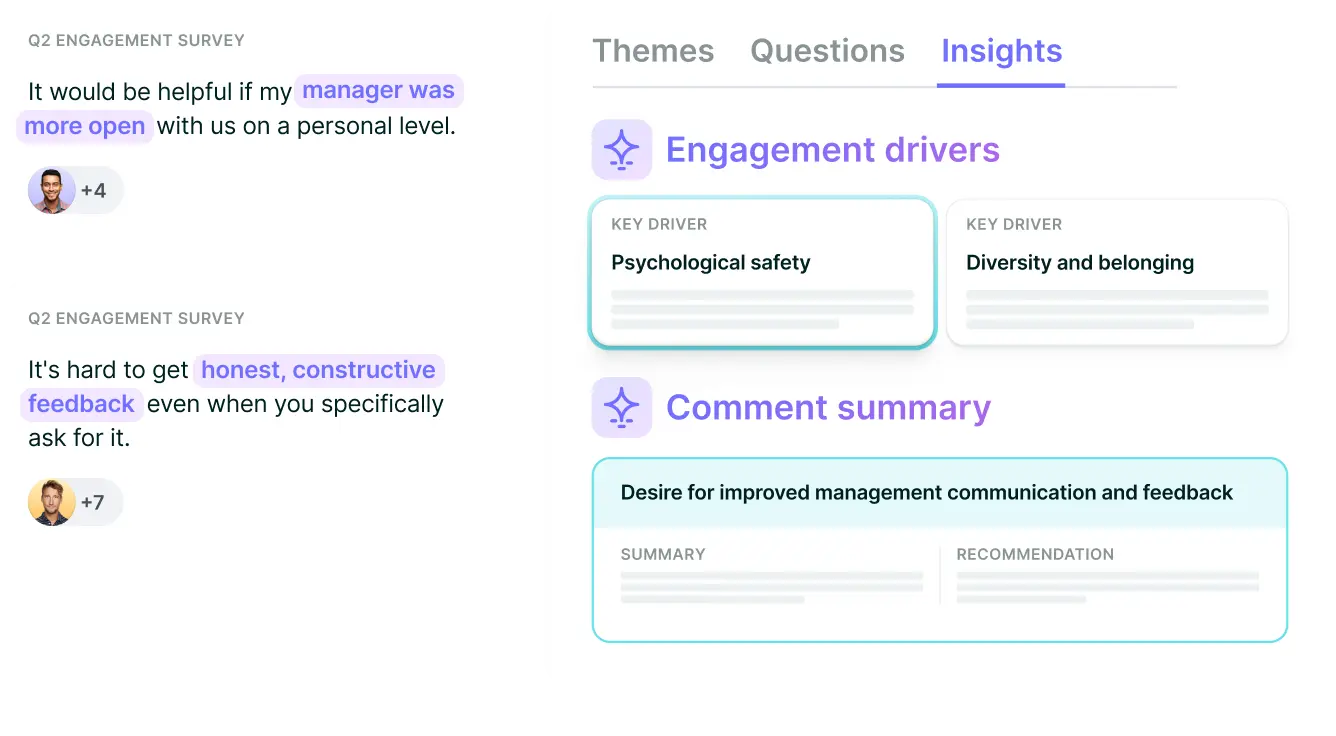
Sentiment analysis will help you determine whether a public stance, internal actions, or silence is the best way forward. It also helps you assess what support and resources you might need to provide.
“It’s not realistic — or sustainable — for organizations to take public positions on every political or social issue that arises,” Rana Robillard, CPO at Tekion, advised. “Doing so can quickly become a no-win situation, given the wide range of views employees hold and the pressure to continually speak out once a precedent is set.”
3. Be open and collaborative.
Approach these conversations as an organizational decision in which everyone’s voice matters. Communicate with transparency and humility, and acknowledge nuance, complexity, and evolving perspectives. This way, even those who are on the other side of the company position can have clarity on where you stand, and are less likely to feel alienated, even if they disagree.
Taking a collaborative approach helps create a safe space for different viewpoints and can defuse any polarizing tensions. Acknowledge how complex the issue may be, and invite dialogue. You don’t want to come off as dismissive of differing views.
Bring in voices from across the organization, from leadership, ERGs, managers, and communications, to create an inclusive decision-making process. Employees should also have the space to feed in their views and concerns, ask questions, and access support without judgment.
Train and equip your managers to handle difficult conversations and disagreements respectfully and safely. In spaces where the issue raises tough conversations or emotive issues, make sure you have good mental health and wellbeing supports in place.
As Ross told us, “Ultimately, HR’s role is to create space for dialogue, protect psychological safety, and model values-driven leadership that balances empathy with pragmatism.”
{{rich-highlight-1}}
How Lattice Can Help
It’s not easy to navigate the myriad interests, discussions, and decisions of an increasingly politicized business environment. It takes careful planning, honest and open communication, and deep analysis. The risks of missteps are real and serious.
That’s why it’s vital to have a reliable system and well-integrated people management tools. Lattice helps HR teams and business leaders tap into employee sentiment on political matters and policies that affect them, navigate challenging conversations with transparency, and analyze the impact of decisions.
- Lattice Engagement taps into whether employees feel aligned with the company culture. Pulse surveys enable HR teams to get a sense of how employees feel about particular political or social issues, and how they feel about the company taking a position.
- Lattice Analytics helps you spot cultural differences or fractures, reveal how strongly employees care, how widespread or limited those opinions are, and what people expect from their leaders.
- Lattice Performance Management lets you assess if cultural or social issues are affecting performance, collaboration, or trust among your employees. It helps you manage performance conversations and one-on-ones with sensitivity and understanding, and discuss social or political concerns that might be impacting your employees.
- Lattice Grow supports employees’ career paths and development plans in line with company values, and helps HR train managers to handle politically charged discussions sensitively, and encourage sharing and collaboration between leaders and teams.
To learn how Lattice can help you build a values-aligned culture and navigate your public stances, schedule a demo.
Better insights, stronger people programs.
Take a self-guided tour of Lattice Analytics to see how our platform can help you make better decisions about your people strategy in less time.
.png)
See what else HR leaders are cooking up in 2026.
People strategy, AI adoption, and high performance: just a few of HR's favorite things.
.webp)