

Performance has taken the spotlight. For the first time in the history of our State of People Strategy Report, performance is the top priority for HR teams, with 40% of respondents putting it at the top of their list. But it’s only nudged into the lead by one percentage point. Employee engagement is right behind it, at 39%.
While employee engagement has been a consistent cornerstone of HR strategy, performance management has risen in importance since 2023, when it was a top priority for just 27% of HR teams.
Here’s what the data reveals about performance management in 2026, plus how HR teams can overcome key challenges and strengthen the relationship between performance and engagement even more.
Performance takes the spotlight as HR’s leading priority in 2026.
Evolving economic headwinds and a renewed push for AI-powered optimization are keeping performance front and center for 2026. While priorities might shift over the years, one constant stands out: the symbiotic relationship between performance and engagement.
“Performance and engagement are so deeply intertwined because engaged employees tend to perform better, and high performers tend to stay more engaged when they work with other high performers,” explained Alexis MacDonald, VP of people at Klue.
This relationship means balancing the two is key, and MacDonald cautioned that leaning too far one way or the other can cause trouble. “Focusing on performance alone can risk burnout and disengagement, especially if employees don’t feel their performance is being evaluated fairly.”
In contrast, MacDonald added that focusing too much on engagement can lead to a culture that tolerates complacency. “Top performers are allergic to a culture that feels disingenuous or overly positive,” she said. “The key is balancing both — supporting performance, growth, recognition, and connection, so employees are motivated and supported.”
That support needs to extend to every individual employee equally. But unlike the rise in importance of performance management, diversity, equity, inclusion, and belonging (DEIB) has hit a slump. In 2023, DEIB programming was a priority for 30% of HR teams. In 2026, it’s only a priority for 16%.
Despite its slip down the rankings, DEIB remains a focus for the highest-performing HR teams. Our 2026 State of People Strategy Report found that, compared to low-performing teams, high-performing HR teams are five times more likely to be prioritizing DEIB in 2026. These teams know that performance also relies on DEIB, because it’s a key component of building a high-performance culture where everyone can thrive.
That kind of inclusive culture also relies on creating an equitable, consistent performance review process.
Performance Reviews
With performance high on the agenda, many HR teams are taking a closer look at their current review practices and assessing whether they still serve the business or not. And during these assessments, one of the most effective ways to test your process is to compare it against what top-performing HR teams are doing.
Quarterly reviews are a hallmark of high-performing HR teams. Our 2026 State of People Strategy Report showed that 39% of high-performing teams conduct quarterly performance reviews, compared to only 10% of low-performing teams.
Regionally, 51% of European HR teams are also leaning into this regular feedback and review cadence. In contrast, only 25% of US HR teams use quarterly performance reviews, highlighting a major opportunity to tighten feedback loops and drive better performance.
Rana Robillard, CPO at Tekion, said she and her team believe that ongoing and consistent feedback is a crucial part of the performance puzzle. “We do regular 1:1s between managers and each employee (biweekly), along with more formal and documented quarterly and annual performance reviews,” she explained.
At Superside, Director of People Experience Joaquin Migliore said that the effectiveness of more regular reviews also depends on the company’s culture and maturity around continuous feedback.
To drive performance, he combines regular performance reviews with active talent reviews led by HR in conjunction with each department. Scheduled in between big performance reviews, active talent reviews “go deeper into the results and skills that make up our talent portfolio,” Migliore explained.
“These can lead to important discussions around underperformance that might be flying under the radar, and they ensure managers keep a close eye on cases that were flagged for continuous monitoring in previous reviews,” he said.
On its own, increasing the cadence of the performance review cycle isn’t enough. Kayshia Kruger, VP of people and organizational development at O. R. Colan Associates, noted that the most effective HR teams are also moving away from compliance-driven performance management toward more developmental cultures. “That looks like continuous feedback, clarity of expectations, and teaching leaders how to coach, not just evaluate,” she explained.
Kruger added that HR’s real impact lies in designing the performance management systems and processes that enable great performance, not just running the reviews. But to do that well, HR teams must overcome some of the major challenges that hold performance practices back.
{{rich-highlight-2}}
Key Challenges of Performance Reviews
Performance reviews have a lot of complexities, including the difficulty of quantifying what employee excellence looks like and the awkwardness of delivering difficult feedback. These elements can make performance assessments challenging to implement effectively — but they’re also crucial to the success of each review.
One promising trend is that globally, HR teams are becoming better at overcoming these challenges. Our State of People Strategy research showed that there was a decrease in HR teams reporting the following challenges in 2025, compared to 2024:
- Quantifying “good” vs. “excellent” performance (40% vs. 61%)
- Reviewing a year’s worth of feedback (41% vs. 47%)
- Pushing managers to give tougher feedback (46% vs. 55%)
It’s hard to know whether this improved confidence is due to HR getting better at manager enablement, or whether technology is getting better at helping managers with the heavy lifting. The most likely explanation is that it’s a bit of both.
Unstructured Approaches
Over the last decade, HR teams have become more intentional in how they enable and support managers. Migliore noted that “more and more best practices around performance management have become widely available and used by smaller HR teams versus 2015, when small startups would have no official performance management practices, and big companies would still have clunky outdated programs.”
By taking a more structured, intentional approach, HR becomes more confident and proficient in running performance review cycles from start to finish, Migliore added. And that confidence is contagious. When HR leads a well-designed review process, managers also gain the clarity and confidence they need to show up for their teams.
Integrating Technology the Right Way
Technology has also reached a turning point. Robillard explained that even though it’s taken a long time for tech to get where HR truly needs it, technology is typically exceeding expectations these days, especially with the addition of artificial intelligence.
Now modern tools like Lattice are capable of delivering the support HR teams need. Whether that’s condensing feedback, uncovering insights, or completing time-consuming admin tasks, HR tech is helping people teams spend more time on what matters.
Even though tech might be more advanced than ever before, “tech alone is never the answer,” said Robillard. She explained that, in addition to a strong tech stack, to truly build excellence in this area, HR teams also need a deep playbook, communications plan, executive support, and training. “But this combination is now the best I have ever seen it,” she added.
Centering the Role of Managers
HR and tech don’t deserve all the flowers. Great managers still have a critical role to play. “I also give a lot of credit to managers who are balancing so many things — including managing performance in a changing environment under pressure to drive efficiency, increase innovation, and do more with less,” said MacDonald.
And to support them in the best way possible, organizations are offering various types of performance review training for managers, including those summarized below.
While manager training influences the quality of performance reviews, AI also has the potential to make a powerful positive impact — as long as it’s used in the right way.
Tips from the Experts: How HR Is Leveraging AI for Performance
AI has impacted almost every HR team, but high-performing teams are most excited about the potential applications of this technology.
Here’s how HR teams across the globe use AI-powered tools, according to our 2026 State of People Strategy survey:
- 48% use AI to write performance reviews.
- 45% use AI to summarize a year’s worth of performance feedback.
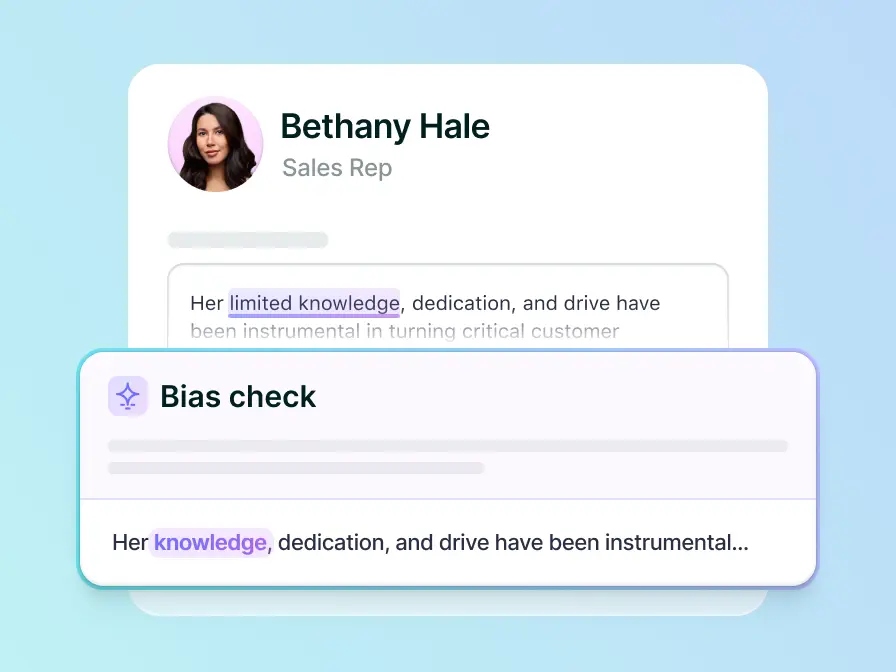
- 23% use AI to identify bias in reviews, handbooks, and promotions.
With the right prompts, AI can also help automate check-ins, identify performance trends, and recommend career growth or development actions.
Below, we’ll explore how HR leaders are using AI to support — not replace — human judgment in performance reviews.
Streamline the review calibration process with AI.
Performance review calibration helps ensure all employees are rated by the same metrics, which creates a consistent, equitable, and fairer review process. But this process can take time.
Small businesses might rely on one-on-one conversations with managers, while larger organizations typically use calibration committees. Both these approaches are effective but labor-intensive.
Migliore said AI can help the calibration process by spotting inconsistencies in criteria and by highlighting hidden trends or biases. This approach is currently underused by HR, with only 23% of teams using AI to identify bias in performance reviews.
Empower managers with AI-driven insights.
AI isn’t just for HR. At Superside, Migliore extends the use of AI to managers to enhance the quality of performance reviews. He said this approach acts “as if you’re giving them a dedicated HRBP to think through reviews with them.”
He added he particularly likes using AI to compare a manager’s own review with the 360-degree review their direct report might have received. This can be a great way to spot inconsistencies or areas that reinforce each other.
At Tekion, Robillard encourages the use of Lattice AI to help managers develop balanced and supportive feedback to employees.
Automate manual tasks with AI.
OakNorth Bank CPO Alan Cairns found that AI helped in many ways, chiefly through removing low-value work and allowing HR teams to focus on more strategic and high-value activities. “A simple example: Talent acquisition using AI for sourcing and interview note-taking releases recruiting teams to add more value,” he explained.
Migliore also encourages the use of AI to condense feedback into actionable growth areas. This not only saves time, but also “makes the performance reviews much more useful and forward-looking,” he said.
Build proactive HR processes using AI.
AI can also help HR become more proactive, without creating extra work. Chuck Marcelin, director of HR at Hudson Valley Property Group, uses AI to get ahead of the curve, as it “can help identify employees who might be struggling, predict who would be good for succession planning, and even pinpoint areas where employees aren’t reaching their full potential.”
Use AI to create a data-driven approach to performance reviews.
MacDonald noted that she’s seeing AI used to create a data-driven approach to performance. “So that means a low-lift and repeatable approach to feedback and performance management. This area is a great use case for leaning in with AI to track and connect feedback and reduce admin work,” she explained.
The Future of Performance Management: Best Practices for 2026 and Beyond
Employee performance might be having its moment in the spotlight — but this shouldn’t be at the expense of engagement.
Robillard cautioned that when performance is prioritized without investment in engagement as well, it can create environments where burnout thrives. On the flip side, she added that focusing on engagement without holding a high bar for accountability leads to stagnation. The key is giving both the attention they deserve.
“The most effective teams, and the most resilient companies, understand that performance and engagement aren’t trade-offs. They are interconnected. When done right, each strengthens the other,” said Robillard.
“High-performing teams are not just built on output,” said Robillard. “They’re sustained by engagement, trust, and shared purpose. As companies focus more on efficiency and talent density, it’s important to remember that employees still crave clarity, development, and fairness. They want constructive feedback, a clear understanding of where they stand, and insight into how they can grow.”
To achieve this kind of holistic approach to performance in 2026 and beyond, try these best practices:
- Create a feedback loop. Move beyond annual reviews by encouraging real-time, multi-directional feedback from managers, peers, and direct reports.
- Set measurable goals. Empower managers and employees to set clear, trackable performance goals. Revisit these quarterly to stay aligned and agile.
- Leverage real-time data. Use analytics to identify strengths and areas for improvement before review season, helping team members course-correct sooner.
- Increase ownership. Encourage employees to take ownership of the review process by using self-reviews and peer feedback to create a more balanced viewpoint.
Adjusting your performance management process to encompass these kinds of best practices might seem like a lot of work — but it doesn’t have to be. The right HR tech can streamline the process and help create seamless alignment between employee growth and company performance.
{{rich-highlight-1}}
Why Lattice Is Built for Modern Performance Management
Human resources teams are ready to upgrade their tech. This year’s State of People Strategy Report found that updating HR software is a top priority for 25% of teams in 2026, a ten percentage point increase from 2025.
A modern performance management system needs more than just software, though. It needs the right kind of HR tech — one that helps connect real-time feedback, development, and goal setting in a way that helps drive performance while also boosting engagement.
Lattice is built to help HR teams achieve all that, and more, with these features:
- Integrated tools provide everything you need to track performance, run reviews, and support employee development on one platform, reducing friction and keeping everyone aligned.
- AI assistance streamlines the review process with personalized insights and recommendations, helping managers save time without compromising meaningful feedback.
- Employee ownership empowers employees to set goals, track progress, and see how their growth and career development contribute directly to company performance.
With Lattice, HR teams can create a more effective and engaging performance management experience that benefits everyone.
To learn more, take a tour of Lattice Performance Management.
Make high performance a habit.
Discover Lattice's AI-powered performance tools that enable managers and employees to stay aligned, focused, and consistently make progress on what matters most.