

The going has been tough for diversity, equity, inclusion, and belonging (DEIB). In 2025, innumerable organizations, including universities, were pummeled by social media attacks, online threats, complaints from the Equal Employment Opportunity Commission (EEOC), lawsuits, and anti-DEIB executive orders.
But scrappy and strategic DEIB professionals are proving that it’s not all doom and gloom. There’s hope. “They’re learning to speak business language, build coalitions, and create change from wherever they sit in the organization,” said talent and DEI consultant Dani Herrera. “Smart HR leaders are reframing inclusion as risk management, retention strategy, employee engagement, and competitive advantage.”
If you’re hanging on to your values, we’ve got you. In this article, we’ll explore ways you can reframe your approach to DEIB, no matter where you are in the fray.
DEIB’s Existential Crisis
One in eight companies planned to reduce or eliminate DEIB programs in 2025, and 49% of them cited political climate changes as a key reason why. Household names like Walmart, Disney, Ford, McDonald’s, Meta, Google, and Amazon scaled back, diluted, or upended their DEIB efforts entirely. According to Lattice’s 2026 State of People Strategy Report, 61% of HR teams plan to keep dedicated DEIB roles, and 28% have already or will eliminate them.
“My clients are split into two camps: The reactive ones are cutting most DEI and talent-related strategies, but realize they need support when something goes wrong,” Herrera said. “And the strategic ones are doubling down because they know this is exactly when you need these practices most.”
Lattice’s 2026 State of People Strategy Report found that high-performing teams are five times more likely to prioritize DEIB in 2026 than low-performing teams. Yet, only 16% of surveyed HR teams said DEIB programs will be a priority in the next 12 months.
Why DEIB Is More Critical Than Ever
Evidence-based practices like DEIB training programs and employee resource groups have suffered intense politicization and legal scrutiny in recent years. As a result, the work of leading DEIB initiatives has grown more fraught and complex. Our 2026 State of People Strategy Report found that 32% of HR professionals feel stuck managing employees’ and senior leadership’s conflicting perceptions of DEIB.
Consumer opinions are also at play. For example, Target paid dearly for its DEIB retreats. In the first quarter of 2025, sales missed expectations by nearly $500 million, stock plunged 12%, and foot traffic declined dramatically for weeks.
“Historically excluded folks have less tolerance for performative actions. We’ve been through this cycle before, and we’re seeing it and calling it out faster,” said Herrera.
Gen Z and millennial employees are asking direct questions about pay equity, DEIB practices, and company values during interviews, she added. “They’re not staying in toxic environments, and they’re making companies compete on culture.”
Paolo Gaudiano, founder and chief scientist at inclusion-focused consultancy Aleria, put it bluntly: “Every company I have ever worked with that has poor levels of diversity always has retention problems that match.” According to Gaudiano, Aleria estimates that a typical company loses 20% of its net profits due to the productivity loss and the attrition costs of poor inclusion.
7 Ways to Keep DEIB a Priority in 2026
1. Make friends with legal teams.
It’s chaos out there. Nathanael E. Wright, a partner and director of DEI at CMBG3 Law, observes an uptick in cases challenging affirmative action, rising claims of reverse discrimination, and legal questions surrounding the validity of DEIB efforts.
Recognizing the need for DEIB initiatives to be both progressive and compliant, “Companies should involve legal counsel early in the DEI planning process,” he said. “Begin by aligning on shared language and goals, especially around core values such as retention, innovation, and reputation.”
Here are a few more tips:
- Work together. Involve legal counsel early in the DEIB planning process. Consider co-drafting DEIB initiatives, and as a policy, require legal sign-off on all communications and DEIB-related decisions.
- Prepare for scrutiny. “Document everything,” advised David Rice, executive editor at People Managing People. “Keep detailed records of program outcomes, legal compliance rationale, and business impact. Be ready to defend your work with data, not just good intentions.”
- Keep evidence trails. Retain structured interview guides, scoring sheets, audit reports, accessibility attestations, and policy change logs to show a consistent commitment to equal opportunities and fair hiring practices over time.
- Remain proactive. US Immigration and Customs Enforcement (ICE) is on the prowl, so prepare to protect your company and your immigrant employees if and when they come knocking. Wright advised the following:
- Regularly auditing I-9 forms to ensure all employment eligibility verification documents are accurate and up to date.
- Training HR staff on lawful procedures to follow during ICE audits or surprise raids.
- Developing a rapid response plan that includes legal counsel, clear communication protocols, and support mechanisms for affected employees.
2. Choose the right metrics.
According to our 2026 State of People Strategy Report, 35% of human resources teams globally feel pressure to defend DEIB efforts. A powerful way to meet this challenge is to measure the impact of your DEIB practices on key areas like retention, employee engagement, productivity, and innovation.
Yet, too often, organizations rely almost exclusively on diversity data: demographic snapshots that show who is in the workforce at a given moment. But this approach is flawed.
While important, representation numbers don’t explain where inequities are arising or how to fix them. That’s why organizations must move beyond ‘outcome’ metrics alone and incorporate ‘process’ and ‘experience’ metrics as well.
“The key is to measure the right quantities at the right level so that you can get the clarity you need to pinpoint problems and take meaningful action,” Gaudiano said.
Outcome metrics establish a baseline and help assess the impact of DEIB initiatives over time. They answer the question: What are the results? These metrics help identify disparities, but they don’t explain why. Common examples include:
- Representation by demographic group at the vice president level
- Promotion and advancement rates across different employee populations
- Retention and turnover rates segmented by demographic
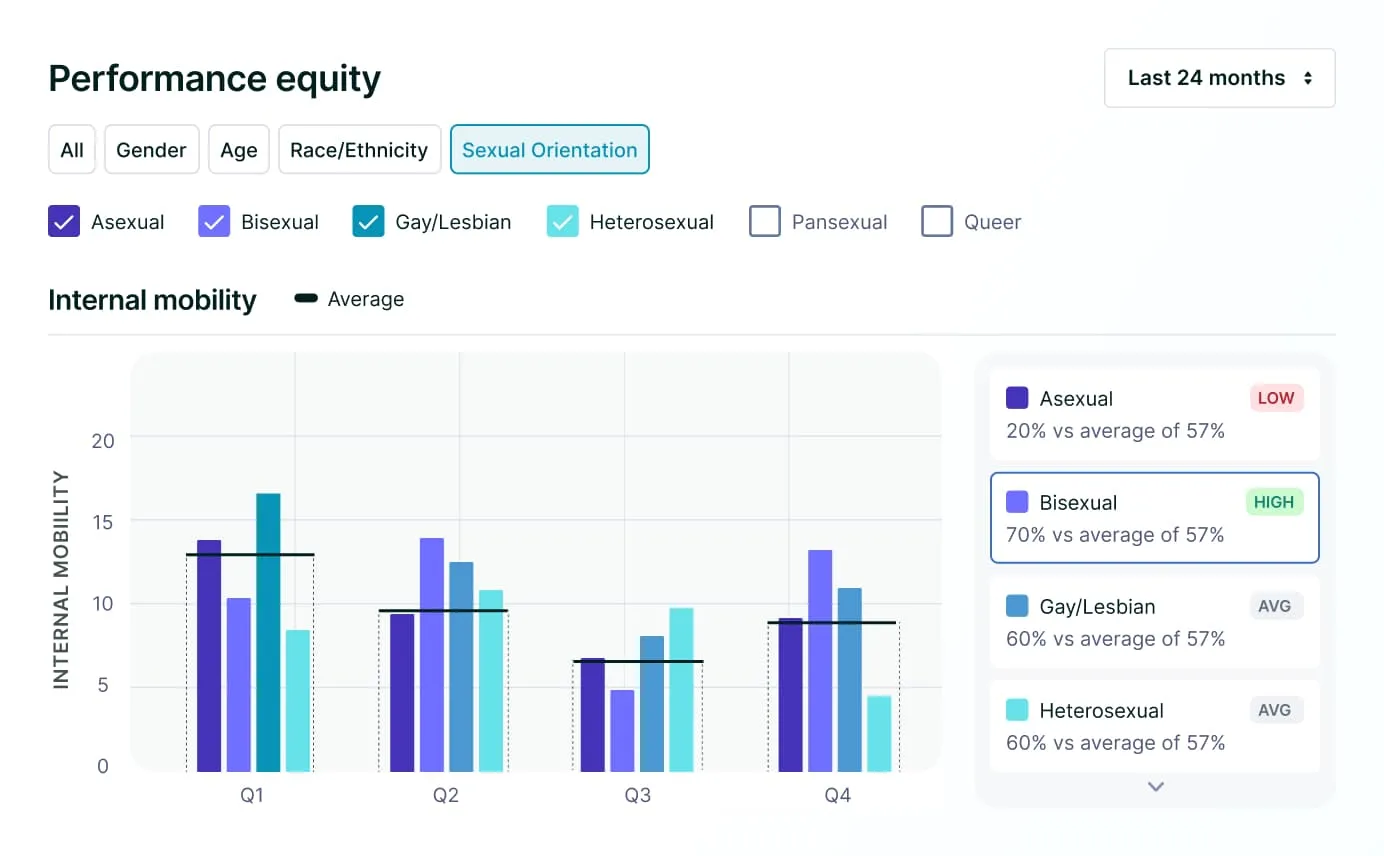
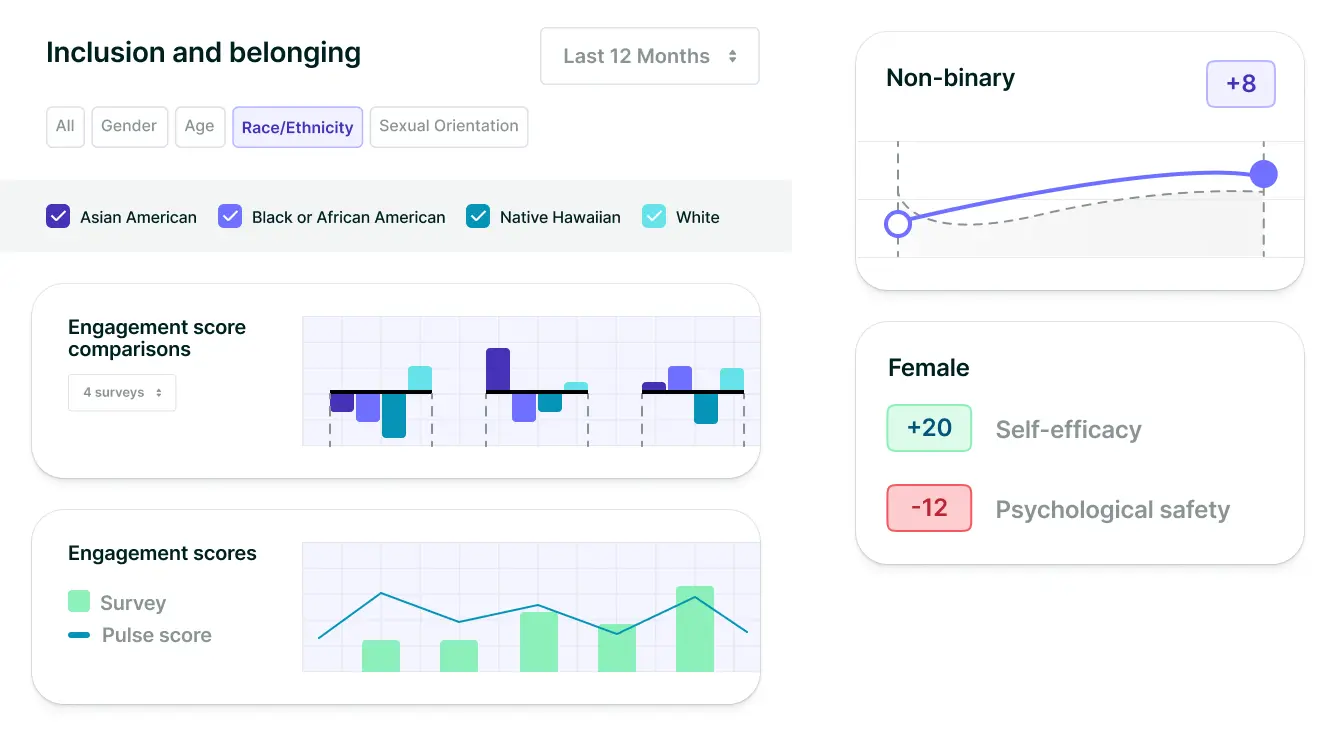
For instance, if you want to improve the internal mobility rate among people of color, a tool like Lattice Analytics can swiftly surface the performance equity data you need at a glance. This offers a quick diagnosis, providing a starting point for building a diverse workforce.
Process metrics, in contrast, help organizations diagnose why disparities exist. They assess whether business systems operate equitably and where bias may be embedded. As Gaudiano put it, “It’s about measuring the impact of workplace policies, processes, and systems on the ability of your employees to succeed.” Examples include:
- Applicant-to-hire conversion rates broken down by sexual orientation
- Participation of Hispanic employees in high-impact projects, sponsorships, or mentorship programs
- The utilization of paid and unpaid leave among employees with disabilities
To build a truly inclusive culture, keep tabs on the subjective experiences of inclusion. Here, you might use anonymized open-ended DEIB surveys or focus groups to examine whether employees feel psychologically safe in their work environment, believe their ideas are valued, or experience a sense of belonging.
3. Communicate with nuance.
Communicating With Employees
“Internally, communications teams are often caught between leaders’ risk aversion and employees’ demand for progress,” said Lisa Chensvold, founder and principal at Chensvold Communications. “Externally, fear of saying the wrong thing leads to inconsistent or overly cautious messaging.”
But rather than stay in that uncomfortable tension, Chensvold advised, it’s better to take a step back and focus on deeper alignment among values, operations, and culture.
“In a polarized moment, staying silent or pretending division doesn’t exist can feel like gaslighting. If your DEI strategy — or how you talk about your DEI strategy — is shifting, say so and explain why. People’s tolerance for complexity is much higher than it is for vagueness.”
When communicating with employees across the political spectrum, Rice suggested looking for common ground. He offered the following tips:
- Avoid jargon that can alienate or confuse. “Instead of ‘privilege,’ discuss ‘different experiences.’ Replace ‘bias’ with ‘assumptions’ or ‘blind spots.’ The goal is understanding, not defensiveness.”
- Acknowledge the complexity of the situation. “Good people can have different perspectives on something like equity initiatives. Validate concerns while providing context.”
- Focus on actions. “When addressing issues, emphasize specific actions and their impact rather than making assumptions about someone’s character or background. This reduces defensiveness and creates space for growth.”
Communicating With Leadership
Depending on how risk-averse your company is, you may need to reposition DEIB while discussing your work. For example:
- Frame the work through customer and talent market demands. “When leadership sees diverse teams as a competitive advantage for reaching multicultural markets or attracting top talent, the conversation shifts,” said Rice.
- Position workplace diversity as risk mitigation. Present inclusion programs as hedging against groupthink. “For example, homogeneous teams or DEI neutrality can lead to expensive mistakes — from product failures to PR disasters,” Rice pointed out.
- Appeal to the business case. “When I approach a client, my pitch is ‘You are losing money without realizing it, we can help you figure out where you are losing it, why you are losing it, and what you can do to stop losing it,’” said Gaudiano.
{{rich-highlight-2}}
4. Bake DEIB into business strategy.
Even the best DEIB initiatives can fall flat when they feel like an afterthought. Here are a few ways to embed DEIB into your business strategy:
- Create or elevate a C-level DEIB role reporting directly to the CEO and board, with a dedicated budget and decision-making authority over strategic priorities and resource allocation. Companies like Condé Nast have continued to appoint chief diversity officers despite the ongoing sociopolitical fracas.
- Tie DEIB goals to your business objectives. Supporting its business strategy of “empowering people through digitalization and making finance accessible to all,” Bank al Etihad crafted a DEIB program that aimed to close Jordan’s economic gender gap. The comprehensive plan targeted current staff, hiring practices, and product design. By raising women’s representation across the bank, Bank al Etihad unlocked an untapped market of risk-conscious, diligent savers and earned goodwill and positive regard from its stakeholders.
- Go beyond your offices. Unilever, one of the world’s largest consumer goods companies, extended its DEIB initiatives to include the women working in its sprawling global supply chains. To protect them from gender-based violence, the company partnered with an impact technology firm to pilot a system that helps its business partners “understand where and in what ways women within their operations may be disadvantaged or at risk.”
5. Reframe your employee resource groups (ERGs).
According to the EEOC, “Limiting membership in workplace groups, such as employee resource groups (ERG)…or other employee affinity groups, to certain protected groups” constitutes unlawful segregation.
The good news is, there are workarounds. Former EEOC officials advised, “Under the law, there is no prohibition on organizing voluntary employee resource groups to address common experiences and provide a supportive environment.”
To ensure ERGs are compliant, provide equal access to all employees. For example, you may establish a resource group dedicated to supporting physically disabled employees, but all employees — regardless of disability status — can join if they share the goal of making the workplace more accessible.
Inclusion Councils
Unlike ERGs, inclusion councils take a top-down approach, governing and guiding inclusion efforts and diversity initiatives across the organization. These councils typically comprise employees from various backgrounds, roles, and seniority levels — including executives and frontline staff. Their work could include shaping company policies, advocating for underrepresented groups, designing action plans, or tracking progress toward inclusion goals.
6. Empower your managers.
According to a 2024 survey by Lattice and YouGov, managers need better training, data, performance management tools, and strategic support to lead engaged, high-performing teams. Here are three ways to meet these needs:
1. Mandate inclusive leadership training at every level.
Equip all leaders to manage, develop, and advocate for diverse teams. Train managers to cultivate psychological safety, champion diverse perspectives, and drive equitable outcomes. Go beyond diversity training and provide targeted skill-building that addresses the specific DEIB challenges all managers face daily. Cover areas like:
- Emotional intelligence: Developing active listening, self-reflection, and emotional awareness skills
- Conflict management: Transforming tense team dynamics into productive dialogue
- Cultural competence: Applying cultural sensitivity, mitigating unconscious bias, and implementing equitable practices within teams
To cement these skills, organize regular peer-coaching sessions where managers work through real-time DEIB challenges with one another and share what they have learned.
2. Provide autonomy in service of inclusive behaviors.
Explicitly grant managers formal authorization to modify roles and workflows to support team members with different needs. For example:
- Rotate ‘urgent response’ duties to support parents and caregivers.
- Allow individuals with chronic illnesses to plan their tasks around their daily capacity, creating backup plans for key deliverables.
- Extend deadlines for dyslexic individuals to perform text-heavy tasks like document reviews.
3. Leverage cutting-edge HR technology.
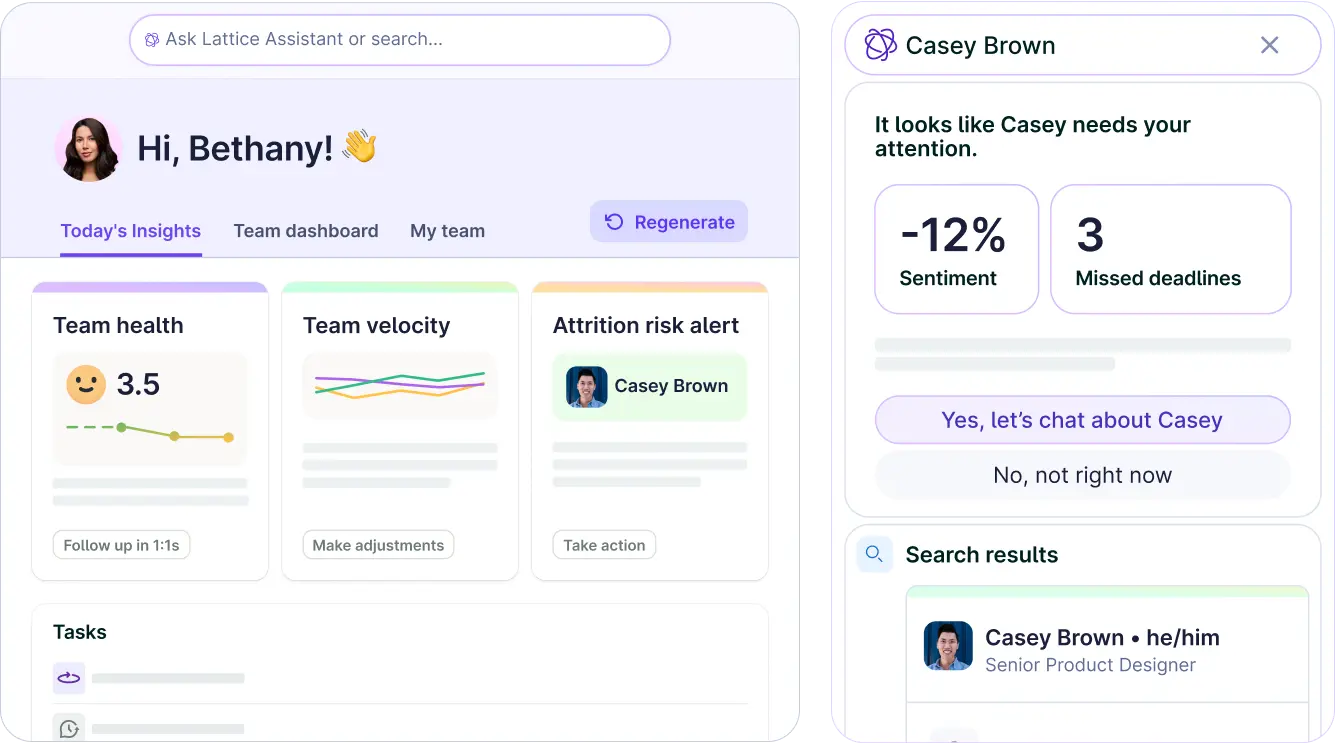
A single tool can go a long way in building an inclusive environment. For instance, Lattice provides managers with an AI-powered, unified, and data-driven platform with dashboards that managers can use to monitor their direct reports’ individual employee journeys.
For managers with large or remote teams, this ensures very little slips through the cracks. Plus, having current, accurate, and sophisticated data on demand supports objectivity and reduces the chances of unconscious bias creeping in.
7. Operationalize DEIB across the employee life cycle.
Rather than stowing DEIB programs away in separate ‘diversity’ buckets, embed equity work into business functions. Here are some economical ideas classified according to each stage of the employee life cycle:
Recruitment
- Expand your talent pool. List your jobs on diversity-focused job boards and partner with professional associations for underrepresented groups like veterans, returning parents, and people with disabilities. Frame this as broad outreach and barrier removal, without tying these efforts to preferences or quotas.
- Keep AI‑assisted hiring accountable. AI is prone to prejudice, too. If software screens résumés or ranks candidates, ask vendors for bias‑testing results, determine how humans can override decisions, and keep those records. Consider conducting an annual independent bias audit.
Onboarding
- Pair new hires with cultural ambassadors or mentors who can guide them during the onboarding process and help them navigate the written and unwritten rules of your work environment. Match them based on specific career aspirations, like lateral mobility or leadership development.
- Update the employee handbook. Make sure to include all the information that a recruit will need throughout their employee journey. Include information like:
- Anti-discrimination policies covering examples, bystander options, and how to seek help
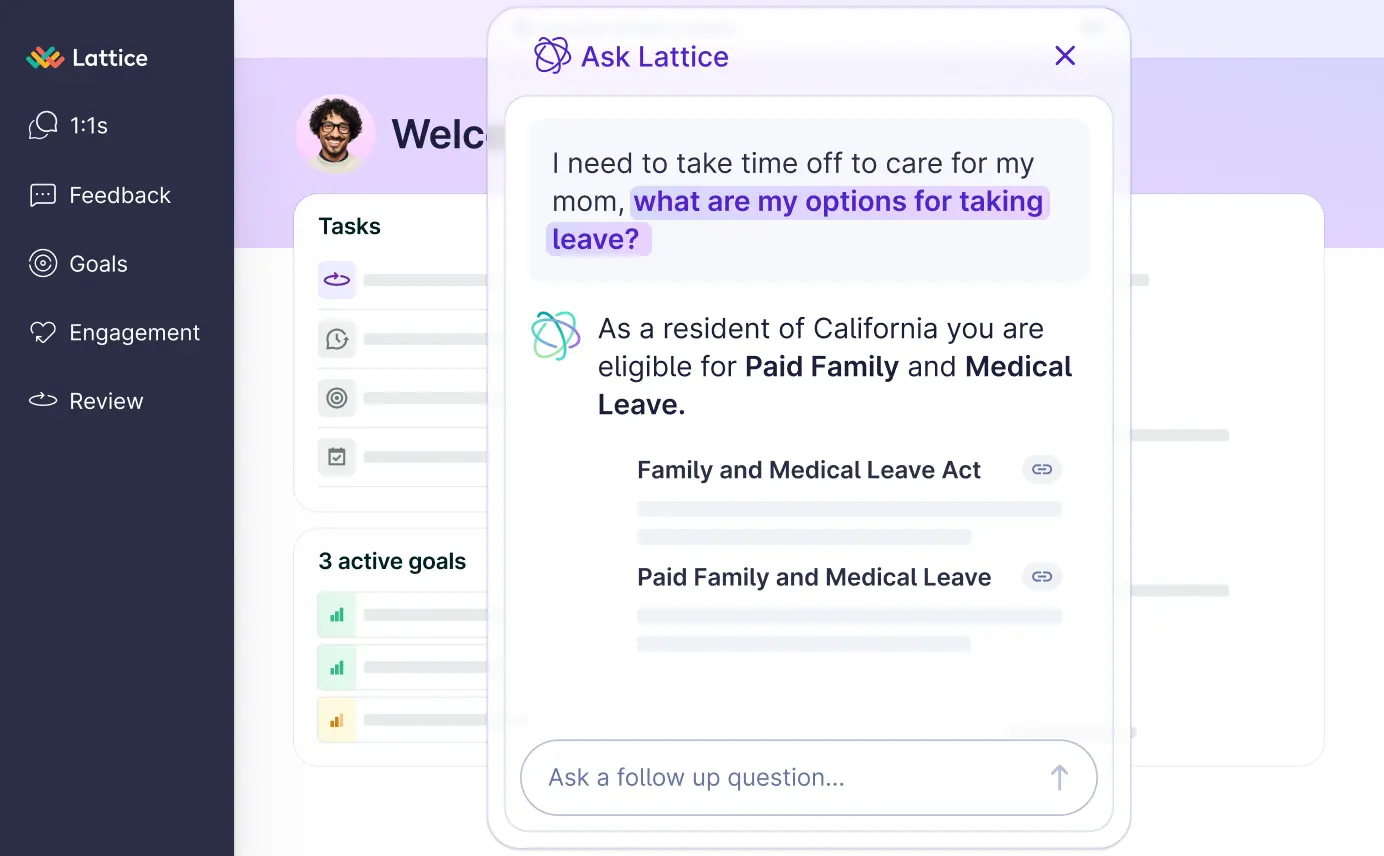
- Leave policies, including entitlements under the Family and Medical Leave Act (FMLA), and how to request time off
- Ways to request assistive technology, accommodations, and flexible work policies for employees with disabilities
Growth and Development
- Create visible and transparent application processes for stretch assignments and leadership development programs, establishing clear criteria for selection. Then, track who gets these career-accelerating experiences, intervening if patterns show inequity.
- Calibrate every performance review cycle. When independent performance reviews are complete, bring managers and people teams together to review, compare, and align employee ratings across teams or departments. When running calibration meetings, use structured agendas, precise role definitions, and documented standards to avoid introducing new biases. After each cycle, check for patterns that might indicate unfair outcomes and adjust the process if needed.
Engagement and Recognition
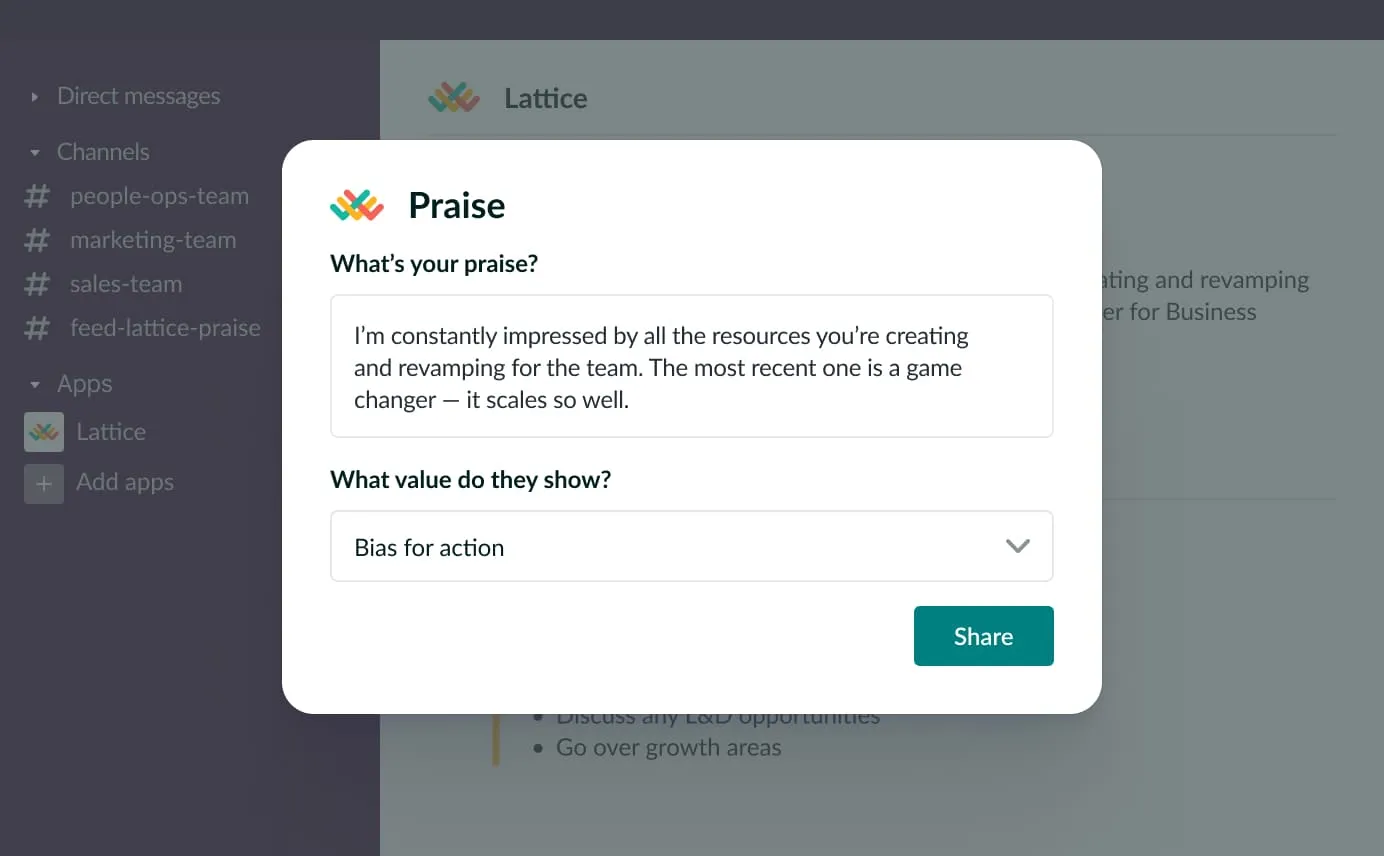
- Recognize inclusive behaviors. Encourage small, immediate acknowledgments (notes or short mentions in team meetings) for clearly defined achievements to boost engagement at low cost. You can even use a tool like Lattice Praise to integrate organic, natural shoutouts on Slack and Microsoft Teams. Praise allows you to highlight company values in your feedback. You can choose to list inclusive behavior as a value here.
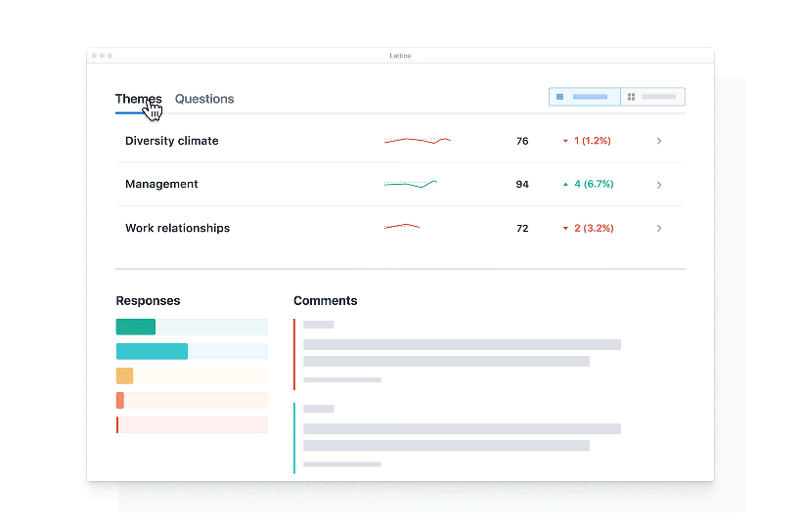
- Administer regular DEIB surveys through anonymized pulse checks, with items addressing DEIB practices, inclusion, belonging, manager support, fairness, transparency, and respect. Lattice Engagement will alert you as soon as your survey results are in by providing AI-generated insights you can act on immediately. To minimize legal exposure, ensure DEIB survey participation is voluntary and the questions are thoroughly vetted for objectivity. You might also consider stating anti‑retaliation protections in survey invitations and follow‑ups.
Compensation
- Disclose pay ranges. A growing number of states are mandating pay transparency, and employees have a federally protected right to discuss wages and other terms and conditions of employment with coworkers. To comply and remain accountable to your employees, include pay range and benefits in every job posting and ensure recruiters carry the same information.
- Leverage leading market benchmarks, analytics, and performance insights to build compensation bands and guide adjustments. Lattice Compensation gives you one-click access to this data, saving you hours on research. It also makes it easier to conduct annual pay equity audits, examining not just base salary but also bonuses, stock grants, and other compensation elements.
{{rich-highlight-1}}
Create an inclusive workplace with Lattice.
It’s not over for DEIB. Yes, the landscape is more complex. Yes, the stakes are higher. However, organizations that rise courageously and creatively to meet this moment will be the ones that thrive.
Ready to build a more inclusive workplace? Learn how Lattice can help you embed DEIB into the employee experience — from performance management and engagement to professional development and compensation — by scheduling a demo.

🌟 Hear from the experts.
For further perspective, catch the webinar replay of What’s Next for DEIB? from Lattiverse to learn from experts on the cutting edge of DEIB.