

The interplay of AI and professional development is on our minds more than ever. We’re wondering: How can I ensure my relevance in the future job market? How will AI change the labor force? And — if we’re honest — will AI take my job?
But, as Karim Lakhani said in an interview with Harvard Business Review, “AI is not going to replace humans, but humans with AI are going to replace humans without AI.” This sentiment should be our guiding light — including when it comes to professional development. By analyzing skills, surfacing opportunities, and offering personalized recommendations, AI will help employees and managers create smarter, more dynamic development plans that actually lead to career advancement.
Below, we dive into the importance of professional development, how to set effective goals with the help of AI, and how managers and HR teams can support employees to make continuous growth a reality.
{{rich-takeaway}}
What are professional development goals?
Professional development goals are the bridge between where employees are currently and where they would like to be. They are central to personal growth, skill development, and career aspirations — not just short-term performance metrics.
Unlike day-to-day business objectives, these more overarching, often long-term goals help employees expand their skill sets, build core competencies, and develop the confidence to pursue new challenges — traits that may be more important than ever.
The more deeply we integrate [AI]...the more indispensable human skills become.
“As generative AI becomes more ubiquitous, a paradox has emerged: The more deeply we integrate the technology into our workflows, the more indispensable human skills become,” according to the authors of a 2025 Harvard Business Review article. In practice, that means doubling down on the competencies AI can’t replicate — like adaptability, emotional intelligence, and interpersonal skills — the same competencies that underpin lasting professional growth.
Some common categories of professional development goals include:
- Skills acquisition: Mastering a new proficiency, software, programming language, et cetera
- Career progression: Aiming to secure a promotion, raise, or a lateral move into a different department
- Leadership development: Improving your ability to manage and lead people and teams
- Role-specific mastery: Becoming proficient in a skill, process, or competency that’s required for success in your position
Find the Sweet Spot: Aligning Development Goals With Business Needs
Professional development goals are most effective when they exist at the intersection of employee motivation and organizational need.
When an employee focuses on new skills that drive personal development and support business priorities, everyone wins. For example:
- A marketing manager improving data analysis and communication skills helps the team make more informed campaign decisions.
- An engineer working on leadership skills and time management builds readiness to mentor others and scale team productivity.
- A people operations leader focusing on mentorship and emotional intelligence builds a stronger feedback culture and models the kind of empathetic leadership that boosts retention.
- A sales associate developing adaptability and problem-solving skills becomes more effective at navigating shifting client needs and closing deals across different markets.
How Managers and HR Support Goal Setting and Growth
Managers and mentors play a crucial role in helping employees connect personal career goals to business outcomes. Informal check-ins, regular one-on-ones, and performance reviews should explore not only what’s currently working, but also where employees want to go next in their careers — and if it makes sense for them to go there.
HR has a role to play here, too. And not just in equipping managers with the tools and training required to facilitate fruitful conversations. HR also needs to ensure that every employee’s development plan ladders up to company strategy to help create a high-performing, future-ready workforce.
When employees get tailored feedback and a more precise action plan, they’re able to be more proactive in meeting their development goals.
This is where good employee development software comes in. Lattice Grow gives HR teams and managers a shared, structured development workspace. You can map competencies by role and level, co-create an individual development plan with SMART goals and time-bound milestones, attach learning resources (like online courses and certifications), and keep everything visible in one-on-ones and performance reviews. And because goals, progress notes, and feedback live together, managers can spot patterns across team members, support mentorship at scale, and ensure development drives toward business goals.
HR teams and managers should:
- Hold development-focused check-ins. Use regular one-on-ones to discuss progress toward goals, upcoming milestones, and where additional support might be needed.
- Encourage ongoing learning. Offer access to training programs, certifications, or online courses to help employees meet their goals.
- Help employees build confidence through exposure. Encourage participation in networking events, seminars, or cross-departmental projects to practice public speaking, grow visibility, and build a stronger professional network.
- Recognize initiative and give praise. Publicly celebrate when team members take ownership of their career development and reach milestones.
- Make feedback developmental, not judgmental. Offer constructive feedback that helps employees identify specific goals and the metrics that show progress, not negative observations or criticisms.
Tools like Lattice Grow simplify this process by embedding professional development plans into the flow of work — linking growth conversations directly with performance reviews, one-on-ones, and feedback. Managers can track milestones, document progress, and align future goals, all within one platform.
{{rich-highlight-1}}
The Role of AI in Modern Professional Development
Artificial intelligence is reshaping how organizations, HR teams, managers, and employees approach career development as AI tools allow a level of personalization and specificity not previously available at scale.
When employees get tailored feedback and a more precise action plan, they’re able to be more proactive in meeting their development goals.
Here are five ways AI can support the different stages of the professional development process.
1. Identifying Skill Gaps
AI can analyze performance reviews, feedback, and accomplishments to reveal patterns, like which technical skills could help an employee prepare for a promotion, or which soft skills could support them in their current role.
For example, an employee in a customer success role might receive AI-driven insights that improving time management skills and project management could support them on their path to team leadership.
2. Generating SMART Goals
SMART (specific, measurable, achievable, relevant, and time-bound) goals are one of the best professional development goal frameworks. SMART goals are so effective because their very format demands employees turn aspirations into structured, actionable commitments.
With AI, simply type in any goal with the prompt, “Help me make this a SMART goal. Ask me some questions so we can get started,” alongside the goal you have in mind. The chatbot will start a dialogue to discern more information and format the goal.
3. Offering Learning Recommendations
AI goes beyond identifying gaps to connect employees to solutions. For example, AI might surface LinkedIn Learning courses, certifications, or mentorship opportunities that match the individual’s skill profile and their development goals.
4. Tracking Progress and Providing Accountability
AI-driven reminders and progress summaries keep managers and employees aligned. By highlighting achieved milestones or overdue goals, AI ensures momentum doesn’t fade between check-ins.
5. Empowering managers to better coach employees.
With AI, managers can get real-time prompts or insights that help guide development conversations to ensure they are as personalized and actionable as possible.
Within Lattice AI, these capabilities come together to support the full cycle of growth. The platform auto-suggests development goals, identifies relevant training programs, and integrates those goals into Lattice Grow, where employees and managers can refine them together.
Sample AI Prompts
As anyone who has experimented with AI since ChatGPT’s debut will tell you, LLMs are great for brainstorming. They don’t always get the output right, but they provide a great starting point.
Rather than racking your brain for another way to generate or phrase a goal, managers and employees alike should use AI to kickstart and refine the goal creation process.
{{rich-highlight-3}}
What to Avoid When Using AI for Professional Goals
People who regularly meet or accomplish goals are not superhuman or morally superior. They use tools to ensure steady progress and to create accountability.
When using AI to support employees’ professional goal setting, avoid:
- Setting vague goals: Broad goals like ‘improve leadership’ lack the clarity and direction to drive meaningful change. This is why SMART goals are so useful — by ensuring that a goal meets each of the five requirements, you build in the parameters required to support an employee’s forward momentum on that goal.
- Forgetting to follow up or track progress: Goals only stay top of mind if they are revisited. Build regular check-ins into employees’ professional development plans and encourage them to use AI chatbots to track their progress.
- Overwhelming employees with too many or irrelevant resources: AI’s data analysis capabilities and natural language processing can make its potential seem endless. But focus on just two or three achievable goals at a time for employees. Too many training programs, online courses, or learning paths can dilute impact.
- Entering sensitive information in AI chatbots: Avoid entering confidential data into an AI chatbot or relying on unvetted external AI tools. Platforms like Lattice AI ensure that data stays secure and that insights are grounded in verified performance information.
- Failing to equip managers with the right resources and competencies: AI alone won’t help employees meet their professional goals. Your workforce still needs the steady hand of managers to offer mentorship, guide progress, identify blind spots, and provide accountability. Make sure managers are up to speed on their own leadership skills and competencies so they can guide direct reports.
{{rich-highlight-2}}
How Lattice Can Help
There’s so much that goes into setting and managing professional goals — yes, managing multiple individual plans for employees, but also ensuring employees feel personally connected to what they’re aspiring to. While creating and maintaining professional development goals shouldn’t be complicated, it often is.
Lattice Grow and Lattice AI are here to change that.
- Lattice Grow lets employees and managers co-create individual development plans, set milestones, and review progress in real time.
- Lattice AI acts as a built-in development coach, suggesting new skills to learn, surfacing metrics that show progress, and recommending personalized learning paths.
- Integrated with one-on-ones and performance reviews, both tools keep career development at the heart of every conversation.
Together, they help organizations build a culture of continuous learning, ensuring every team member has a clear roadmap toward their career advancement — and the right tools to get there.
Emphasizing Development Benefits Everyone
Professional growth isn’t static — nor is it ever really strictly professional. Wrapped up in our developmental goals are our dreams and aspirations for our career, and therefore, life. On the organizational side, industries are constantly changing, so companies need employees equipped with the most up-to-date, relevant skills and competencies possible.
Helping employees more readily meet their professional goals is win-win — employees feel invested in and supported, and businesses get the human capital they need for success.
With Lattice Grow and Lattice AI, employees and managers can align on the right goals, track progress with confidence, and turn insights into action.
Whether employees are building leadership skills, pursuing a professional certification, or expanding their professional network, these tools empower them to move from intention to impact — and transform professional development from a task into a continuous journey of growth.
Request a demo to discover what’s possible with Lattice Grow and Lattice AI.

📖 Everything HR Needs to Get Started With AI
AI is changing how HR teams operate. This ebook cuts through the hype to show how real HR leaders are already using AI to supercharge performance and boost employee engagement.
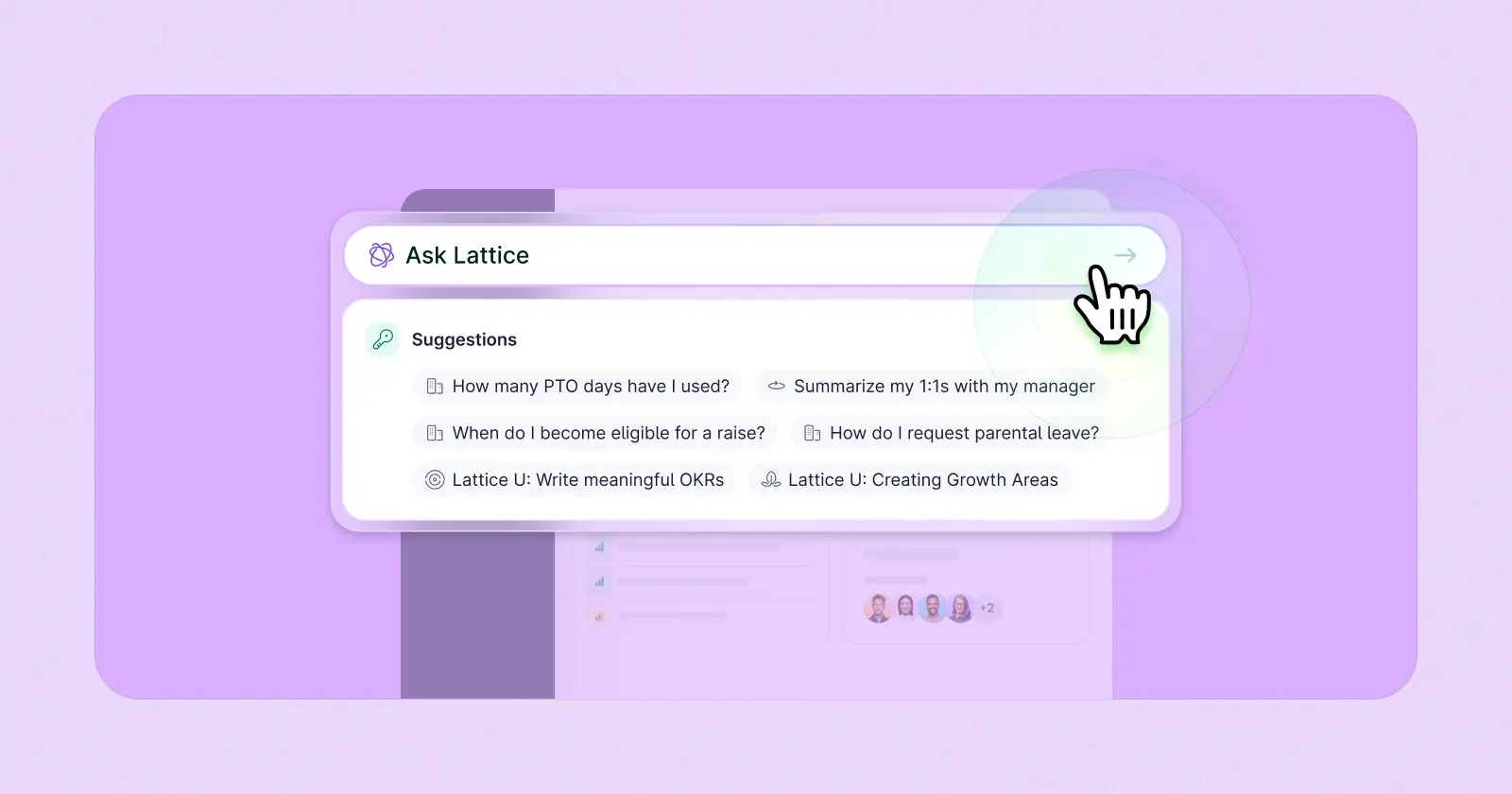
🕹️ Tour: AI That Promotes You, Not Replaces You
We built the Lattice AI Agent to empower everyone to get the most out of work. Check it out on your own time with our interactive tour.
Sample Prompts:
Here are a few prompts you can use directly in the Lattice AI Agent or other tools to kick off your professional development plan.
- Based on recent feedback, what are one or two development goals I should focus on this quarter?
- What skills do I need to grow to become a senior [job title] within the next year?
- What are examples of stretch goals for a mid-level product manager looking to move into leadership?
- How can I tie my career growth goals to our company’s current business priorities?
- Suggest one long-term and one short-term goal based on my role and recent performance review.
- How can I improve my decision-making and prioritization skills to enhance my overall job performance?
- Which industry trends should I focus on to stay competitive in my field over the next [timeframe]?
- What are measurable goals that could help me grow as a thought leader within my department and share new ideas more confidently?
- How can I set development goals that improve job satisfaction and support retention across my team’s work environment?
Key Takeaways:
- The most effective professional development goals sit at the intersection of employee motivation and organizational need.
- AI can kickstart employee goal setting by surfacing insights, analyzing performance, and ensuring goals meet both organizational and individual needs.
- Employees need frequent check-ins and feedback, which can be augmented by AI but should be driven by leadership.
- The best tech solutions simplify development planning for people teams by supporting scalable, personalized employee development.