There's a question that keeps coming up in HR leadership circles, usually around budget season or after someone's third frustrating integration call of the week: "Should we just consolidate everything into one platform?"
It's a fair question. Managing a sprawling collection of HR tools, each with its own login, its own data model, its own customer success rep who emails you too much, can feel like herding cats. But the alternative, cramming all your people programs into a single platform that does everything adequately and nothing brilliantly, has its own costs. Costs that are harder to see on a spreadsheet, but very easy to feel in your engagement scores.
The good news? You don't actually have to choose between simplicity and impact. But to understand why, it helps to first understand what we're really talking about when we talk about "consolidating" versus "specializing" your HR tech stack.
What We Mean When We Say 'Consolidate'
A consolidated HR stack traditionally means leaning on one vendor for most (or all) of your HR functions — payroll, benefits, recruiting, performance, learning, you name it. The appeal is real: one contract, one data source of truth, one vendor to call when things break.
Specialized stacks take the opposite approach. Instead of one vendor doing everything, you pick the best tool for each job: a dedicated platform for performance and engagement, another for recruiting, another for payroll. You then stitch them together.
The goal isn't fewer tools or more tools. It's making sure employees and managers have a seamless experience.
Most organizations live somewhere in between. They have a core system of record (an HRIS like Workday, BambooHR, or ADP) handling the administrative stuff, and then a mix of point solutions layered on top for things like performance reviews, pulse surveys, and learning. It works, mostly. But the friction points are real.
Here's a more useful framing than consolidate vs. specialize: consolidation of experience vs. specialization of capability. The goal isn't fewer tools or more tools. It's making sure employees and managers have a seamless experience, even if that experience is powered by multiple best-in-class systems under the hood.
The Honest Tradeoffs
Neither path is without tradeoffs. The real question is: which tradeoffs are you willing to live with, and which ones quietly undermine the things you're trying to build?
What the Data Actually Says
Here's where things get interesting. The instinct to cut tools in a tight budget environment is understandable. But the evidence suggests it might be exactly the wrong move — at least when it comes to people tools.
According to Lattice's 2026 State of People Strategy Report, 55% of HR teams are currently facing tech cutbacks. But look at what high-performing HR teams are actually doing, and what dedicated solutions they prefer to invest in:
72% of high-performing HR teams use four or more tools. And top-performing teams use six or more at double the rate of average teams. The conclusion isn't that more tools are automatically better; it's that the best HR organizations are thoughtful about using the right tools for the right jobs and have figured out how to connect them in a way that creates leverage rather than chaos.
Listen to the report's lead producer, Halah Flynn, discuss these findings with Rana Robillard, Tekion's chief people officer, below.
The Employee Experience Problem Nobody Talks About Enough
Here's what often gets lost in the consolidate-vs-specialize debate: the conversation is usually framed around what's convenient for HR and IT. Fewer vendors. Less admin. Easier audits. All valid. But what about the experience on the other side?
Employees experience a fragmented tech stack as friction, and it shows up in predictable ways:
This matters more than most HR tech discussions give it credit for. Shallow tools don't just create operational headaches, they actively undermine the programs you're trying to run. A performance review process that employees find cumbersome and opaque will produce worse outcomes than no process at all, because at least a missing process doesn't actively build resentment.
The real opportunity is to unify the experience across the moments that matter most: giving and receiving feedback, having growth conversations, understanding where you stand, and recognizing your team. When those moments feel connected and intentional — when a manager can pull up someone's feedback history, development goals, and recent wins all in one place — that's when people programs start to actually change behavior.
Why Performance, Engagement, and Development Are Different
Not all HR functions are created equal when it comes to the build-vs-buy question. Payroll, benefits administration, compliance tracking — these are important, but they're largely table stakes. You need them to work reliably. You don't necessarily need them to be brilliant.
Performance, engagement, and development are different. These functions sit at the intersection of business strategy and human behavior, and the quality of the tools you use has a direct and measurable impact on your ability to retain talent, develop leaders, and build a high-performance culture.
Breadth and depth are not the same thing. In people programs, depth is what drives outcomes.
Many large HCM platforms offer these capabilities. And to their credit, the functionality has improved. But there's a meaningful difference between "we have a performance module" and "we have a performance platform that managers actually use, that surfaces meaningful insights, and that employees feel makes their work lives better."
Breadth and depth are not the same thing. In people programs, depth is what drives outcomes. If you choose a consolidated platform that offers performance and engagement as secondary features, you may be trading real business impact (retention, productivity, manager effectiveness) for the convenience of a single vendor. That's a legitimate choice to make. Just make it with your eyes open.
The Modern Approach: Integrate, Don't Replace
Here's where the conversation shifts from "either/or" to "yes, and."
You don't have to choose between your system of record and a best-in-class people platform. Modern integrations have made it entirely possible (and increasingly common) to keep Workday or BambooHR or ADP doing what they do well while adding a specialized layer for performance, engagement, and development on top.

Read the Lattice + Workday Ebook
This is exactly how Lattice is designed to work. It integrates with your HRIS — syncing employee data, respecting your existing org structure, sitting on top of your core system in a way that enhances the experience without disrupting what's already working. Lattice connects with:
- Workday, ADP, Gusto, and BambooHR for core HR data
- Greenhouse and other ATS tools for recruiting
- Slack, Teams, and the tools your people already live in
Think of it like this: a company using Workday for core HR data adds Lattice to power its performance cycles, engagement surveys, one-on-ones, and development planning. Employees and managers interact with Lattice for the people stuff, while the data flows back to Workday where it needs to. The result is stronger employee outcomes — without an eighteen-month rip-and-replace project.
The principle is simple: Keep what works. Add what's missing.
How AI Changes the Calculus
There's one more factor reshaping this conversation right now, and it's big enough to deserve its own section: AI.
AI is being embedded into HR platforms at a remarkable pace. And the promise is genuinely exciting: smarter feedback summaries, personalized development recommendations, early warning signals on engagement risk, automated insights from performance trends. But there's a catch that not enough people are talking about: AI is only as powerful as the data and workflows behind it.
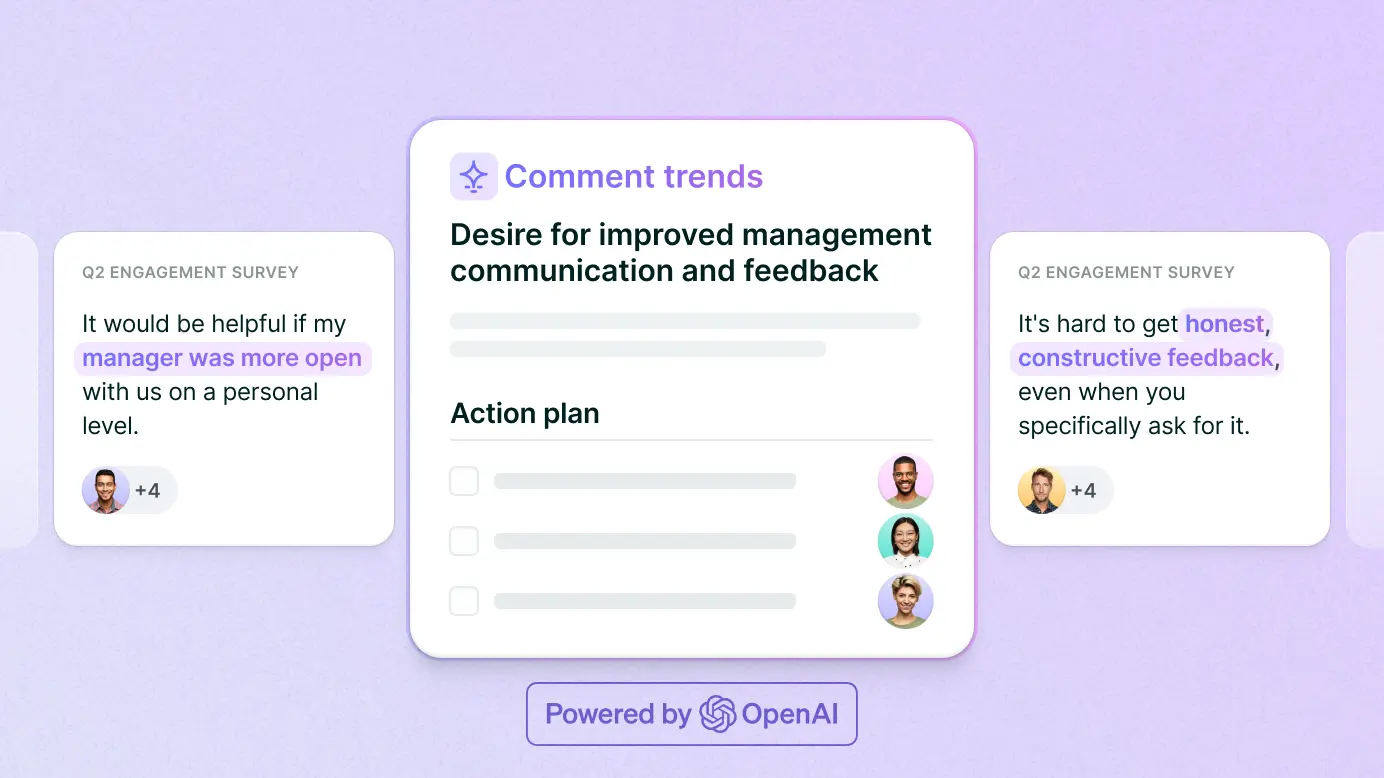
Shallow tools produce shallow insights. If your performance data consists of annual ratings and a few comments typed in at the end of the year, your AI layer doesn't have much to work with. The output will be generic, unreliable, or both.
Lattice AI is built differently — embedded across performance, engagement, and development workflows designed to capture rich, ongoing signals throughout the year. When an AI system has access to a manager's history of one-on-one notes, a pattern of peer feedback, an employee's stated development goals, and engagement survey responses over time, it can surface insights that are actually actionable. Specifically, that means:
- Smarter feedback summaries that go beyond "great job" to surface patterns
- Personalized development recommendations grounded in actual goals
- Performance trend visibility that helps managers act before problems compound
- Engagement signals that flag risk early — not in the exit interview
The implication for stack strategy: If AI outcomes matter to you (and they should), depth isn't optional. Shallow data in, shallow insights out. The quality of your people tools is now directly connected to the quality of your AI outputs.
Building a Stack That Can Evolve
One of the underappreciated virtues of a modular approach is adaptability. HR strategies evolve. What your organization needs from its people programs today may look quite different in two or three years — new business priorities, new workforce demographics, new expectations from employees about what good management looks like.
Locking yourself into a monolithic platform because it's simpler today can make it harder to adapt tomorrow. Lattice is designed with modular adoption in mind. Organizations can start with what they need most urgently (often performance or engagement) and expand into compensation, development planning, and people analytics as their strategy matures. The system scales with you.
Here's a practical comparison of what this looks like across different approaches:
No approach is perfect. But for organizations that care about people outcomes and want to preserve flexibility as their strategy evolves, the integrated model offers the best of both worlds, without the downside of starting from scratch.
The Bottom Line
The consolidate vs. specialize framing has always been a bit of a false choice. What HR leaders actually need isn't fewer tools or more tools — it's the right tools, connected in a way that creates a coherent experience for employees and managers and generates data that's rich enough to power real insight.
Performance, engagement, and development aren't features to check off a list. They're the core of how organizations build cultures that attract, retain, and develop people. They deserve tools built specifically for them, not modules grafted onto an administrative platform.
You don't have to blow up your existing stack to get there. Keep the systems that are working. Add what's missing. Connect them deliberately. And make sure that whatever you add is deep enough to actually change outcomes — not just deep enough to make it past the procurement checklist.
Your people programs are worth more than good enough. Your tech stack should be too.
{{rich-highlight-1}}
Ready to see what this looks like in practice?
Schedule a demo to explore how Lattice adds a high-impact performance, engagement, and development layer to your existing HR tech stack, without disrupting what's already working.