
Growing companies have plenty to celebrate. But when it comes to managing a workforce, scaling also brings strain, especially when human resource management relies on manual systems or Google Sheets.
Without standardized talent management practices, workforce challenges can escalate quickly, and opportunities to make a strategic difference for the organization get lost. Comprehensive talent management tools, on the other hand, can nurture best HR processes and practices, provide analytics that drive smart workforce decisions, and ensure employees remain engaged and motivated.
This guide explains what talent management tools are, reviews eight top options for employers, and shares how employee management solutions support growth and build a strong organizational culture.
Talent Management Tool Basics
Talent management tools vary widely in scope and function, but their primary objective is to track employee performance and nurture their growth. Robust tools also deliver the metrics and workflows that leaders need to build high-performing teams, retain top talent, and ultimately reduce the high cost of turnover.
A comprehensive talent management solution that covers those bases often offers:
- Performance tools with ongoing tracking and structured review workflows
- Templates to standardize one-on-ones, developmental plans, 360-degree reviews, and other performance management processes
- Employee engagement tools such as pulse surveys and sentiment tracking to monitor employee satisfaction
- Manager enablement solutions that provide frameworks for one-on-ones and real-time feedback and praise
- Learning and development opportunities to assess skills, map out growth opportunities, and enable upskilling
- Compensation analysis to plan and scale employee pay strategically
- Goal setting to help set objectives and key results (OKRs) and monitor progress
Some talent management platforms may only offer one or several of these capabilities. But the ideal choice is a talent management tool that integrates all of them and is enhanced with the power of artificial intelligence for HR teams.
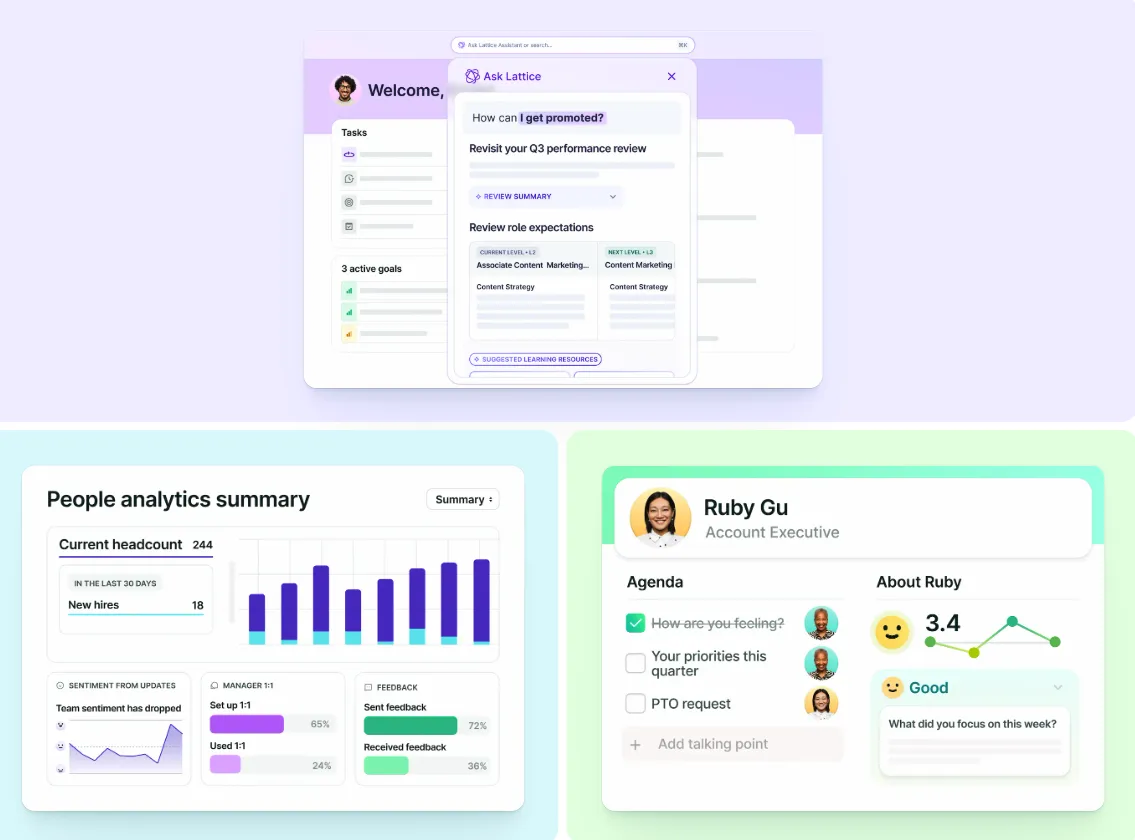
Lattice delivers exactly that for HR departments. Designed for growing organizations, Lattice’s Talent Suite combines comprehensive talent management capabilities with AI-powered analytics — from personalized growth plans to insights from survey data. With it, leaders and managers gain actionable insights to make strategic, data-driven decisions that future-proof the business.
When the right tool is deployed, the return on investment (ROI) is measurable. At Huge, a global design and technology company, the organization saved 2,000 hours by transforming its feedback practices with Lattice.
“We wanted to create the most efficient and effective system for growth and feedback,” said J.D. Slaughter, Huge group vice president, organizational development and effectiveness. “Lattice helps us remove unnecessary feedback burdens while making sure managers engage in meaningful conversations that drive impact.”
8 Top Talent Management Tools
Not all talent management tools are created equal. Every option brings its own strengths and tradeoffs, and cost is a major consideration for organizations. A standard pricing model for HR software solutions is a per-employee, per-month (PEPM) subscription fee.
Here are eight talent management solutions, each suited for different workforce sizes, business goals, and organizational needs.
1. Lattice
Lattice provides a unified platform that merges foundational HR systems with AI-powered talent management tools, including solutions that support employee growth, engagement, wellbeing, and goal setting. With detailed analytics and insights from across its solutions, Lattice helps leaders make strategic decisions to future-proof their businesses. Reach out now for a demo.
Pricing: Starts at $11 PEPM
Capterra Rating: 4.5 out of 5
G2 Rating: 4.7 out of 5
Pros and cons, according to G2 raters:
✅ Pros: Easy to use with intuitive and effective goal tracking and one-on-one management
⛔️ Cons: Mobile app could use improvements
Best for: Small, mid-sized, and enterprise organizations
2. Namely
A human capital management (HCM) solution, Namely includes talent management capabilities such as goal tracking, performance reviews, competency mapping, continuous feedback, and learning and development.
Pricing: Starting at $9 PEPM
Capterra Rating: 4.2 out of 5
G2 Rating: 3.9 out of 5
Pros and cons, according to G2 raters:
✅ Pros: Easy to implement and use
⛔️ Cons: Poor customer support and limited features
Best for: Small to mid-sized organizations
3. BambooHR
BambooHR combines HR functions, including employee experience and performance management, into a centralized system. Users can track goals, one-on-ones, create custom review cycles, and monitor employee engagement.
Pricing: Starts at $10 PEPM
Capterra Rating: 4.6 out of 5
G2 Rating: 4.4 out of 5
Pros and cons, according to G2 raters:
✅ Pros: Easy to use
⛔️ Cons: Limited features and customization
Best for: Small to mid-sized organizations
4. Rippling
Rippling, an all-in-one HR platform, includes performance management, learning management, and headcount planning solutions, along with other functions.
Pricing: $40 base/month + ~$8 PEPM minimum
Capterra Rating: 4.9 out of 5
G2 Rating: 4.8 out of 5
Pros and cons, according to G2 raters:
✅ Pros: User-friendly design and intuitive interface
⛔️ Cons: Missing features; steep learning curve required
Best for: Small to mid-sized organizations
5. Deel
An all-in-one platform for HR operations, Deel includes feedback capabilities, career development mapping, a learning management system, and employee surveys.
Pricing: $20 PEPM for Deel Engage
Capterra Rating: 4.8 out of 5
G2 Rating: 4.8 out of 5
Pros and cons, according to G2 raters:
✅ Pros: Easy to use and convenient
⛔️ Cons: High fees for international transactions
Best for: Global teams
6. HiBob
HiBob offers performance management and people analytics capabilities, including review cycles, goal setting, one-on-ones, and workforce reporting and key performance indicators (KPIs).
Pricing: $16–$25 PEPM
Capterra Rating: 4.6 out of 5
G2 Rating: 4.5 out of 5
Pros and cons, according to G2 raters:
✅ Pros: Intuitive interface with helpful reminders
⛔️ Cons: Missing features, limited customization, integration issues
Best for: Mid-sized organizations
7. Workday HCM
Workday HCM, part of Workday’s product suite, provides talent optimization capabilities, including performance enablement, goal management, and career and development planning.
Pricing: Contact vendor
Capterra Rating: 4.5 out of 5
G2 Rating: 4.1 out of 5
Pros and cons, according to G2 raters:
✅ Pros: Seamless integration and comprehensive features
⛔️ Cons: Learning curve required; somewhat limited customization.
Best for: Enterprise organizations
8. Personio
Personio’s platform includes performance and development capabilities, such as continuous feedback tools, goal setting, and employee development.
Pricing: $10–$14 PEPM (varies with add-ons)
Capterra Rating: 4.3 out of 5
G2 Rating: 4.4 out of 5
Pros and cons, according to G2 raters
✅ Pros: Intuitive, user-friendly, versatile
⛔️ Cons: Limited features and customization options
Best for: Small to mid-sized organizations
When to Invest in Talent Management Tools
The best time to invest in talent management software is when your company is ready for more structured, consistent processes around performance reviews, feedback, and employee development, said Shannon Curtis, a senior human resources business partner at HR consulting firm Employers Advantage.
“Even as a two-person company, a talent management tool can add value,” Curtis said. “Overall, it reiterates, as a company, your investment in the employee’s success.”
Early investment also establishes a culture of feedback and accountability and helps managers cultivate strong management habits. “When you’re just using paper forms, you forget the importance of talent management,” Curtis added. “You don’t have any external tool prompting you and reminding you that this is something you need to put attention toward.”
The tools become particularly valuable as companies scale, making it easier to spot internal talent, plan for succession, and manage skillsets across departments, said Kim-Adele Randall, CEO of consultancy Authentic Achievements. This is especially critical in small businesses and startups where employees wear multiple hats.
“Very often, people are learning to do lots of things in a startup that maybe they don't have on their CV,” Randall said. “You can keep track of that [in a talent management tool], so as you grow, you don't lose sight.”
Budget is important when evaluating any software solution, but don’t overlook the ROI of HR solutions. A commissioned Forrester Consulting study found that Lattice’s software boasts a 3-month payback period and delivers a 195% ROI, including $2 million in savings from reduced employee attrition.
For some Lattice customers, the impact even extends to revenue. At USAirtours, a holiday business, sales increased 20% year-on-year after deploying Lattice. “We haven’t changed our pricing or marketing, so this must be attributable to our investment in Lattice and how it’s empowering our people towards even greater levels of performance and productivity,” explained Guy Novik, USAirtours chief people officer.
8 Things to Consider Before Choosing Your HR Software
As you evaluate different talent management platforms, consider how tools can best support the short-term and long-term growth and development of your workforce. Here’s how eight features and functions in a talent management solution can help you better support your workforce.
1. Scalability
If your growth strategy includes employee expansions or increased workforce complexity, such as multi-state operations or international teams, ensure the platform you choose can scale to support those plans and needs. “If your company grows, can this tool grow with you?” asked LaShawn Davis, founder of HR consultancy The HR Plug.
2. Integrations
What does your existing HR tech stack and other business-critical software tools consist of, and does this tool easily connect with them? Those HR tools can include payroll software, applicant tracking systems, recruitment software, employee onboarding process and benefits administration solutions, and digital timesheets and other virtual time-tracking tools.
Before buying HR software, pull in your IT team, HR professionals, and future users to ensure the new tool integrates with those essential systems, Davis recommended.
{{rich-highlight-2}}
3. Analytics and Insights
Does the tool deliver the kind of actionable, data-driven insights that will inform how you support your employees? Before investing in a solution, think critically about the talent challenges your company is facing, Curtis advised. For example, if you need to understand why certain managers or teams outperform others, you may need a talent management system with robust survey capabilities and continuous feedback options.
4. Customization
Is the tool flexible enough to allow you to create custom-built workflows and processes to meet your company’s unique needs? “Can I create custom fields that are specific to my industry and my organization? Can I create custom reporting? Does it offer branding opportunities?” Curtis asked.
5. Employee Development Plans
Does the tool include long-term development and career planning? Templates, in particular, can be helpful for employees unfamiliar with HR tasks, Curtis shared. “Guides, templates, samples, all of that is extraordinarily useful.”
6. Feedback Systems
Does the tool provide opportunities for real-time recognition and 360-degree feedback? Notifications and prompts that encourage timely reviews and praise are “essential,” Curtis said. “It just helps managers be more accountable for their individuals beyond just being task managers.”
7. AI Features
Does the solution offer AI features that help managers better understand their direct reports and drive performance? When evaluating AI features, first identify day-to-day, time-consuming tasks that could be automated to assess whether AI could streamline your workload, Davis advised. “Start where you are and see if it reduces that administrative work, but don’t replace human connection and empathy.”
8. Ease of Use
Is the user interface intuitive for all employees? Does it include a self-service dashboard where workers can access employee records, such as performance evaluations, and find templates for core HR and talent management practices, for example?
But be sure to consider your workforce, Davis advised. While office workers may be able to engage with platforms easily, employees on factory or warehouse floors without device access during the workday may struggle to participate. “You may need to invest in a training supervisor or training coordinators if you're really serious about enhancing technology for these users,” she said.
Standardize Your Processes and Strategize Your Growth with Lattice
With a comprehensive talent management platform, Lattice can grow alongside your business. It provides standardized workforce management processes to ensure fairness and protect against accusations of bias. Its AI-powered tools equip managers to drive team performance and productivity. And continuous feedback systems flag retention risks early and reduce turnover.
Across the workforce, Lattice’s detailed analytics give leaders the visibility needed for strategic planning. And its intuitive platform ensures high adoption rates, fostering a culture of connection across the organization.
“Lattice gives us a direct line to our employees to understand what's going well and what's not,” said Lattice user Sophie Martin, head of people at Sensat, a geospatial AI firm. “As a people team, Lattice’s tools and data empower us to prove why we need to take action on employee feedback to both our managers and leadership team.”
Ready to boost your talent policies and HR management processes like Sensat and Lattice’s thousands of other users? Schedule a Lattice demo today.
{{rich-highlight-1}}
This guide is for informational purposes only. Pricing for third-party vendors is based on publicly available sources, vendor websites, and/or estimates available at the time of publication and may vary by plan, contract terms, company size, region, or features. Prospective buyers should confirm current pricing directly. Review ratings and scores are sourced from review platforms and reflect user feedback at the time of inclusion.
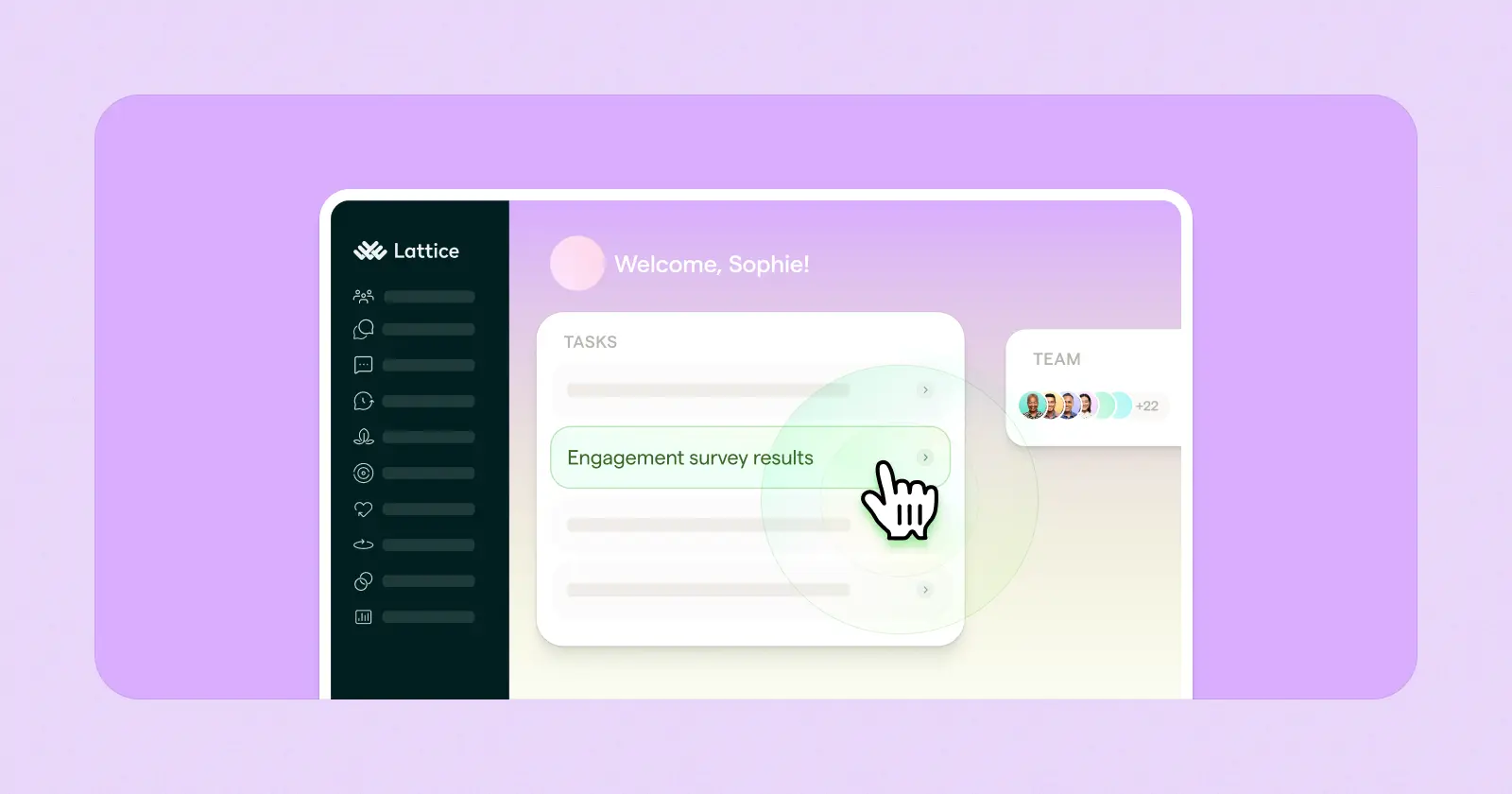
🔎 Test drive the Lattice Talent Suite.
Deciding on your HR Platform can be hard. That's why we've made evaluating Lattice easy. Check out our free, interactive tour.