

Artificial intelligence has quickly gone from a curiosity to a core part of many HR teams’ daily operations. Deployed with intention, AI tools for HR teams can turn talent and performance management from a back-office function into a strategic force across the organization, in part, by helping build the culture, habits, and governance required for AI to succeed across an enterprise.
According to Lattice’s 2027 State of People Strategy Report, 83% of human resources professionals are somewhat or very excited about the use of AI in HR, a notable jump from last year. As AI systems evolve, so do their potential benefits across the HR function. Early tools required people to enter prompts before generating content. Now, AI agents can act within HR workflows and platforms with less human intervention.
This article explores what AI agents are, what they can and can’t do for today’s HR teams, and how professionals are using them now.
What is an AI agent for HR?
An AI agent for HR operations is a software system that uses AI to gather and analyze data, make decisions, and take action to complete specific administrative tasks. Unlike older HR chatbots, which could respond to prompts, but not take action, AI agents can carry out tasks within defined workflows.
For example, a chatbot might generate a generic performance review template, while an AI agent can turn notes from one-on-one meetings into a first draft tailored to a specific employee before scheduling interviews for a 360-degree review. Similarly, a chatbot could list common reasons why employees leave, while an AI agent could analyze hiring and performance data to flag skills gaps, highlight turnover risks, and suggest strategic initiatives to address the issues.
Think of AI agents as digital assistants that are capable of handling repetitive HR tasks and can help with some strategic work. “It’s like having a smart, reliable teammate who doesn’t sleep,” said Faye Almeshaan, chief of staff and interim VP ops, tech, and partnerships at Co-Active Training Institute.
Agentic AI vs. Generative AI vs. Chatbots
To start, let’s clarify some common AI jargon:
These AI technologies may serve different HR functions, but they aren’t competing categories. They’re increasingly designed to work together, with each handling a different part of the job. For example, a manager might use a chatbot to check the organization’s parental leave policy, prompt a generative AI tool to draft a coverage plan for the employee’s absence, and assign an AI agent to update the work calendar.
What AI Agents Can Do for HR Teams Today
AI agents are already helping HR teams and managers save time on routine tasks and get ahead of potential issues. Across a manager’s daily work and the employee lifecycle, here’s what AI agents are doing now.
Answering employee questions at scale: HR teams often field the same questions on repeat. “How many days of PTO do I have left?” “When will I be eligible for a raise?” “How do I request parental leave?” An HR AI agent can answer these instantly, freeing up people teams to focus on the more complex issues that need a human touch.
Surfacing people insights: Spotting employee satisfaction and disengagement trends or retention issues isn’t easy, especially when managers lack the time or training to notice red flags. AI agents can analyze employee sentiment data, provide engagement insights, and flag issues before they escalate, helping managers and HR support employees and navigate complex employee dynamics.
Supporting performance and review cycles: Organizations gather a lot of data about employees through performance reviews, one-on-ones, and other formal and informal feedback conversations. During those meetings, the Lattice AI Agent can take notes and highlight potential action items, allowing leaders to stay fully present. On request, the Agent can then quickly add a one-on-one talking point, draft an update, surface data patterns, or request feedback through connected Lattice products.
Coaching managers through complex moments: Not every manager is equipped to navigate challenging employee dynamics or map out a direct report’s career development path. AI agents can summarize information from performance reviews, career tracks, and feedback to help managers create an individual development plan for each employee.
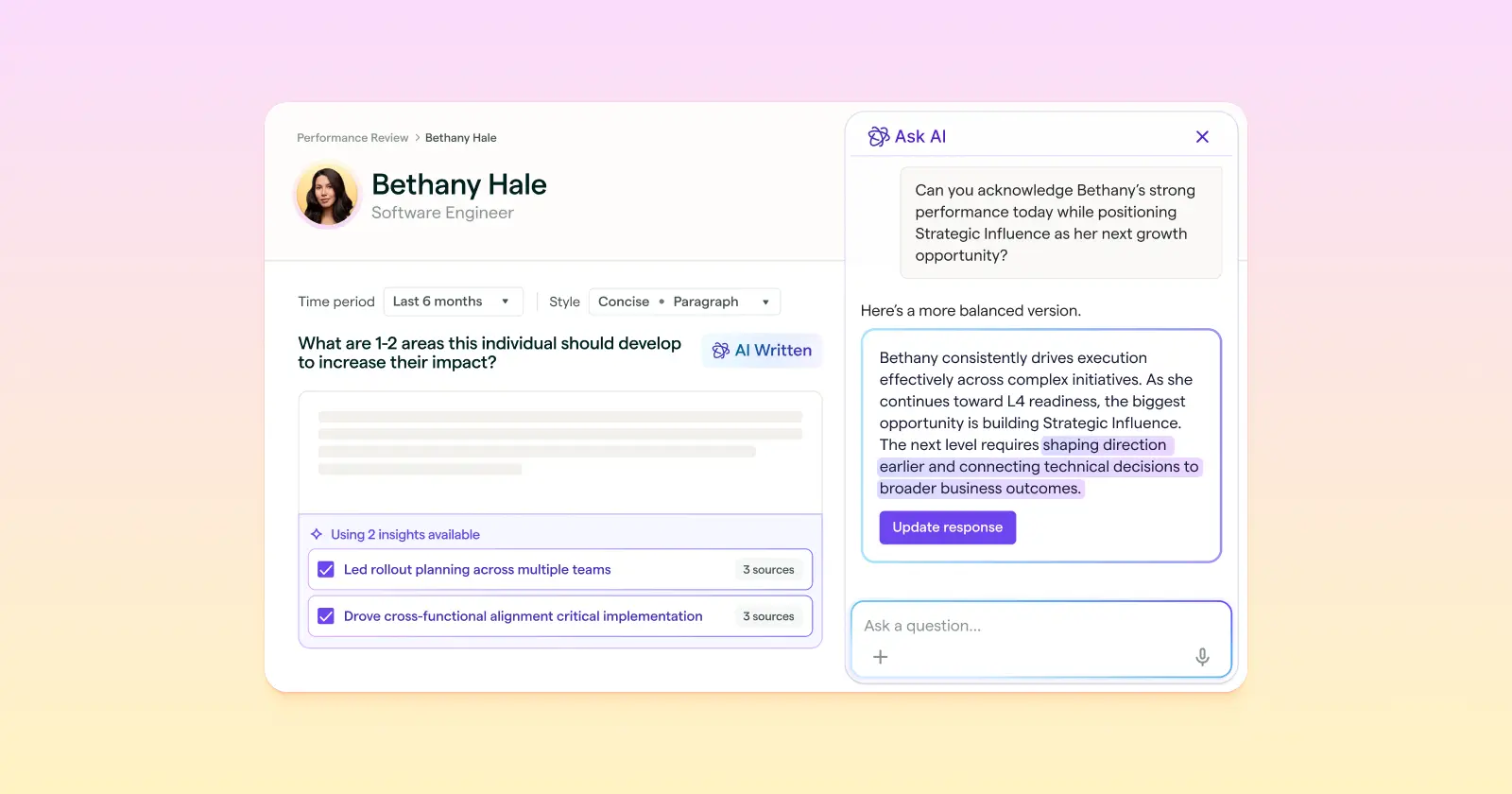
Making feedback easier to give and receive: Writing clear, fair, and actionable performance feedback can be challenging. Managers’ writing skills vary widely. AI agent features, such as Lattice Writing Assist, can help managers draft stronger performance reviews and recommendations. The Lattice AI Agent can also help managers provide more equitable feedback by identifying biased language patterns and ensuring they focus on a direct report’s documented work history, not personality traits.
What AI Agents Shouldn’t Do (Yet)
Not all HR processes should be outsourced to an AI agent. Difficult employee conversations and decision-making around hiring, firing, promotions, and pay require human judgment. In fact, several states have passed or are considering legislation that regulates how employers can use AI, including requiring humans to remain in the loop for some tasks.
Remember: Though it can handle some complex tasks, agentic AI is just a tool. “Just like we double-check Excel formulas, we need to validate what AI is doing before relying on it, especially in HR where decisions affect people’s lives and careers,” Almeshaan said.
AI agents can’t:
- Make HR management decisions. No matter how sophisticated, an AI tool shouldn’t have final say on hiring, firing, or promotions. Agents can make recommendations, but humans should make the ultimate call on decisions that affect employees.
- Handle sensitive matters. AI agents can make mistakes and miss the mark entirely. Don’t let them answer delicate questions or write reviews without carefully checking and editing their outputs.
- Deliver difficult news. AI agents should never communicate major changes or break bad news.
AI provides plenty of opportunity for HR departments to streamline time-consuming and repetitive tasks, said Jessica Donahue, a fractional HR consultant for venture-backed startups, but humans are better equipped to understand the context in sensitive situations, which won’t be intuitive to an AI tool. “There needs to be a human element.”
How HR Teams Are Actually Using AI Agents
According to our 2027 State of People Strategy Report, HR leaders are growing increasingly optimistic about agentic AI. Since 2025, the percentage of highly enthusiastic leaders climbed from 13% to 19%, while those reporting cautious optimism rose from 31% to 35%.
In organizations employing agentic AI, here are six ways AI agents are showing up across the employee lifecycle.
1. Answering Employee Questions
Employees come to HR daily with routine questions about time off, benefits, and company policies. AI agents can answer many of them instantly, reducing the burden on HR teams and eliminating employees’ wait for a return email or call. The Lattice AI Agent, for example, can answer policy and benefits questions grounded in company documents, such as an employee handbook or benefits information.
An AI agent can also help HR maintain that source material in the first place, including writing and updating job descriptions and employee handbooks. In a large company, that could add up to hours saved every week.
2. Supporting Performance Reviews and Feedback
AI agents take the most tedious parts of review cycles off managers’ plates, while keeping the judgment calls human. Summarizing meeting notes and polishing performance reviews are some of the more popular uses of AI in HR. In our people strategy survey, 74% of respondents said some or most managers are using AI to help write performance reviews. Nearly two-thirds (64%) agree that using AI in the review process improves quality and increases participation rates, and 76% said AI makes writing reviews faster.
That same capability extends to interviews and lengthy feedback notes. Instead of rewatching interviews or rereading pages of feedback, managers can use AI agents to find key information and act on it faster, drafting specific, consistent reviews and summarizing months of performance history so important details aren’t overlooked.
Tools like Lattice Writing Assist support this work, checking drafts for clarity and bias and suggesting talking points for one-on-ones based on recent feedback and goals.
3. Surfacing People Insights
AI agents turn scattered data from engagement surveys, feedback, one-on-one notes, and goal progress into insights that might otherwise go unnoticed. Agents can track employee engagement trends, flag burnout risk, sort job applications, and detect bias. In our survey, 65% of HR professionals said they are comfortable or very comfortable with managers using AI to identify potential bias in reviews.
Lattice Engagement Insights automatically gathers and analyzes employee data to detect trends such as early signs of attrition or burnout risk, giving managers an opportunity to address concerns earlier. It relies on natural language analytics, so users can ask questions in everyday language like “How does my team’s engagement compare to last quarter?” without needing to query through technical scripts or code.
4. Coaching Managers in the Flow of Work
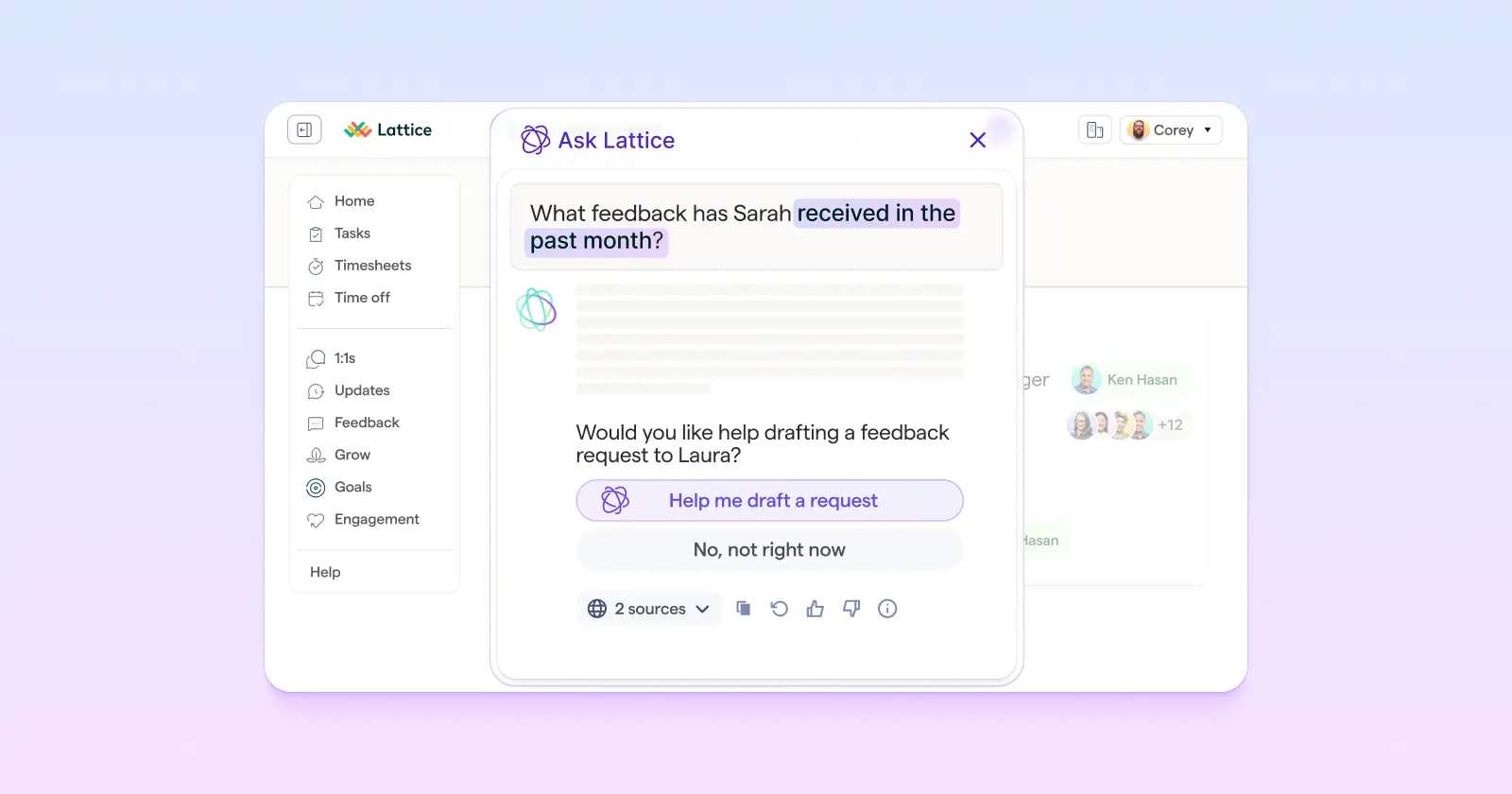
On-demand or reactive coaching takes place when a manager asks an AI agent a question and gets guidance on a particular issue, such as how to open a career conversation.
The full power of AI agents comes when they’re able to coach managers proactively, using context from past feedback, one-on-ones, goals, reviews, and growth areas. An AI agent can proactively flag feedback gaps, workload imbalances, or engagement concerns a manager might not have noticed on their own. From there, the AI agent can advise managers on next steps, such as specific questions to ask in an upcoming one-on-one.
During check-ins or one-on-ones, AI agents can generate meeting summaries and agenda items for the next conversation, so managers can focus on the discussion rather than taking notes. Built directly into Lattice 1:1s, the Lattice AI Agent combines these capabilities to help managers provide more consistent support.
5. Encouraging Employee Growth and Development
Too often, employee growth and development slip down the priority list amid daily demands. AI agents can help managers and HR teams identify growth opportunities and create more personalized development plans. AI can identify employees ready for a promotion, providing HR and managers with the relevant data as they make the final call.
Plus, for employees who aren’t quite sure where they’d like their career to take them, an AI agent can help map the path forward. In Lattice Grow, for example, the Lattice AI Agent powers Growth Areas, turning scattered feedback and performance history into a clear, personalized path that’s grounded in an employee’s actual performance history, not generic advice.
6. Taking Quick Actions Inside Workflows
Traditional software often requires switching between tools, copying and pasting information, or opening another screen just to complete a task. Agentic AI works differently. The entire process is embedded into the flow of work, not bolted on as a separate destination.
A manager might ask an agent to add a topic to a one-on-one, update a goal, or draft an agenda — all through natural language prompts, not complicated coding — without leaving the conversation. Less movement between different tools means fewer administrative steps and more time for managers to focus on their team.
What Responsible AI Adoption Looks Like for HR
Bringing agentic AI into HR isn’t just a technology decision — it’s a people decision. It might be tempting to conduct a sweeping audit of your tech stack, map every integration, and build a companywide rollout. But those big projects can stall, and the technology keeps moving.
Instead, start small. Choose a high-impact use case, get it right, and build from there. These four principles can help.
1. Start with data you can actually trust.
AI agents are only as useful as the information they pull from. Before adopting one, make sure the internal company information it will draw on is current and complete. This includes the tasks outlined in job descriptions, employee feedback history, and the workplace policies, employee benefits, and expectations spelled out in the employee handbook.
Ask yourself: If an employee asks about parental leave or the roles and responsibilities of their current job, how accurate and useful will the agent’s outputs be, given the data available to it? Starting with a single use case, such as answering routine employee questions based on your handbook, limits the amount of data you need to clean and update at the start.
2. Bring managers along early.
Managers will be using the tools daily and play a key role in encouraging their employees to adopt them. Get their buy-in before launching anything. Ask them what will make their jobs easier, show them what the agent can and can’t do, and give them the training so they can explain how it works to their direct reports.
3. Earn employee trust with transparency.
Some employees will be eager to embrace AI at work; others will be wary, particularly when it touches performance, pay, or promotion decisions. According to Stanford’s 2026 AI Index Report, 59% of respondents surveyed globally said AI products and services offer more benefits than drawbacks — though 52% said they also make them nervous.
“AI needs to build its trust with these workers,” said Ankur Ahlowalia, CEO of Chronus, a mentoring and connection platform. “If it comes across as this thing is not really helping me and it’s spying on me and it’s tracking me, that is not our objective. Our objective is development. It has to earn trust for the workers. It has to earn trust by the enterprise.”
Before any AI tool is launched, be transparent with your workforce about why you’re implementing it, what it will do, how it works, and how humans will always stay in the loop on critical decisions. “There need to be guardrails and expectations on how that information is used and what we use it for,” said Kimberly Prescott, founder and president of Prescott HR.
4. Measure what actually matters.
Saving managers hours on performance reviews is useful, but it’s only one metric of success. Track whether the agent’s outputs are accurate, whether employees and managers find it useful, and whether it will actually optimize the employee experience.
“It’s such a wild west where we’re just testing all the things,” said Rachel Ego, owner of and human resources director at Big Time HR, an HR consulting firm. “We’re trying all the different things right now, which is fine. But that’s where that final step of measurement, or reviewing the results, is so important.”
Meet the Lattice AI Agent.
AI should make work more human, not less. That’s the guiding principle behind the Lattice AI Agent, designed to help employees and HR teams alike spend more time on the work that matters. Built with responsible AI principles like transparency, empathy, and accountability, the Agent is carefully evolving to support people-first organizations.
Unlike a standalone AI search tool bolted onto your HR stack, the Lattice AI Agent is embedded directly across the entire suite of Lattice products. It shows up inside the workflows managers already run — one-on-ones, weekly updates, goal check-ins, and feedback requests — delivering the right nudge exactly when it’s needed.
The Agent handles:
- One-on-one summaries: Automatically generate summaries of one-on-one meetings, so you get reliable, detailed updates.
- People and engagement insights: Spot patterns across teams or individuals, synthesize survey results and open-ended feedback, and monitor sentiment trends with recommendations to improve participation, reduce attrition, and inform your next talent management strategy.
- Workload and capacity insights: Analyze employee updates to ensure work is fairly distributed and nip burnout in the bud.
- Engagement insights: Pull together survey results and open-ended feedback, and then benefit from automated employee data analysis and recommendations.
- Performance review and feedback assistance: Help people write performance reviews more efficiently, with real-time recommendations for grammar, clarity, and bias reduction.
- Self-service answers to common HR questions: Employees and managers get instant answers — like how to request time off or find performance reviews — without waiting on HR.
Get more out of Lattice with our Agent.
The Lattice AI Agent is transforming how HR teams, managers, and direct reports support each other and their organizations. When employees have questions, the Agent can answer them in real time, drawing on information from company intranets, documents, and knowledge bases. When managers evaluate and coach their employees, the Agent can streamline the work of drafting reviews, growth plans, and other feedback.
And, freed from some busywork and time-consuming administrative tasks, HR teams can focus on driving performance, shaping the company culture and workforce, and making data-backed, informed decisions that fuel business success.
Curious how it can work for you? Check out the Lattice AI Agent in action.
FAQs:
How is an AI agent different from the HR chatbots we’ve had for years?
Traditional chatbots answer questions by sourcing information from the employee handbook or benefits documents. AI agents go a step further. Instead of simply explaining how to request time off, for example, an AI agent could start a request on the employee’s behalf, pulling from HR systems, such as HRIS and HCM platforms to get it done.
Do AI agents for HR replace HR team members?
No. AI agents can take on many of the time-consuming, tedious tasks that pull HR teams away from the strategic work required to build a thriving, competitive workforce. But keeping people in the loop will always be essential, especially in areas that require their judgment, creativity, and intuition. And, in some regions, human oversight is legally required. For example, several states and cities are regulating how employers use AI in the hiring process.
What’s the difference between reactive and proactive AI coaching, and why does it matter?
Reactive AI coaching happens when a manager asks an AI agent a question, and the tool responds with guidance informed by what it knows about the manager, their team, and company policies. A manager might ask, “How do I address conflict on my team?” or “How can I prepare for my employee’s next one-on-one?”
Proactive AI coaching doesn’t require a prompt, and that distinction matters because it makes it easier for managers to catch problems earlier. A proactive AI coach identifies a potential issue — such as missed one-on-ones or a dip in engagement — and alerts the manager with suggested next steps. By surfacing concerns in the moment, proactive AI coaching helps managers notice and address issues before they escalate.
How do AI agents handle sensitive employee data?
AI agents protect sensitive employee data in three primary ways — restricting access, minimizing the data footprint, and enforcing strict privacy controls. With Lattice, for example, the Agent only accesses information a user is already permitted to see, and organizations can restrict access to uploaded documents to specific groups.