
Employees are feeling so disconnected and detached at work that many are giving the minimum effort. Nearly 70% of employees aren’t engaged, according to Gallup’s State of the Global Workplace 2025 Report.
When asked what would help, 35% of respondents pointed to communication and clarity about what is expected of them at work. Respondents wanted more support for their individual development and transparency about the direction of the company.
Regular one-on-ones with managers fulfill that need, providing a space for open dialogue between direct reports and managers to share feedback and work toward business objectives and personal development goals.
In this guide to one-on-ones, we’ll cover:
- How to structure one-on-one meetings
- Questions to ask for both managers and employees
- Templates to guide effective one-on-one meetings
- Common mistakes to avoid
- How Lattice can help streamline your one-on-one process
What are one-on-ones?
One-on-ones (or 1:1s) are regularly scheduled meetings for managers to check in with direct reports.
Effective one-on-ones help companies and managers understand how employees are feeling about their work, professional development, and the organization as a whole. These meetings track progress toward goals, increase output, and help managers get a read on employees’ happiness.
Elements of an Effective One-on-One
Successful one-on-one meetings are:
- Employee-led: Individual contributors own the meeting agenda and dictate the conversation, which provides agency and opportunities for constructive feedback.
- Consistent: Meeting cadences should be regular. Consistency keeps goals and projects on track, and helps managers keep a regular pulse on how their team members are doing.
- Comprehensive: Agendas should be a cross between day-to-day challenges, career development, job satisfaction, and anything else on the employee’s mind.
- Ongoing: Open-ended conversations are a feedback mechanism to help employees grow their skills and overcome challenges. One-on-ones make sure performance review conversations happen more than once a year.
Benefits of One-on-Ones
One-on-ones can help advance goals, keep projects on track, and make sure everyone stays aligned on priorities across the company. When done well, one-on-ones can create significant value for both participants.
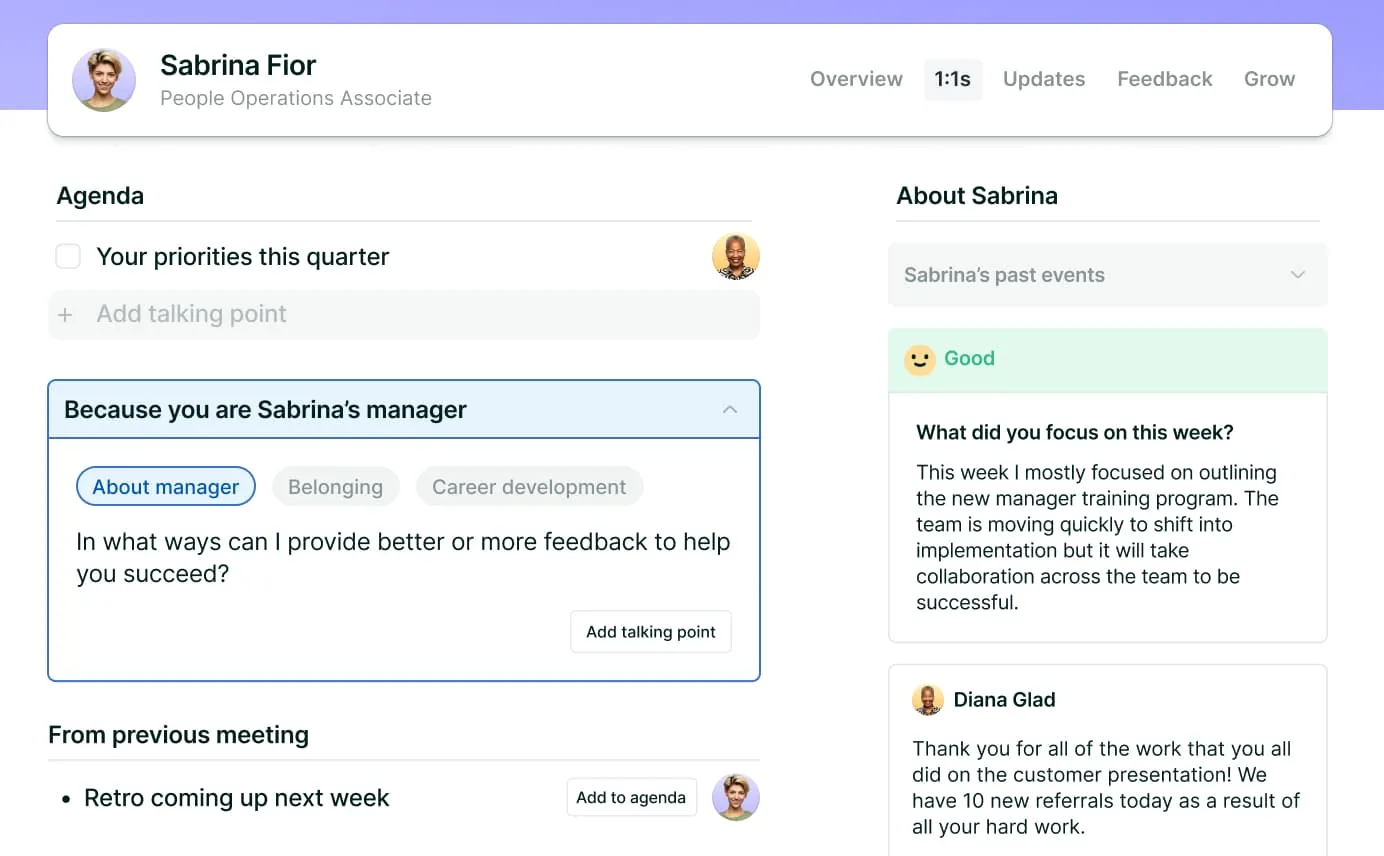
For employees, regular one-on-ones help clear workflow roadblocks, gather feedback, encourage regular discussion on career growth and goal setting, and help them reach the next level of their careers.
Meanwhile for managers, one-on-ones are an opportunity to gain a perspective on their team’s challenges and help course-correct. They’re also an opportunity to build trust and working relationships, mentor employees on their career development, and identify new areas ripe for innovation.
And what benefits the team benefits the whole organization. When employees at every level participate in regular one-on-ones, companies benefit in several ways:
- Employee engagement: Regular one-on-ones means employees are more likely to reflect on their work and needs, and feel more engaged in their day-to-day work.
- Talent retention: Workers feel important and valued when they are confident their voices and contributions matter. Recognizing employees’ needs and accomplishments shows them the company cares about their team goals and career goals.
- High-performing teams: When managers are well-informed and employees are empowered to share feedback, teams can achieve their goals more effectively.
Across the board, investing in one-on-ones ensures employees receive recognition for significant achievements, get the training they need to overcome work challenges, and feel supported.
How to Prepare for a One-on-One
With one-on-ones, an old adage holds true: Fail to prepare, or prepare to fail. When participants arrive for a one-on-one meeting without a clear agenda, the discussion can quickly become aimless and unproductive.
Showing up prepared with talking points and questions to follow up on creates mutual respect and paves the way to a productive conversation for all participants.
{{rich-highlight-1}}
Employee Preparation: Reflect and Prioritize
For employees, the lead-up to a regular one-on-one is all about making sure you’re bringing the right priorities and questions to the table.
Before your next one-on-one:
- Review the last meeting notes and check the status of any action items from the last discussion.
- Identify two to three priority topics — such as current blockers needing manager input, feedback on specific work, or career development questions.
- Prepare and write down specific questions that give your manager something concrete to address. For example, ask: “What skills do I need to develop for a senior engineer role?” instead of “How can I take the next step up?”
- Note any recent wins or accomplishments to flag to your manager.
- Look at next week’s priorities to align with your manager on focus areas and team goals.
Manager Preparation: Review and Engage
In a one-on-one conversation, a managers’ role is simple: Show up, give your employee your full attention, and create a safe space for candid dialogue.
To prepare:
- Review the employee’s recent work, current goals, and previous discussion notes for context.
- Prepare three to four open-ended questions to prompt discussion if conversation dries up. Focus on topics including employee sentiment, company culture, and team dynamics.
- Block time entirely to create a distraction-free environment — no multitasking, calendar alerts, or email checking.
- Surface context on team priorities and available resources so you can make decisions in the moment.
- Identify specific positive feedback based on recent observations and behavior. Instead of “great job,” try “I was really impressed how you handled client pushback in our recent product launch.”
- Take a look at the action items mentioned during the last meeting and report on their progress.
Questions to Ask in One-on-One Meetings
The most important insights in any one-on-one aren’t in structure or regularity — they’re in what you ask. The best one-on-one questions can unlock mutual problem-solving, and transform a simple status update into a strategic conversation that enables progress.
To work best, the questions both participants ask should be specific, open-ended, and outcome-focused. Don’t dwell on what happened — invite reflection on what’s working, what’s not, and what can change.
Use the question banks below to help prepare for your next conversation.
Questions for Employees to Ask their Manager
If you’re an employee, your questions need to be personalized to your exact needs — whether that’s an issue on a project, insight on professional growth, or going through some feedback. Come to your one-on-one meeting prepared with two to three questions that reflect your current priorities.
Career Growth Questions
- What skills should I develop to reach [specific next role or level]?
- Where do you see opportunities for me to take on more responsibility?
- What's one thing I could do differently to have a greater impact on the team?
- How does my work connect to broader team goals and company objectives?
- Who should I learn from or collaborate with to build specific skills?
Feedback and Performance Management Questions
- How am I tracking against expectations for my role?
- What's one area where you'd like to see me improve over the next month?
- Is there a recent project where I could have approached things differently?
- What should I continue doing that’s working well for the team?
- How do my contributions compare to those of my peers?
Support and Resources Questions
- What blockers should I escalate to you versus solve myself?
- Are there resources or tools that would make my work more efficient?
- How do you prefer to receive updates on [specific project type]?
- What decisions do I have the authority to make independently?
- Is my workload sustainable, or should we reprioritize?
Company and Team Context Questions
- What are the team's top priorities for next quarter?
- Are there any upcoming changes I should prepare for?
- How is leadership viewing our team's performance?
- What skills will be most valuable for our team in the next year?
Questions for Managers to Ask Employees
For managers, the key goal during a one-on-one is fostering openness and trust with your direct reports, helping them solve problems, and keeping team members engaged.
The following questions can be effective to gauge how your employees are feeling and where they’re stuck.
Short- and Long-Term Goal Questions
Help employees connect daily work to bigger ambitions.
- How can we help improve your day-to-day work?
- How are you feeling about your current projects?
- What would you like to work on next quarter?
- A year from now, what do you want to have accomplished?
- Where do you see yourself in 5 years? 10 years? 20 years?
Company Improvement Questions
Surface insights from the team closest to the work.
- What’s the biggest opportunity we’re not thinking about?
- How can the team work better together? Where are we failing? Where are we succeeding?
- What’s your least favorite thing about the work environment?
- How are you feeling about the company’s future? Why do you say that?
- If you were the CEO, what changes would you make?
Career Development Questions
Show investment in your employees’ growth beyond their current role.
- Do you feel like we’re helping to advance your career? What else can I be doing to help grow your career?
- Do you feel like you’re learning at work?
- What projects are you most proud of? What do you want to work on next?
- If you were not in your current role, what industry or field would you like to be in?
- What’s a professional development project you’d like to pursue?
Manager Improvement Questions
Build trust by showing openness to feedback.
- How can I be a better manager?
- How can I make your work easier?
- In what areas of your work do you want more/less direction from me?
- What additional resources do you need?
- How can we improve these 1:1s?
Job Satisfaction Questions
Identify the early warning signs of disengagement.
- Are you happy in your current role?
- What’s not fun about working here?
- What’s working for your work-life balance?
- I’ve noticed you’re more (adjective) than usual. Is there anything you’d like to talk about?
- What do you want to do but don’t feel like you have the time for?
Remote Worker One-on-Ones
Address the unique challenges of remote work.
- Are there specific projects or tasks that you feel are blocked or impacted by working remotely?
- Are you facing any challenges while working remotely that those in the office aren’t facing?
{{rich-highlight-2}}
How to Run a Successful One-on-One
A successful one-on-one serves as an opportunity for a consistent, two-way conversation between managers and their direct reports. But many managers are getting it wrong. In fact, almost half said their one-on-ones were “suboptimal,” according to a 2022 Harvard Business Review article. Instead of entering a one-on-one with plans for a monologue and a list of demands, follow these steps for better outcomes.
1. Center on employee needs to foster openness and trust.
Remember that the meeting is about the employee: their feelings about work, current challenges, innovative ideas, career aspirations, and desire for growth.
The conversation should demonstrate that you hear what they’re saying, give them the continuous feedback (and recognition) they deserve, and show how the company values their contributions. But employees should dictate the flow of this conversation — so start by asking what’s on their mind.
Not every employee will be forthcoming about their challenges, and discussion will sometimes naturally start to slow down.
When that happens, ask questions rooted in empathy and care, turning the focus on how the employee is doing, recent wins and highlights, and their career aspirations:
- How are you feeling about your workload and development right now?
- What were your work and non-work highlights over the past week?
- What blockers can I help you with?
- How can I support you better?
Another effective strategy to help employees open up is a change in scenery — go for a walk or get a cup of coffee together. This change of pace can help managers and direct reports build stronger relationships, encouraging employees to be honest and open.
It might take time for some direct reports to feel comfortable enough to share. But when managers consistently demonstrate that they are focused on their employees’ needs and willing to act on concerns raised during one-on-ones, they will create a sense of psychological safety in the workplace.
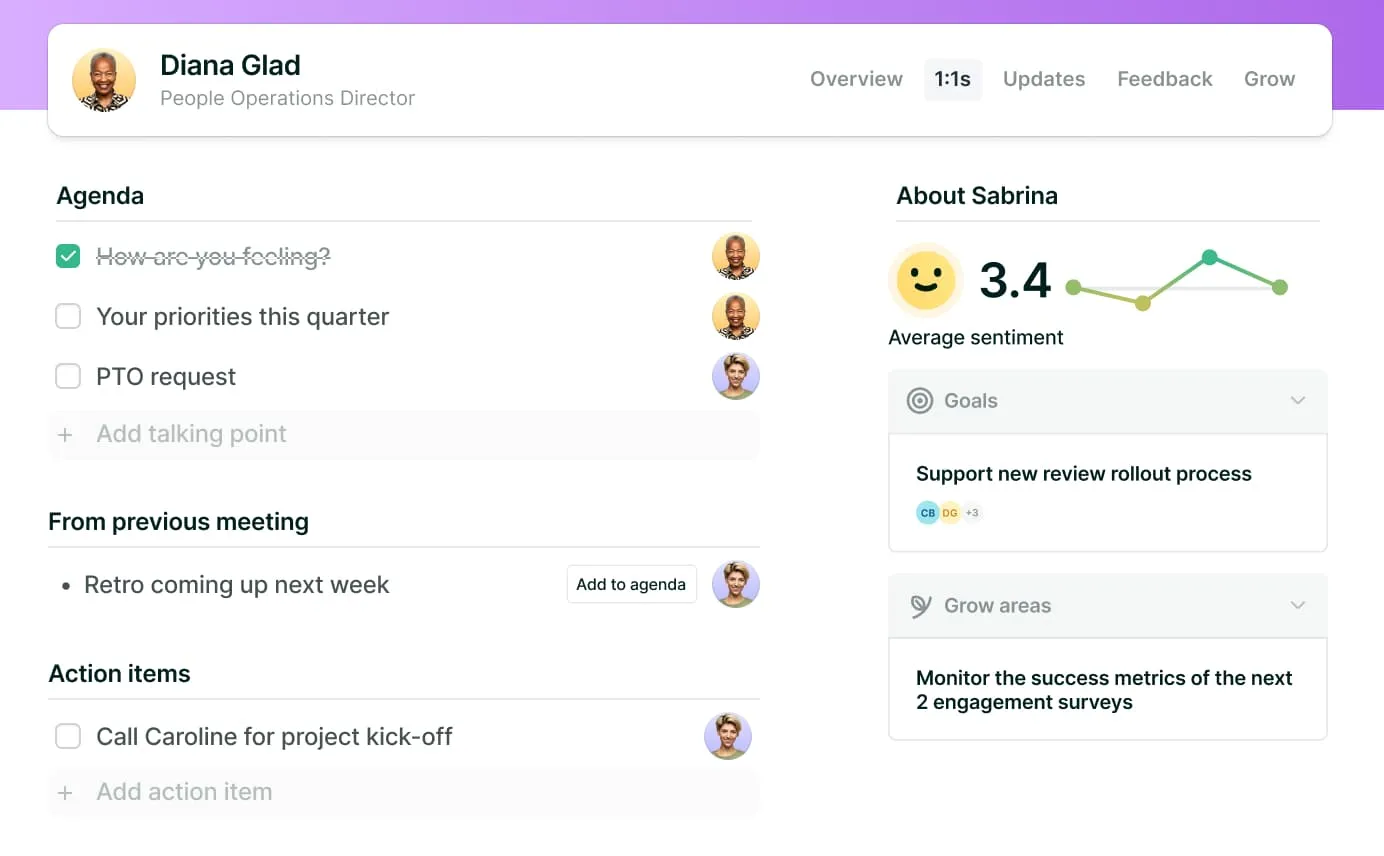
2. Schedule and commit to regular one-on-one meetings.
In the day-to-day shuffle, it’s easy to think about one-on-ones as non-essential, especially when they don’t seem directly related to the bottom line or client work. But the opposite is true: A 30-minute conversation with your employee can go a long way in making sure they're on track to support organizational success.
In fact, according to internal Microsoft research from 2020, employees who received clarity about priorities were 2.5 times more likely to feel they maintained their productivity levels alongside work-life balance than those who did not receive that guidance. Additionally, a 2021 market study by Lattice, employees who set and discussed goals the most frequently were the most engaged.
Most one-on-ones last between 30 and 60 minutes — but the exact cadence depends on your team, direct reports’ needs, and project complexity. Common cadences include:
- Weekly: These work well for new employees who need more support, as well as during times of major organizational change, and for teams working on complex projects.
- Biweekly: Biweekly one-on-ones balance consistency with manager time constraints. They’re frequent enough for a focused conversation without becoming a time-sink.
- Monthly: Monthly meetings are the minimum frequency teams need to maintain a relationship. They’re best for very autonomous teams where less support is needed.
But remember that consistency and focus matters more than agonizing over frequency. To ensure regular, uninterrupted check-ins, put the time on your calendar and do your best to avoid canceling. If for some reason you can’t make it, always reschedule. Not only will this show employees that they’re a top priority but it will also improve the work product and efficiency of the team.
3. Empower employee-led agendas in one-on-ones.
Productive meetings take preparation, and one-on-ones are no exception. Since it’s the employee’s meeting, it’s on them to own the agenda and prepare ahead of time.
A 2022 Harvard Business Review article reported that one-on-ones are most successful when employees are active participants in the discussion — speaking for 50% to 90% of the meeting time.
But at Lattice, we’ve also found it helpful for managers to have consistent opening questions each week to get the conversation flowing:
- What did you focus on this week?
- What are your plans and priorities for next week?
- What challenges or roadblocks do you need help with?
- Is there anything else on your mind?
Listening matters just as much as the questions you ask. As the employee begins to open up, demonstrate that you’re engaged in the conversation with eye contact and other visual cues, such as nodding. At times, repeat what your employee has said to confirm that you understand their challenge by asking “Is that right?” at the end.
4. Document and address one-on-one insights.
The best way to ensure honest and open feedback from employees during one-on-ones isn’t just listening actively — it’s also addressing any challenges and concerns they raise.
And when you’re running one-on-ones, you’ll likely uncover a variety of challenges and insights about your employees each week — whether it’s a desire to grow a new skill or a problem they’re experiencing on a particular project. Following up on these issues is essential to ensure continuous growth and show that managers truly care about their direct reports’ concerns.
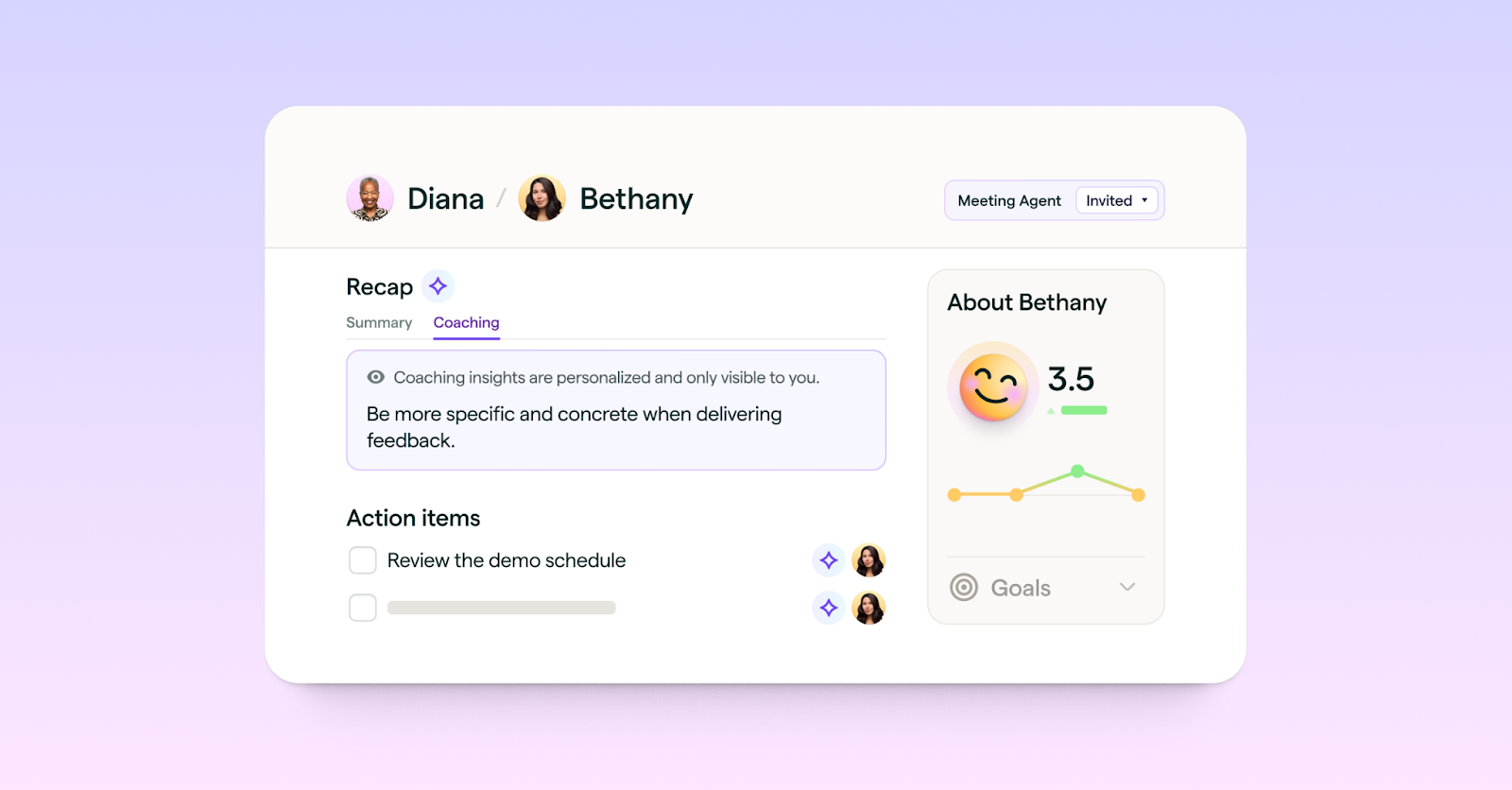
To do this effectively, you’ll need to create a record. Taking notes during every meeting provides a great starting point to record issues and action items. But it also allows you to chart an employee’s progress over time — providing a real-time record for performance reviews, goals, and compensation or promotion decisions.
Common Mistakes to Avoid
Not every one-on-one runs as planned — and even well-intentioned managers can fall into the trap of making mistakes that undermine their effectiveness.
Avoiding the following tripwires paves the way for effective, well-structured meetings that drive performance and engagement.
❌Using One-on-Ones as Status Update Meetings
While one-on-ones can be a great place to check in on a specific project or task, that’s not the sole goal — and they’re not a replacement for status updates. Instead of focusing on checklists, use time in one-on-ones for problem-solving or strategic thinking.
Why this matters: Using one-on-ones purely for work status updates risks making the whole meeting feel transactional and employees feel unsupported, instead of unblocking issues or building relationships.
❌ Canceling or Rescheduling Frequently
Sometimes cancellations are unavoidable — but nothing says a direct report isn’t a priority like ditching your one-on-one with them at the last second. Canceling frequently will create anxiety and erode trust, so if you need to cancel, explain why and reschedule within the same week.
Why this matters: Consistency builds trust, and being unreliable can quickly destroy it. When employees feel their manager has no time for them, they quickly disengage.
❌ Manager Dominating the Conversation
One-on-ones should be a conversation, but employees need to hold the majority share of voice — as it’s their chance to say what’s on their mind. Talking more than half the meeting leaves no space for reflection and signals to employees that their perspective isn’t valued.
Why this matters: When managers dominate the conversation, employees feel unheard, which can lead to disengagement. Over time, this erodes psychological safety and employees stop feeling safe to bring real challenges into the discussion.
❌ Skipping Documentation
Taking notes may seem unnecessary for a 30-minute check-in, but without them, action items get missed, behavioral patterns go unnoticed, and managers miss progress and performance signals.
Why this matters: Undocumented conversations lead to duplication of work and circular conversations about the same issue time and time again, stalling progress and goal achievement. Everyone needs to leave the meeting with a clear idea of what decisions were made, and who’s doing what.
❌ Failing to Follow Up on Previous Discussions
When an employee raises a concern, it’s just as important to act as it is to listen. Revisiting your employees’ concerns from a previous meeting closes the feedback loop and lets your employees know that you care about their challenges just as much as the work they deliver.
Why this matters: Employees share less and are less engaged when they feel like their efforts and feedback go into a black hole. Regular follow-ups on issues and concerns create psychological safety and make them feel heard.
❌ Focusing Only on Problems
Fixing problems and course-correcting blockers will help improve your employees’ output. But to maximize their engagement, you need to balance that with praise and recognition — acknowledging wins and progress on goals and projects.
Why this matters: Only highlighting negative feedback will create a cycle of dread, meaning employees come in feeling defensive, rather than valued and ready to grow. Over time, this harms engagement and motivation.
{{rich-highlight-3}}
One-on-One Meeting Template
Effective one-on-one meetings allow for open dialogue and two-way conversations, and they’re built on a foundation of consistency and clear intentions.
Using a one-on-one template to structure this discussion can be helpful — because it provides a clear framework while allowing flexibility for employee-led discussion. This means meetings stay on track without feeling rigid or prescriptive.
The best templates adapt to meeting length and employee needs. Try our sample template below.
Sample 30-Minute One-on-One Meeting Structure
Minutes 0–5: Warm-up and Personal Check-in
- Build rapport with non-work conversation.
- Ask how the employee is doing beyond work projects.
- Briefly discuss weekend plans, hobbies, or personal updates.
Minutes 5–15: Employee’s Agenda Items
- Current challenges or blockers needing manager support.
- Feedback requests on specific projects or deliverables.
- Ideas or suggestions for team dynamics or improvements.
- Questions about priorities or direction.
Minutes 15–25: Career Development or Strategic Discussion
- Progress on growth goals or skill development.
- Opportunities for stretch assignments or new responsibilities.
- Longer-term career aspirations and path forward.
- Training or mentorship needs.
Minutes 25–28: Action Items and Commitments
- Document next steps with clear owners and timelines.
- Manager commits to removing specific blockers or providing resources.
- Employee commits to follow-up actions or deliverables.
Minutes 28–30: Closing and Previewing the Next Meeting
- Summarize key takeaways from the discussion.
- Preview topics for the next meeting.
- End on a positive note, and ask if there’s anything else they need before you wrap.
Ready-to-use Agenda Template
A consistent agenda keeps one-on-ones focused and ensures nothing gets forgotten. Try adding this template to your meeting notes as a starting point, making sure that both participants fill it out before the meeting:
- Wins from this week: What went well, and accomplishments to celebrate
- Current priorities: Top two to three focus areas for next week
- Blockers and challenges: What's stuck, and what needs manager support
- Feedback needed: Specific work requiring manager input or direction
- Career development: Skills to develop, growth opportunities, long-term goals
- Action items from last meeting: Status update on previous commitments
- New action items: Decisions and next steps from today
- Topics for next time: Items to revisit in future meeting
{{rich-highlight-4}}
How to Customize Your Template for Different Meeting Types
While most teams opt for biweekly 30-minute slots, the best one-on-one format is one that your team can run consistently over time. Use our template as a starting point — and adjust the structure for the time you have:
- 15-minute check-ins: In this speed round, focus only on immediate blockers and quick feedback. Skip career growth and development in favor of quick touchpoints.
- 45–60 minute meetings: Add in agenda time for strategic career discussions, plus touch on team dynamics, company culture and direction, or deeper, focused problem-solving.
- Quarterly deep dives: Use a longer format for comprehensive career reviews and aspirations, to set goals for the next quarter, or address larger challenges.
Pro tip: Create structure and consistency with Lattice.
Lattice’s one-on-one templates enable teams to customize recurring agendas, meaning teams get the same structure every time without the need for manual work. Plus, both managers and employees can see the agenda beforehand and add one-off topics to the agenda asynchronously.
{{rich-highlight-5}}
FAQs
How often should you have 1:1 meetings with your manager?
Regular one-on-ones work best to drive progress and engagement. Frequency varies, but most teams opt for a weekly, biweekly, or monthly cadence. This will help you check in on issues, keep feedback flowing, and maintain a supportive relationship.
How long should a 1:1 meeting last?
While there’s no definitive length for a one-on-one meeting, the sweet spot to build trust generally hits around the 30 to 60-minute mark. Shorter meetings of 15 minutes can work in a pinch as long as they’re focused, but they’re not ideal if you want to communicate to your employees that their time matters.
What if my manager keeps canceling our 1:1s?
Cancellations are sometimes unavoidable, but if you’re noticing a pattern, then bring it up at your next meeting, and ask if you can find a more reliable time. If this keeps happening, raise it in a skip-level meeting with their manager or HR.
Should 1:1s be in-person or remote?
Remote and in-person one-on-ones both work — the format matters less than the intent and process. That said, in-person one-on-ones can be better for building rapport and noticing non-verbal cues during conversation.
How do you make 1:1s valuable when you have nothing to discuss?
When there’s nothing urgent to say, one-on-ones can be a great opportunity for diving in on deeper discussions that support long-term employee engagement, such as career goals and development opportunities, employee wellbeing, and employee sentiment.
What should I do if my 1:1s feel like interrogations?
If your one-on-ones are starting to make you sweat, try asking your manager if there’s a way to make them more collaborative. Suggest using a template to help structure discussions — or offer to schedule dedicated project check-ins separately from one-on-ones to make their intent and purpose clear.
Prepping for your next one-on-one?
Consider it done. Use our free template to get ideas for talking points and making better use of your meeting time.

Ask better questions.
For more ideas on what to ask remote workers, download our free Remote One-on-One Questions Template.
One-on-Ones That Drive Performance
Download our free one-on-ones ebook, which will prep you with all the prompts and questions to run a successful one-on-one.
Make your next one-on-one your best one yet.
Use our free template to get ideas for talking points and making better use of your meeting time.
Optimize Your One-on-Ones with Lattice
For managers, the juggle is real. Managing on-on-ones for multiple direct reports, each with their own needs, priorities, and career stages, and staying on stop of context is nearly impossible without the right platform.
Lattice 1:1s streamline this work, giving you:
- Collaborative agenda-building for both managers and employees before the meeting, ensuring employee ownership into the process, and manager visibility into concerns.
- Automatic documentation that saves notes and surfaces action items from previous meetings — creating a searchable history to inform performance reviews.
- Integrated context that highlights employee goals, recent feedback, and progress on development plans across multiple meetings.
- Analytics that track meeting frequency, highlight patterns in topics or action items, and drive consistency.
Managers spend less time repairing fragmented context or taking notes, and more time coaching and problem-solving. Employees feel heard because action items, concerns, and commitments actually get addressed. And organizations build a feedback culture where performance discussions happen continuously, and one-on-ones become a high-leverage activity that supports engagement and retention, not just a checkbox exercise.
See how Lattice 1:1s work by booking a demo.