

If you’re spending more than 30 minutes prepping for your regular one-on-one, you’re doubling your work. And if you have more than one direct report, you’ll run out of time for everything else on your to-do list.
Winging it isn’t the right answer either. There’s a solid middle ground where managers feel prepared and use their time wisely, freeing up time to get to the crucial action items that inevitably result from a one-on-one well spent.
These seven templates can help managers find that elusive sweet spot. Lattice has templates for regular check-ins, career development, performance feedback, wellbeing, and roadblock removal.
Download the content for free and paste directly into your next one-on-one. You can thank us later.
Manager Templates for One-on-One Meetings
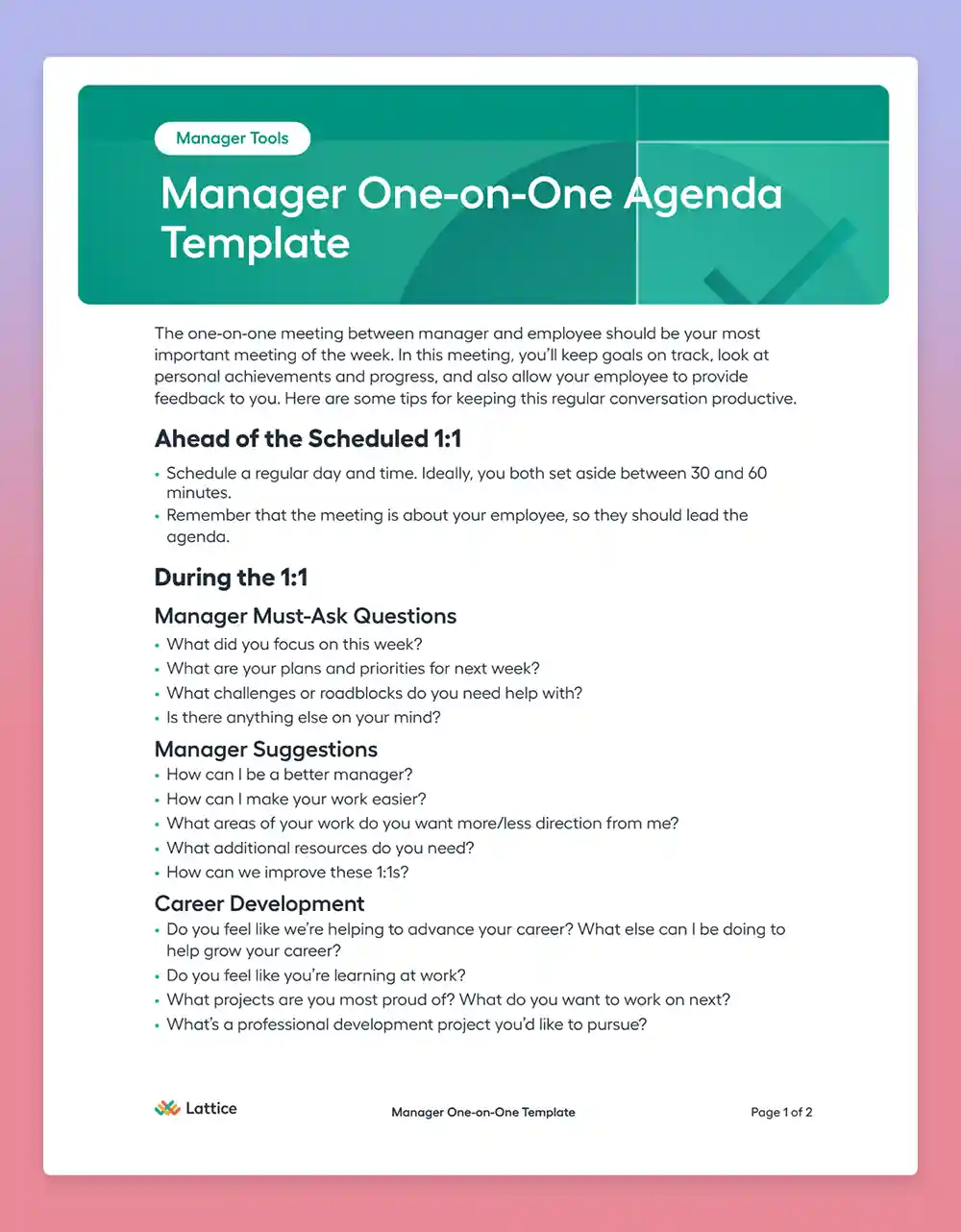
One-on-One Agenda Template
Lattice’s one-on-one agenda template is perfect for a comprehensive weekly or bi-weekly check-in covering current work, career goals, and job satisfaction, with ready-to-use questions across six categories. The employee-led agenda format creates space for two-way feedback while ensuring managers cover critical topics.
- Benefits of this template:
- Questions cover employee priorities, development, and satisfaction without missing critical topics across recurring meetings.
- Agenda balances manager- and employee-led discussion to create psychological safety where both voices matter equally.
- What this template covers:
- Must-ask questions for managers: Weekly focus, priorities, roadblocks, and open topics
- Manager suggestions: Questions about management effectiveness, work support, and meeting improvement
- Career development: Questions exploring advancement, learning, project interests, and professional development
- Goals discussion: Prompts for quarterly priorities and one-year to 20-year career aspirations
- Company improvement: Space for team collaboration ideas, product feedback, and organizational suggestions
- Job satisfaction: Questions about happiness, work-life balance, and experience improvement
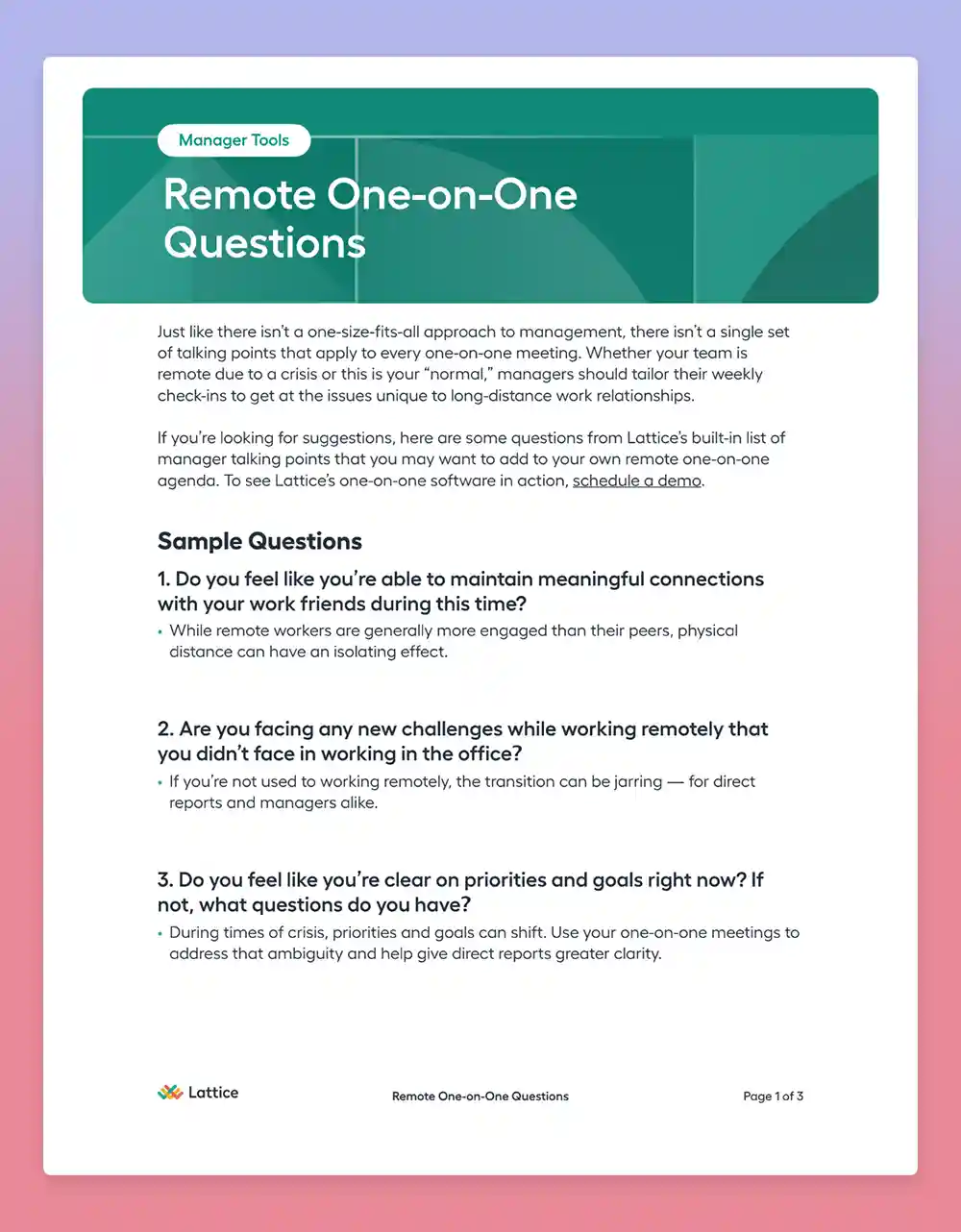
Remote One-on-One Questions Template
Lattice’s remote one-on-one questions template includes ten targeted questions addressing isolation, communication gaps, work-life boundaries, and technical needs specific to distributed teams. It covers everything from maintaining work friendships to hardware setup challenges.
- Benefits of this template:
- Meeting agenda surfaces burnout and disconnection early through direct questions about energy, stress, and work friendships.
- Allocates dedicated time to logistical challenges (hardware, software, scheduling) before they impact productivity.
- What this template covers:
- Connection check: Maintaining team dynamics and work relationships during remote work
- Remote challenges: New obstacles faced while working from home versus an office environment
- Clarity discussion: Whether team members feel clear on priorities and goals
- Energy assessment: Direct questions about feelings, energy levels, and stress
- Boundary check: Whether team members take breaks during the workday
- Caregiving support: Schedule accommodations for parents and caregivers
- Technical setup: Hardware, software, and tools needed for effective remote work
- Communication: Daily communication issues and preferred contact methods
- Project blockers: Tasks impacted by remote work
- Career development: Professional growth opportunities for distributed workers
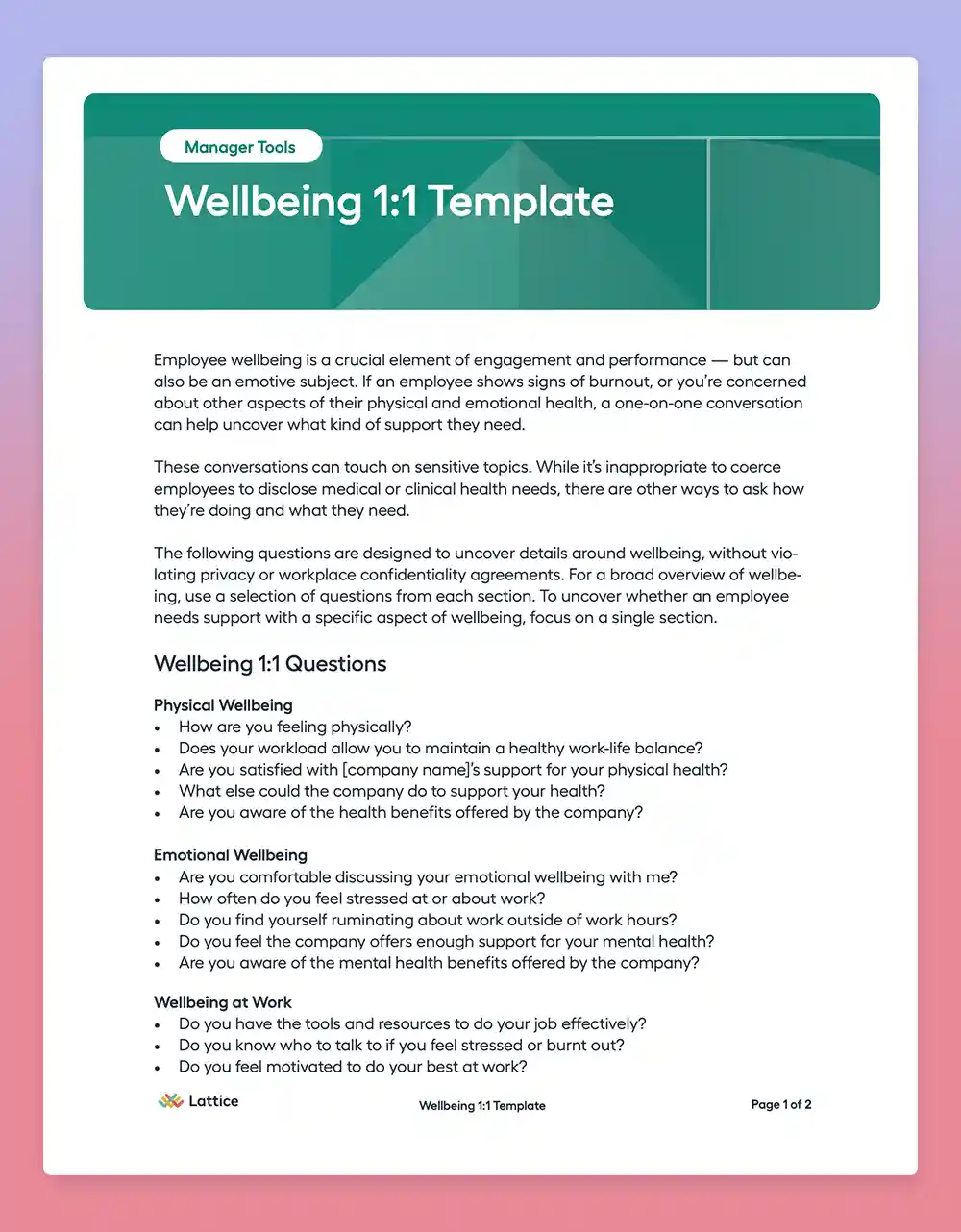
Wellbeing One-on-One Template
Lattice’s wellbeing one-on-one template provides focused questions for dedicated well-being conversations covering physical health, emotional wellbeing, workplace stress, social connections, and values alignment. It respects privacy boundaries while uncovering where support is needed.
- Benefits of this template:
- Separates wellbeing from performance so high-performing team members feel safe being honest about struggles.
- Structure respects privacy while uncovering where support is needed, to build trust where it matters most.
- What this template covers:
- Physical wellbeing: Feeling physically, work-life balance, health support satisfaction, benefit awareness
- Emotional wellbeing: Comfort discussing mental health, work stress frequency, after-hours rumination, mental health benefits
- Workplace wellbeing: Tools and resources, knowing who to talk to when stressed, motivation levels
- Social wellbeing: Workplace support networks, feeling valued by team, isolation, team connection ideas
- Societal wellbeing: Role's positive contribution, values alignment, ESG initiative awareness
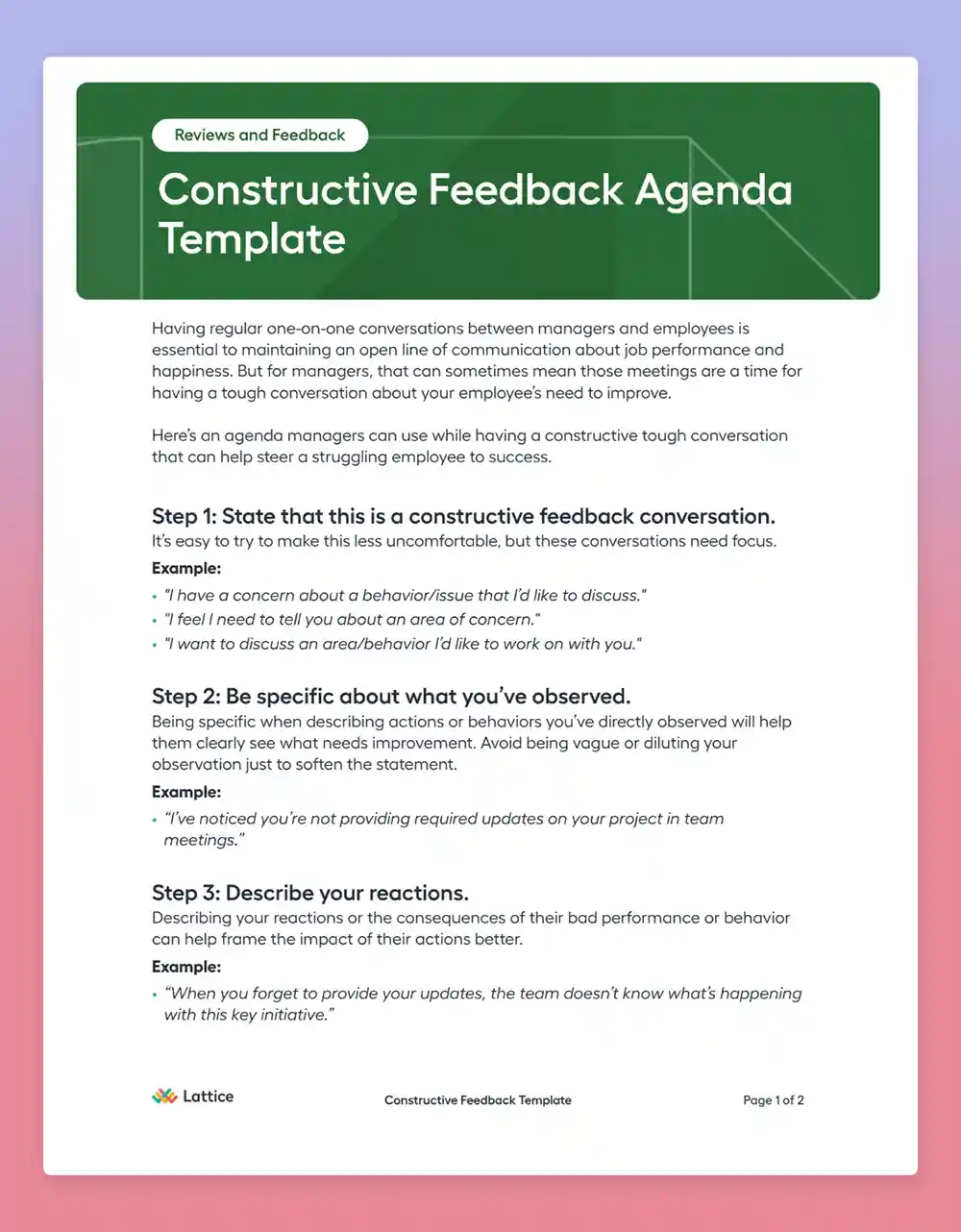
Constructive Feedback Agenda Template
Lattice’s constructive feedback agenda template provides a six-step framework for delivering difficult feedback with language examples for each step. It guides managers from opening through specific examples, impact discussion, response, solutions, and follow-up planning.
- Benefits of this template:
- Step-by-step structure reduces anxiety by clarifying what happens next.
- Focus on observable behaviors prevents vague feedback that doesn't lead to improvement.
- What this template covers:
- Step 1: State intent — clearly name this as a constructive feedback conversation.
- Step 2: Specific observations — describe specific behaviors observed directly.
- Step 3: Describe reactions — explain impact and consequences on team, projects, or outcomes.
- Step 4: Let them respond — create space for employee perspective with open-ended questions.
- Step 5: Offer solutions — come prepared with supportive solutions and resources.
- Step 6: Summarize — restate key points, document in writing, make it a focus area for ongoing 1:1s.
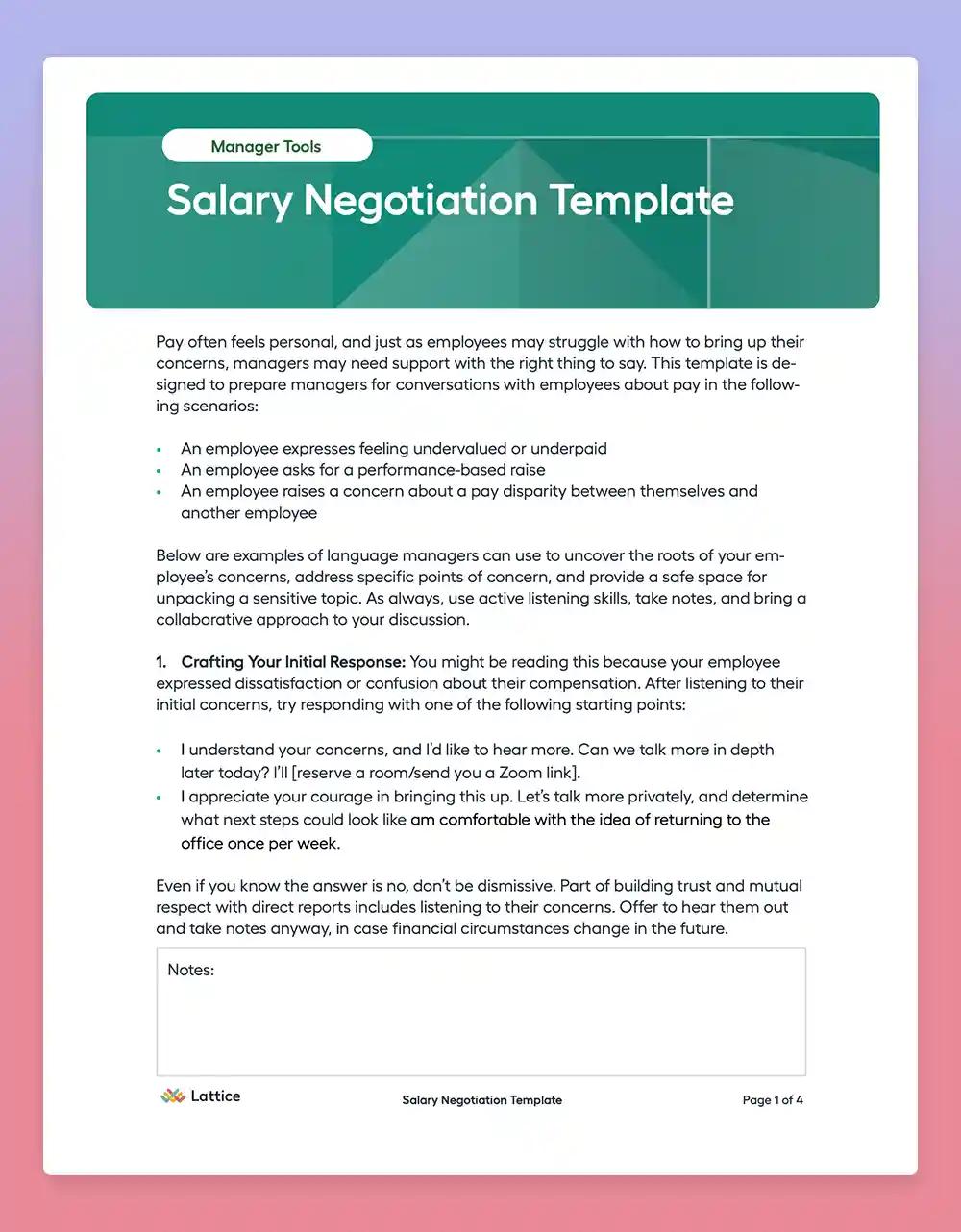
Salary Negotiation Template
Lattice’s salary negotiation template is a six-section guide with conversational scripts about pay, covering salary band explanations, pay disparities, merit increases, and next steps. It offers realistic, ready-to-use language for sensitive money conversations.
- Benefits of this template:
- Ready-to-use language reduces manager anxiety during sensitive money conversations.
- Covers multiple scenarios (feeling underpaid, merit raises, pay disparities) so managers are prepared.
- What this template covers:
- Initial response: Scripts for acknowledging employees’ concerns without being dismissive and scheduling follow-up
- Taking the plunge: Language for opening deeper discussion and creating psychological safety
- Salary bands: Scripts explaining how ranges work, where employee falls, what promotion-level pay looks like
- Pay disparities: Language for responding to unfair pay gaps and advocating for equity with HR
- Gathering proof points: Scripts for enlisting employee help documenting merit and accomplishments
- Next steps: Language explaining review process, timeline expectations, HR involvement preferences
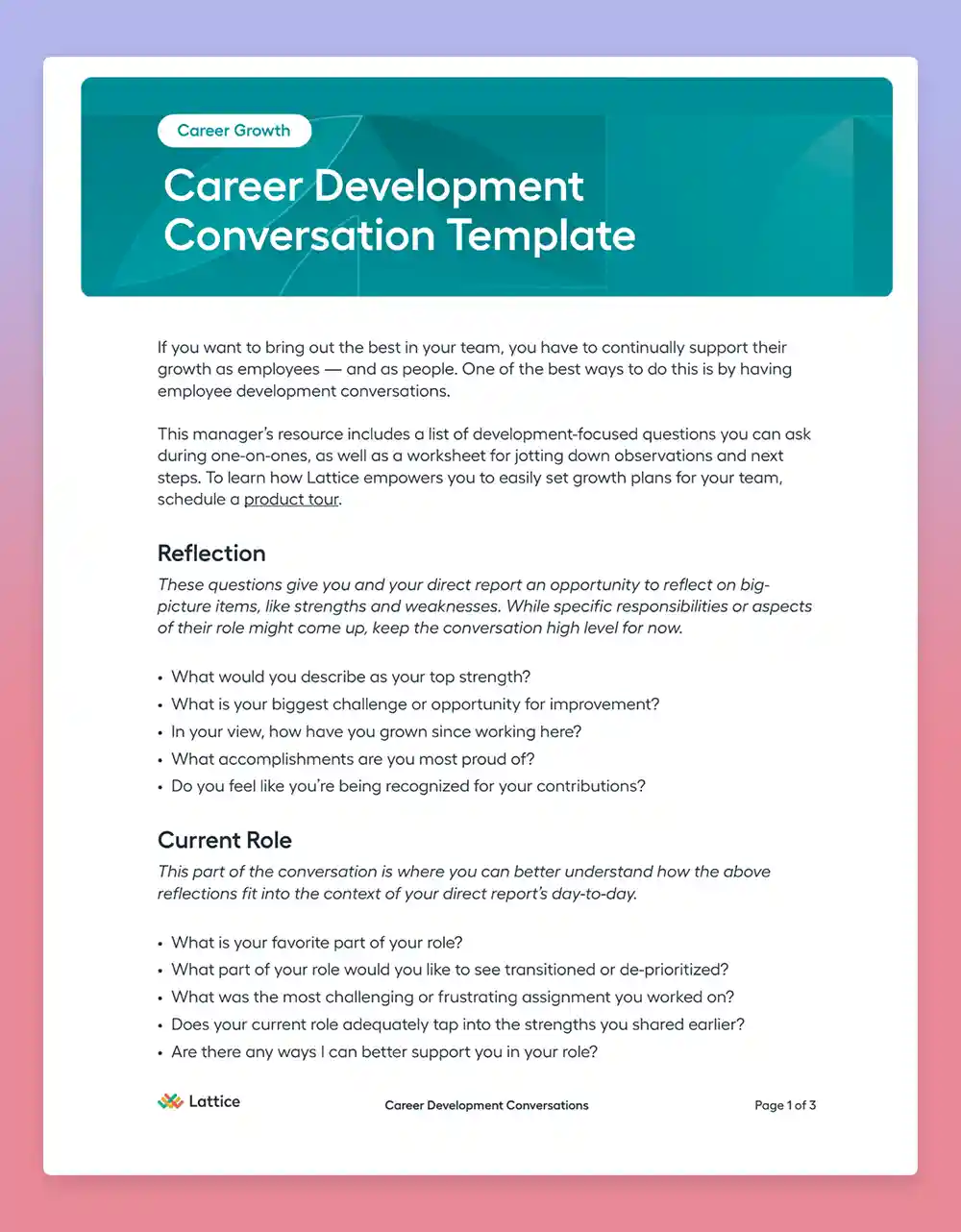
Career Development Conversation Template
Lattice’s career development conversation template is a three-part question framework and action planning worksheet for quarterly career conversations. It covers reflection on employee strengths, current role satisfaction, and future growth planning with commitment tracking.
- Benefits of this template:
- Separates big-picture career discussions from weekly status updates so development gets dedicated attention.
- Worksheet captures manager and employee commitments with timeline and check-in dates for accountability.
- What this template covers:
- Reflection questions: Top strengths, biggest challenges, growth since joining, proudest accomplishments, recognition satisfaction
- Current role: Favorite aspects, parts to transition, challenging assignments, strength alignment with daily work
- Growth planning: Success definitions for 1-2 years, new responsibilities, work frequency preferences, business areas to learn, tools or training interests
- Action worksheet: Structured space for manager commitments, employee commitments, timeline, next check-in date
- Note-taking space: Area for managers to capture observations for future reference
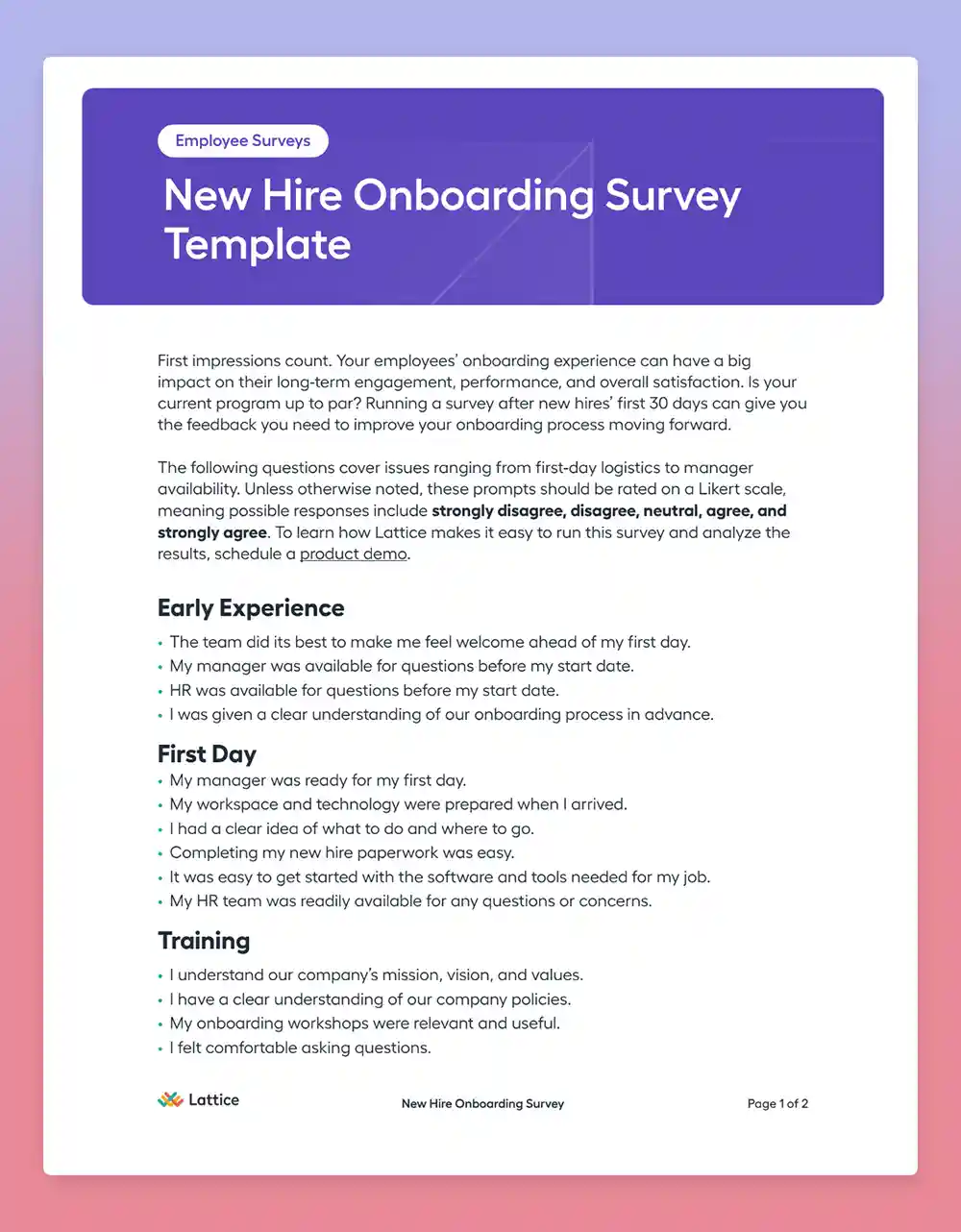
New Hire Onboarding Survey Template
Lattice’s new hire onboarding survey template includes a comprehensive 30-day onboarding survey with Likert scale questions covering early experience, first day logistics, training, manager support, and engagement. It helps identify onboarding gaps early — when they're easy to fix.
- Benefits of this template:
- 30-day timing catches problems when they're simple to fix instead of waiting for 90-day reviews.
- Likert scale format provides quantifiable data for tracking onboarding improvements over time.
- What this template covers:
- Early experience: Team welcome efforts, manager and HR availability before start date, onboarding process clarity, address FAQs
- First day: Manager readiness, workspace and technology preparation, clarity on what to do, paperwork ease, software setup, HR availability
- Training: Understanding mission and values, policy clarity, workshop relevance, comfort asking questions, presenter knowledge, team introductions, tool training
- Manager relationship: Manager availability, direction quality, communication frequency, professional growth support, recommendation likelihood
- Engagement: Company pride, job satisfaction, two-year outlook, friendship development, interview-to-reality match, productivity, welcome experience
{{rich-highlight-1}}
{{rich-takeaway}}
Improve Your One-on-One Meetings with Lattice
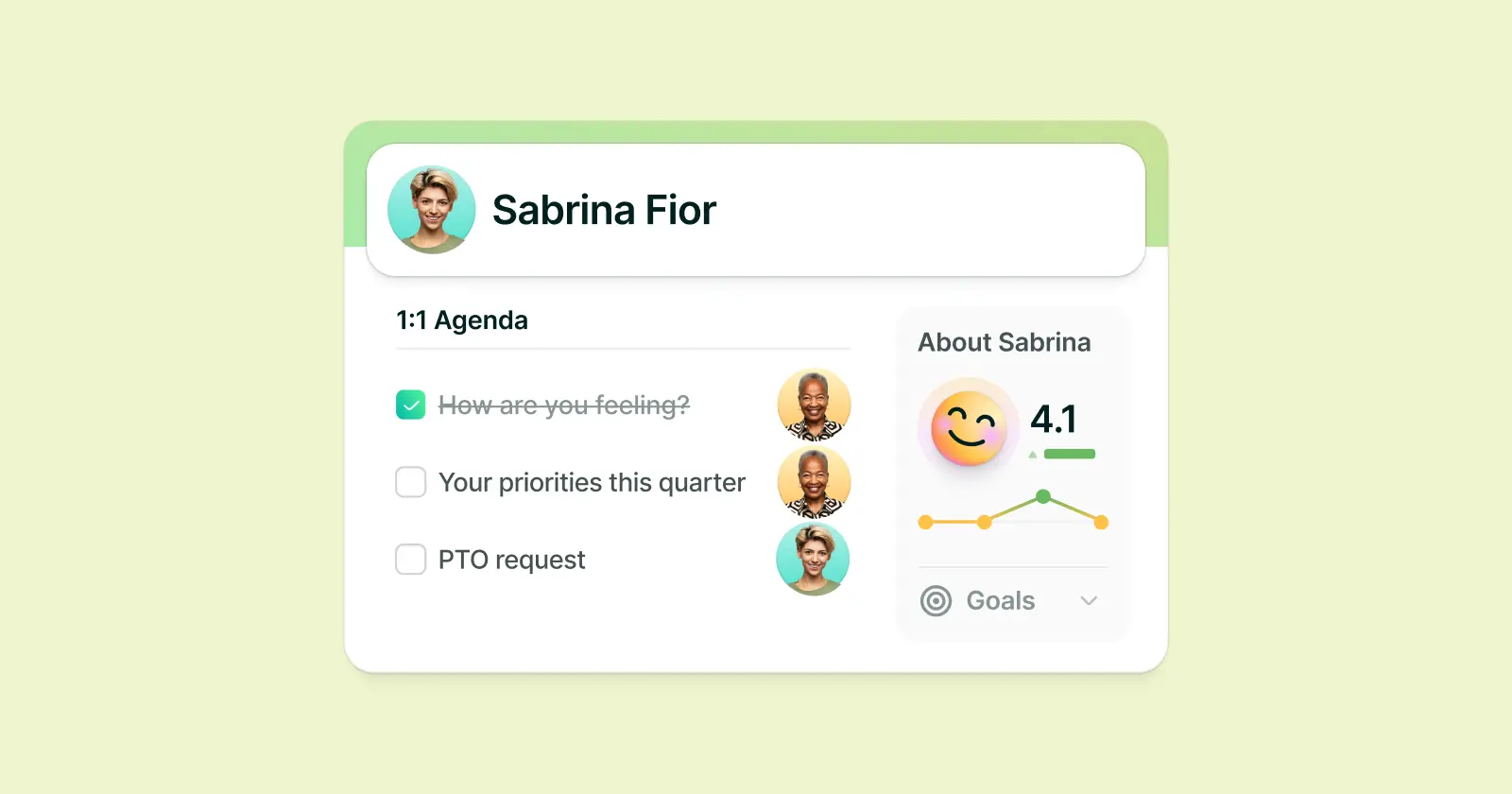
Templates are a helpful starting point for building agendas, but Lattice’s AI-powered performance management tools offer talking points and action items for managers automatically, so they can stay present instead of getting bogged down taking notes. Here’s how:
- Streamline context: Lattice workflows surface relevant information automatically, including recent peer feedback from review cycles, goals with upcoming due dates, action items from previous meetings. Everything appears in one place instead of scattered across tools.
- Action item tracking: When you assign an action item or set goals with an owner and due date, they don’t disappear into meeting notes. They surface in task lists, status updates, and your next 1:1 agenda automatically.
- Development continuity: Career goals discussed in your 1:1s connect directly to performance reviews, feedback cycles, and development plans. You're tracking multi-month progress toward real objectives, not having the same isolated conversation quarterly.
- Meeting history: Every 1:1 note lives in a chronological feed. Recaps help managers see patterns over time instead of isolated conversations, making it easy to reference previous one-on-one conversations and track progress over quarters.
Ready to see how Lattice can help managers reclaim their time and make better use of it? Request a demo.
✨ Disclaimer: This content was developed with the help of artificial intelligence, though reviewed, edited, and approved by (real) humans.