

For the first time in the history of Lattice’s State of People Strategy Report, performance management is HR teams’ top priority.
But prioritizing employee performance is just the beginning. Achieving and improving it is another thing entirely. If you’re relying on an annual or quarterly retrospective performance evaluation of what went well and what didn’t, you’re really just running to stand still.
Instead of looking at how employees have performed, it’s important to shift to how they are performing in real-time. Making performance conversations part of your day-to-day people management is the change that can raise your team’s game.
Here, we’ll examine six key drivers of great performance and the pitfalls to watch out for. And we’ll give you six strategies to help your people consistently perform at their best.
Is there a link between performance and engagement?
Performance and engagement are closely linked. Put simply, engaged employees tend to perform better. Lattice’s 2026 State of People Strategy Report clearly reflects this dynamic, and performance and engagement are now all but tied as the top priorities for HR teams — 40% to 39%.
To create a high-productivity work environment, you want to create a positive feedback loop, where performance outcomes inform engagement efforts, which in turn encourage greater performance.
Managers can achieve this by tracking employee engagement and performance together. This helps ensure that employees recognize the value in their own work and how it contributes to the company, and so feel empowered to perform at their best.
The Key Drivers of Employee Performance
Incorporating the following elements into your employee experience will go a long way toward driving and maintaining high performance.
1. Clarity on Goals and Expectations
When they have clear expectations, employees work with greater certainty and confidence toward task completion. They can assess their own individual efforts and how they align with the overall business priorities.
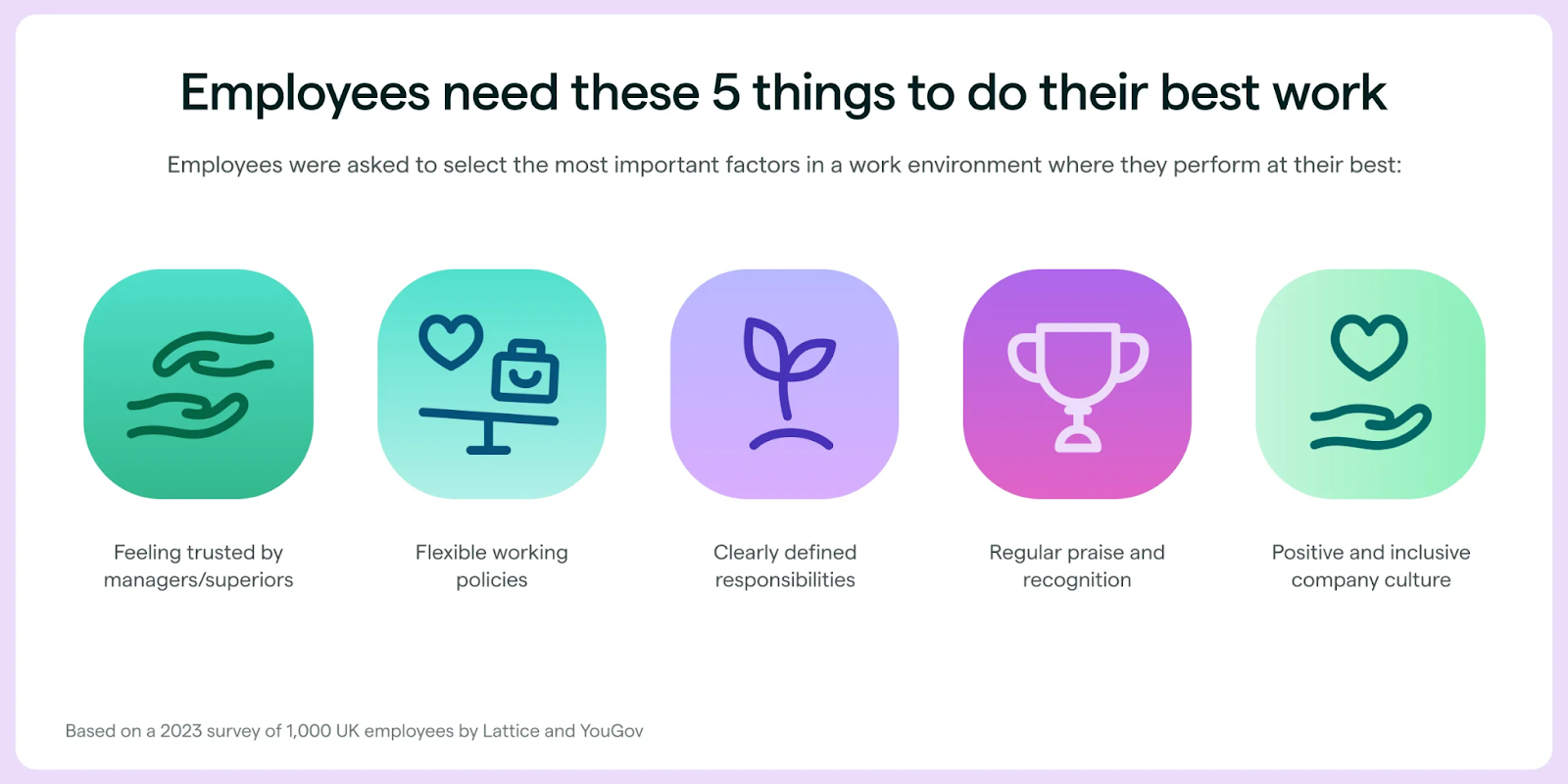
Goal-setting frameworks like objectives and key results (OKRs) and key performance indicators (KPIs) provide a solid grounding for employees and managers to establish those expectations and track progress toward them, leaving less room for confusion.
What to watch out for: Avoid vague or ambiguous wording and inconsistent targets. If employees aren’t clear on what’s expected of them, it can cause confusion and frustration. Uncertainty is toxic to engagement and motivation, and by extension to work performance.
2. Regular Feedback and Coaching
There’s a reason some employees dread annual reviews. They can see reviews as retrospective judgment sessions for analyzing every little flaw in their past performance. Rather than spurring stronger future performance, highlighting underperformance can easily demotivate your employees.
However, if you treat performance management as an ongoing part of employees’ work, they can see it less as a critique of the past and more as a tool for keeping their present performance on point. Regular one-on-ones, complemented by informal check-ins, also help them course-correct before small issues become big problems.
Getting input in between periodic reviews keeps the focus on maintaining good performance rather than making up for past shortfalls. That’s not just more supportive for employees, but it also makes for better business results.
What to watch out for: If you leave problem-solving too long, you can lose the obvious connection between problem and solution. Employees might be surprised by your feedback or find it harder to make the change after so much time has passed. But be careful not to overdo it. Micromanaging your employees can cause frustration.
3. Recognition and Motivation
Motivation can come from outside (extrinsic) or internal (intrinsic) factors. Both have their benefits, but for long-term performance improvement, you want your employees to be self-motivating. That means delivering extrinsic motivation that encourages intrinsic motivation.
Empathetic and considerate employee recognition, such as bonuses, awards, and promotions, can show employees that they’re valued and appreciated. But such extrinsic motivators should do more than simply reward employees for good performance, hard work, and initiative. They should also nurture intrinsic motivators, like morale, a sense of purpose, expertise, and autonomy. To help sustain long-term performance, they should also relate clearly to company values.
What to watch out for: Make sure recognition is clearly tied to good performance behavior, and avoid flattery.
4. Skills Alignment and Development Opportunities
Employees are more likely to perform well if they feel their particular skillset matches the demands of their role. Regular, accessible skills training helps employees stay sharp so they can perform better, even as tech tools and work processes change.
Putting their know-how to good use makes people feel competent in their work and more capable of meeting their personal and organizational goals. Skills alignment also supports career development by equipping employees with the tools to advance within the company.

And, with Gallup reporting that employees who feel supported in their development are significantly more likely to stay with their organization, we recommend coupling skills-building with clear progression pathways to maximize retention and growth. That way, employees can see not just how they're growing, but where that growth is taking them.
What to watch out for: Be aware of skill gaps, both in individuals and teams, and ensure there are clear professional development opportunities or advancement paths so your employees can reach their full potential.
5. Psychological Safety and Trust in Leadership
Employees work best when they feel secure and trusted. When people don’t feel confident in what they’re doing, are worried about being judged, or are afraid of making mistakes, they’re not likely to push themselves.
When leaders encourage experimentation and open communication, it builds the trust that fuels employee productivity. It creates a permission structure and an atmosphere of psychological safety that gives employees the confidence to innovate responsibly, contribute to decision-making, and give critical feedback without fear of blame.
What to watch out for: Avoid emotionally-loaded feedback, as this can discourage employees, get their defenses up, and cause conflict that impacts performance in the long run. Also, be conscious of the message your own leadership behaviors send. Employees consider what you do, not just what you say. If your actions don’t match your words, you stand to lose the trust of your people.
6. Resource and Workload Balance
When you’ve got an important objective, going the extra mile to achieve it can be truly rewarding — for you, your team members, and even the organization. But chronic overwork can hit performance hard.
Under sustained pressure to perform, employees can lose focus and be less careful about their work. At worst, they can burn out, leaving you with lower quality of work, absenteeism, and even turnover.
Resource gaps can be just as damaging as overwork. Employees who lack the tools, information, or support to do their jobs effectively are set up to struggle — and no amount of effort can fully compensate for that.
The bottom line is, investing in employee wellness and resources can help your teams reach peak performance.
What to watch out for: Be alert to signs of fatigue, disengagement, or burnout, such as declining performance. Monitor workloads and make sure you don’t overburden high performers.
{{rich-highlight-2}}
6 Strategies for Improving Employee Performance
Strong performance doesn’t happen by accident — it comes from intentional practices. Here are six proven approaches:
1. Set clear, measurable goals.
If you want to guarantee strong performance from your teams, make sure they have well-established goals with clear metrics.
SMART goals (which are specific, measurable, achievable, relevant, and time-bound) provide employees with precise and well-rounded targets with an unambiguous metric for success. Goal-setting approaches like OKRs create cascading goals that flow from the organizational level to the individual, creating alignment between employees’ performance and the company’s success.
Making all goals accessible through your people management platform means that employees and leaders can review and adjust them quarterly or as needed.
2. Implement constructive employee feedback practices.
Building and embedding a feedback culture in your business keeps individuals and teams focused on their performance. Introduce weekly or biweekly one-on-ones to maintain ongoing performance. Regular informal check-ins can also keep teams on track and surface any issues before they become major problems.
Effective 360-degree reviews offer even more in-depth feedback from managers, peers, and direct reports. That comprehensive perspective can help you home in on the key areas to target for improvement. It also creates a safe space to offer upward feedback to managers. When employees can feel that their input and perspectives are welcome, it can be a real morale boost that helps embed that feedback culture and feeds into better performance.
If your performance and talent reviews surface any issues, you can address them using a performance improvement plan (PIP). This gives your employees a framework for improvement and shows how you’ll support their efforts.
3. Recognize, praise, and reward performance.
Beyond feedback, actively celebrating outstanding performance shows that you value your employees’ efforts. Prioritize timely and genuine praise and recognition when someone goes the extra mile, gets promoted, or reaches a key milestone.
Develop a multi-level recognition system that encourages:
- Manager-led recognition, such as public acknowledgements of high performance
- Peer-to-peer praise, where colleagues can highlight and support each other
- Reward structures, such as bonuses or career development opportunities
Making recognition and rewards accessible as part of daily workflows (for example, by using a tool like Lattice Praise), you help to cultivate morale, engagement, and higher performance.
4. Create clear growth plans.
Lattice’s 2026 State of People Strategy Report found that HR’s next highest priority after performance and engagement was learning and development (L&D). Nearly a third (31%) of HR leaders cited L&D as a priority, recognizing the importance of providing employees with potential for future growth.
Establish well-defined individual learning paths that provide employees with development opportunities aligned with their career goals. Document and communicate clear expectations in writing and track your employees’ professional development outcomes.
Combine training programs with stretch projects to help employees push themselves to greater performance. Then, support their efforts with constructive mentoring and cross-functional rotations. For example, you might give a high-potential customer support lead the chance to run a small process-improvement project, supported by a mentor in operations.
These strategies can demonstrate your commitment to your employees’ growth, while also giving them something to drive for.
5. Invest in manager enablement.
Great performance starts with strong leadership, so it’s also crucial to train managers on coaching employees effectively. Provide managers with communication training so they know how to deliver clear, constructive feedback. Coach them on collaborative goal-setting using OKRs or SMART goals.
Help managers recognize early signs of underperformance or burnout — drops in work quality, missed deadlines, or less engagement in meetings. Use role-plays to train them on how to intervene effectively and handle difficult feedback, focusing on empathy and joint problem-solving rather than blame.
Encourage managers to foster a supportive company culture to build trust and openness. This could mean starting one-on-ones with a quick personal check-in to strengthen rapport and surface any issues.
Finally, provide the right tools to help managers integrate talent and performance management, to keep goals, performance, and career growth records aligned.
6. Create psychological safety.
Make sure to incorporate employee wellbeing and inclusion into your performance strategy. Supporting your employees’ physical, mental, and emotional health will help them maintain their performance over time.
Use wellness initiatives to prevent burnout and promote rest and recovery. No-meeting days, flexible work, and paid time off can actually improve performance by letting your people recharge their batteries. For example, according to research published in Frontiers in Psychology in 2021, recovery experiences like vacations led to increased creativity at work.
Choose performance management software that allows you to monitor workload distribution across teams, and use pulse surveys to assess employee sentiment and wellbeing.
{{rich-highlight-1}}
How Lattice Helps Improve Employee Performance
Improving performance is easier when your tools work together. Lattice brings reviews, goals, feedback, and development into one system so managers and employees have a shared view of expectations and progress. Here’s how each part of the platform supports stronger, more consistent performance:
- Lattice Performance Management enables leaders to manage continuous reviews, goal tracking, and 360-degree feedback within a single platform. Employees can see exactly how their own work supports and ladders up to the overall organizational priorities. Managers and employees can collaborate on goal-setting using OKRs or SMART goals, and track progress in real time.
- Lattice Praise integrates with email, Teams, and Slack channels to let managers and peers alike recognize and celebrate each other’s accomplishments and offer constructive feedback.
- Lattice 1:1s enables managers and team leads to facilitate check-ins and collaborate on shared agendas, notes, and action items so everyone is up to speed. Managers can document and follow up on coaching conversations, priorities, and obstacles.
- Lattice Grow can empower employees to take charge of their own career paths and enable tailored development plans that help employees imagine a future at your company. They can work with managers to collaboratively create Individual Development Plans (IDPs), complete with competency matrices to help plan for career development.
- Lattice AI helps HR highlight skill gaps and coaching opportunities, and spot patterns, performance dips, or engagement risks early. Smart analysis of performance data helps you pinpoint improvement opportunities and suggest personalized development plans, based on career paths, performance reviews, and feedback.
To discover how Lattice can help you continually improve employee performance with clarity, consistency, and coaching, request a demo.
Get more out of weekly one-on-ones.
In this free guide, we break down how to lead conversations that strengthen relationships, unlock employee potential, and drive results.
What’s inside:
- The proven structure for high-impact one-on-ones
- Tips for balancing tactical updates with long-term career coaching
- Conversation starters that actually spark performance
- How to turn meetings into momentum
- Real advice from Lattice customers who’ve seen results