No CFO would accept a financial close that happens once a year. No COO would run operations on annual status updates. Yet most companies still manage their largest operating expense, people, on exactly that cadence.
The annual review is a 12-month feedback loop. By the time a problem surfaces, it has already cost you: in missed targets, in drifting priorities, and in the high performer who quietly took a recruiter's call in March.
HR leaders already see it. In Lattice's 2027 State of People Strategy Report, a survey of 1,358 HR professionals, 38% named performance their top priority (42% in the US). The cadence is moving too: 33% of organizations now run reviews quarterly and 12% monthly, triple the share running monthly reviews in 2025.
Continuous performance management shortens that loop from a year to a week. Goals stay current, feedback happens close to the work, and reviews summarize a year of evidence instead of reconstructing it from memory. This isn't an HR nicety. It's an operating discipline, and it pays off where executives keep score: retention, productivity, and execution against strategy. Here's the business case, and how Lattice makes it work.
{{rich-takeaway}}
The Cost of Waiting a Year
The annual review doesn't fail because managers are lazy. It fails because it's built on a cadence the business abandoned years ago. Plans change quarterly, priorities shift monthly, and the review still arrives once, late, and mostly from memory. That gap shows up on the P&L in four places.
- Regrettable attrition. Gallup estimates that replacing an employee costs one-half to two times their annual salary. More telling: 52% of people who quit say their manager or company could have kept them, and 51% say no leader talked to them about their satisfaction or future in the three months before they left. Those aren't surprise exits. They're missed conversations.
- Disengagement at scale. Global engagement fell to 20% in 2025, and Gallup puts the price of low engagement at roughly $10 trillion in lost productivity — about 9% of global GDP. Manager engagement dropped faster than anyone's, from 27% to 22% in a single year.
- More work, same paycheck. In Lattice's 2027 report, 54% of HR professionals say employees are being asked to do more without more pay, up from 43% a year earlier. That's the setup for the next wave of regrettable exits, and annual reviews won't catch it in time.
- A review process nobody believes in. Only 14% of employees strongly agree their reviews inspire them to improve. You are paying for a process that, by its own participants' account, mostly doesn't work.
- Expensive manager hours. When Deloitte audited its own system, it found that producing ratings alone consumed close to 2 million hours a year. That's time your most expensive people spend reconstructing the past instead of shaping what's next.
What Continuous Performance Changes
Continuous performance management replaces one big annual event with a few small, regular habits: goals that get updated as plans change, weekly check-ins, frequent feedback, and reviews that draw on all of it. The research on why this works is consistent.
- Frequency beats intensity. Gallup found that 80% of employees who received meaningful feedback in the past week are fully engaged. Short, regular conversations of 15 to 30 minutes outperform longer, rarer ones. You don't need managers to do more. You need them to do it more often.
- Better managers, measurably better results. In the same research, teams led by managers trained in these habits saw 21% to 28% lower turnover and a 20% to 28% higher likelihood of performance improvement compared with peers.
- Problems surface while they're still cheap. A missed goal flagged in week three is a course correction. The same miss discovered in a December review is a write-off. Continuous check-ins turn performance from a lagging indicator into a leading one.
- Reviews get faster and fairer. When a year of goals, updates, and feedback is already on record, reviews stop being an exercise in memory. Managers write from evidence, recency bias shrinks, and calibration becomes a conversation about data instead of anecdotes.
What It Means for Each Seat at the Table
The same system pays off differently depending on which number you own.
For the CEO, it's about alignment. Strategy only works if people know what it asks of them this quarter, and can see it change when the plan does. Lattice's 2027 report found that organizations doing a good job of living their values were twice as likely to say most employees can articulate company goals (44% vs. 22%), and more likely to say employees meet or exceed them (59% vs. 42%).
For the COO, it's about operating rhythm. Weekly performance signals belong in the same cadence as every other operational metric you already track. Your HR team is likely feeling the same pull: 51% of HR professionals say they're under pressure to quantify manager effectiveness with data.
For the CFO, it's about return on the biggest line item. Payroll is likely your largest expense. Continuous performance gives you the data to defend raises, spot flight risks, and stop paying for a process that doesn't change behavior. Most companies (64%) already use merit raises and bonuses to reward high performers. Those dollars are only as defensible as the performance data behind them.
How Lattice Makes It Operational
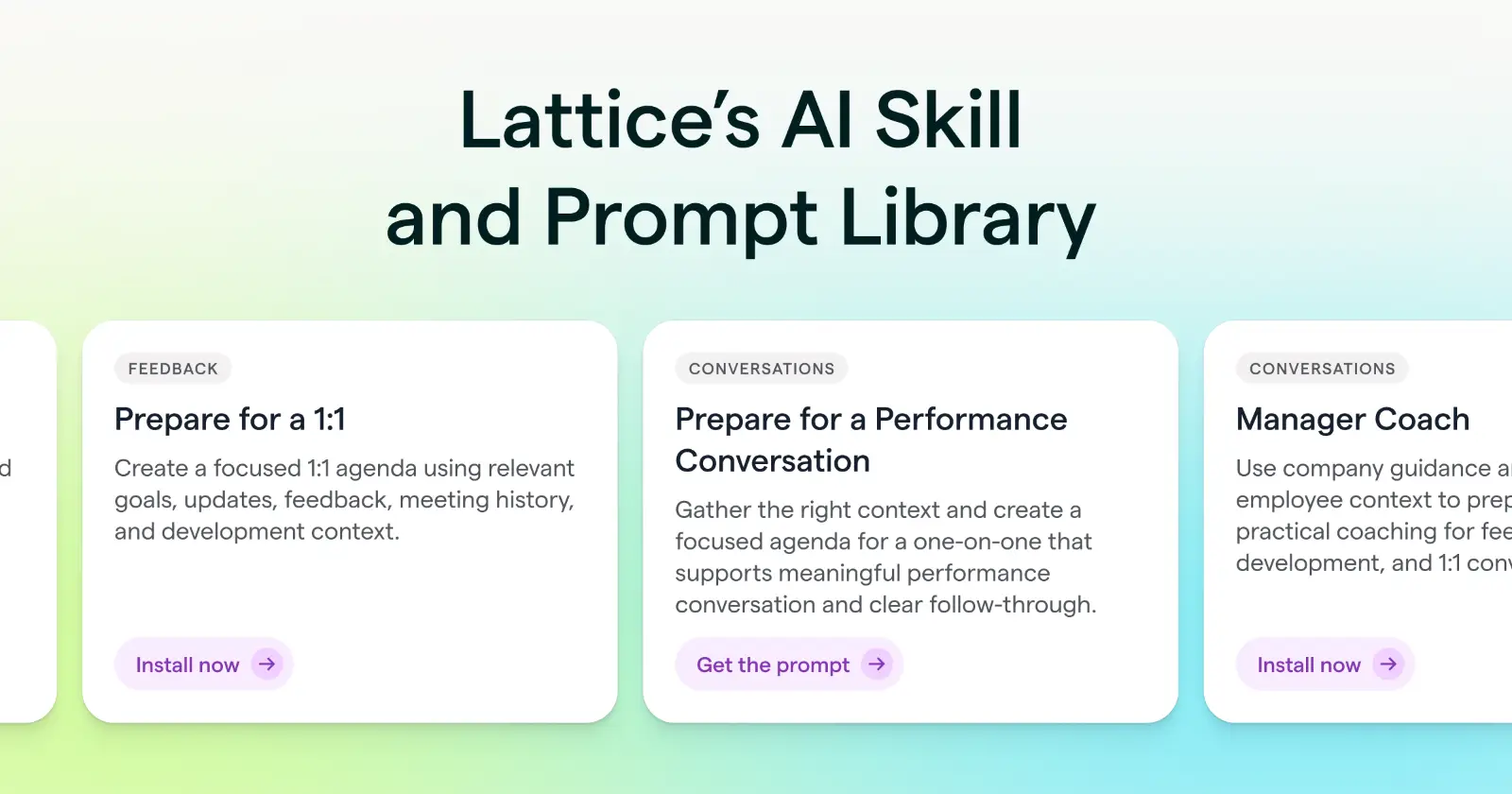
Continuous performance only works if it's easier than the alternative. Time is the real constraint: 70% of US HR teams say it's the main barrier to more 1:1s, updates, and feedback. Lattice puts the habits, the data, and the review process in one platform, so the system runs itself instead of relying on manager heroics.
AI handles the busywork. People make the calls. HR leaders are about twice as comfortable with managers using AI for meeting notes and emails as for deciding promotions or raises, and 74% believe companies cutting jobs for AI overestimate the productivity gains. Lattice AI is built for that line: it drafts reviews and summarizes a year of feedback so managers spend their time on judgment, not paperwork. Calibration and compensation decisions stay with humans.
Because everything lives in one place, each habit feeds the next. Goals shape 1:1 agendas. Updates and feedback become review evidence. Review outcomes inform compensation and talent decisions. Integrations with tools like Slack, Microsoft Teams, and HRIS systems such as Workday keep it in the flow of work. That matters: 47% of HR leaders regret a tech purchase from the past two years, and integration problems are the second-biggest reason.
The results show up in customers' numbers. Huge saved 2,000 hours by replacing inefficient annual peer review cycles. VantageWest reduced attrition by 27%. GoCardless raised review participation from 62% to 100%, and LiveRamp saw a 3.5x higher check-in completion rate than in its previous system.
Making It Stick
The shift fails when it's treated as an HR rollout. It succeeds when leadership treats it like any other operating change: clear expectations, visible sponsorship, and a few numbers reviewed on a regular cadence.
- Start with goals. Get company and department goals into the system first. Everything else hangs off them.
- Set a minimum rhythm. A biweekly 1:1 and a weekly update is enough to start. Consistency matters more than volume.
- Model it from the top. If the executive team writes updates and holds 1:1s in the system, managers will follow. If it doesn't, they won't.
- Keep the review, change its job. Reviews still matter for calibration and compensation. They should summarize a year of evidence, not replace it.
- Put the metrics on the exec dashboard. Review check-in completion, goal progress, and regrettable attrition alongside revenue and burn. What gets reported gets managed.
The Bottom Line
You wouldn't run finance, sales, or operations on a once-a-year feedback loop. Your people deserve the same operating discipline, and so does the budget that pays them. Continuous performance management turns your largest expense into something you can see, steer, and improve every week.
Lattice gives you the system to do it. See how Lattice Performance works. If you're the seeing-is-believing type, why not take an interactive tour?
Key Takeaways
- The annual review is a 12-month feedback loop for your largest expense. By the time it flags a problem, you've already paid for it in missed targets and regrettable exits.
- Frequency beats intensity. 80% of employees who got meaningful feedback in the past week are fully engaged, and short, regular check-ins outperform long, rare ones.
- The payoff lands where executives keep score. Better alignment for the CEO, earlier warning signs for the COO, and lower attrition and more defensible comp spend for the CFO.
- It only sticks if it's easy. Lattice connects goals, 1:1s, updates, feedback, reviews, and analytics in one platform, with AI handling the busywork so managers can focus on judgment.