
There’s a clear difference between a boss and a coach. Today’s most effective managers are choosing to be the latter.
Modern managers aren’t just in charge of assigning work and evaluating performance. They’re also responsible for developing their people — asking thoughtful questions, giving meaningful feedback, and helping employees grow, as coaches do.
However, many managers lack formal coaching training, feel unprepared for challenging conversations, or don’t have the time or visibility to coach their teams effectively. The result is surface-level feedback, missed growth opportunities, and reactive (not proactive) development.
That’s where an AI coach can help (and no, we’re not talking ChatGPT!). In this article, we’ll explore how HR teams can use artificial intelligence to equip managers with the insights, guidance, and time they need to become more effective coaches. All without adding more to your HR team’s plate!
Why Coaching Matters for Employee Engagement and Performance
Traditional, top-down management styles in which leaders set the strategy with little room for employee input are quickly becoming relics of the past. In these environments, employees may only hear from their manager during annual reviews or when something goes wrong, reinforcing the idea that the manager’s main role is to judge performance and control promotions and raises. Over time, this approach can limit innovation, reduce autonomy, and lead to employee disengagement.
In contrast, coaching-oriented leadership takes a more collaborative approach. Instead of only evaluating results, coaching managers build ongoing relationships with employees through regular one-on-ones, continuous feedback, and collaborative problem-solving. They focus on employee growth in addition to performance.
By creating more consistent opportunities for support, development, and two-way communication, coaching managers can have a measurable impact on engagement and performance, including:
- Increased employee engagement and motivation: Managers trained in coaching and people development see up to 18% higher team engagement. And when employees feel their manager is invested in their growth, they’re more likely to go above and beyond in their roles.
- Faster skill development: Continuous feedback helps employees identify strengths and areas for improvement, so they can take action in real time.
- Stronger trust between managers and employees: Two-way feedback builds trust and encourages employees to speak up, share challenges, and seek support when they need it.
- Higher retention and internal mobility: Employees who understand their growth opportunities are more likely to stay and build long-term careers within a company.
- Greater confidence and autonomy: Ongoing coaching empowers employees to take ownership of their work and make decisions more independently.
Together, these benefits make investing in manager coaching a critical priority for organizations looking to build resilient, high-performing teams. But scaling that impact across every manager isn’t easy…unless you have AI, of course!
How AI Can Help Managers Become Better Coaches
AI tools don’t replace human coaches — they make them more effective. With AI streamlining preparation and documentation, managers can focus more on their people and delivering feedback at the right moment.
AI can elevate everyday coaching sessions by helping to:
- Surface performance trends and development insights: When managers are in execution mode, they have less time to step back, analyze data, and connect the dots across performance, feedback, and goals. AI-powered insights can do that heavy lifting by identifying trends like missed deadlines, feedback gaps, or stalled goal progress so managers can deliver the right support at the right time.
- Suggest coaching questions or discussion prompts: Great coaching starts with great questions, but they're not always easy to think of on the spot. AI can recommend tailored prompts based on an employee’s goals, recent feedback, or performance trends, helping managers guide more meaningful conversations.
- Highlight potential risks like engagement dips or workload imbalances: AI can surface early warning signs — like slipping sentiment scores, reduced participation, or uneven workloads — that might otherwise go unnoticed. With this newfound visibility, managers can identify and address issues early, before things escalate to burnout, disengagement, or turnover.
- Streamline one-on-one and career conversation prep: Instead of winging it or defaulting to to-do lists, managers can use AI to suggest discussion topics, leadership coaching angles, and follow-up actions ahead of time. Then, they can jump straight into impactful professional growth conversations with their direct reports.
- Automate tasks to free up more time for coaching conversations: When managers are slammed, coaching is often the first thing that slips. By automating tasks like note-taking, data analysis, and scheduling, AI frees up managers’ time to mentor and develop their teams.
Practical Ways HR Teams Can Use AI to Build Coaching Cultures
Building a coaching culture doesn’t happen by accident. It requires the right combination of manager training, consistent habits, data-driven insights, and tools. Here’s how HR teams can use these ingredients to form a recipe for coaching success.
1. Train managers on coaching fundamentals.
You can’t expect managers to become great coaches on their own. HR teams need to equip them with the skills and frameworks required to coach effectively by teaching them how to:
- Ask the right questions
- Give and receive feedback
- Build individual development plans
- Navigate difficult development conversations
- Use the GROW coaching model to help employees
Next, ensure managers understand how growth works within your organization. That includes:
- Where to find open roles
- How career paths are structured
- How to use competency frameworks
- What professional development resources are available
They should also be familiar with available employee resources — like mentorship programs, tuition reimbursements, and training opportunities — so they can suggest them to their teams.
If you’re using an AI-powered coaching platform like Lattice, training and new-hire onboarding should also cover how to use these tools effectively. Walk through the tool’s user experience and share real use cases, suggested prompts, and success stories so managers feel confident using the platform right away.
Finally, set clear expectations for responsible AI use. Provide a clear overview of how large language models (LLMs), AI algorithms, and machine learning models work, and reinforce that confidential company or employee data should never be entered into these tools. This helps protect your business, supports your people, and strengthens your overall data protection practices.
2. Use AI insights to guide development conversations.
AI can surface performance trends, feedback gaps, and skill development opportunities in real time. Instead of relying on gut instinct, managers can use these insights to have more targeted, impactful coaching conversations that are grounded in data.
With AI-powered chatbot tools like the Lattice AI Agent, managers can quickly review performance trend summaries, uncover employee personal growth areas, and get recommended actions based on engagement and feedback data — without having to dig through multiple systems. This makes it easier to move from insight to action in the moment.
For example, Lattice might highlight that an employee consistently delivers strong results but hasn’t taken on stretch projects or built skills in a key area, like cross-functional collaboration. The tool can then suggest that the manager brainstorm some stretch projects and cross-functional opportunities to expand their employee’s skill set.
Have a manager who’s unsure how a conversation with an employee might go? They can role-play a traditional coaching session with the Lattice AI Agent to build confidence ahead of the meeting and create space for meaningful self-reflection. The result: a more proactive approach to coaching that supports ongoing leadership development.
3. Encourage regular one-on-one meetings.
Too many organizations treat development as a once-a-year conversation during performance reviews. In reality, growth only happens through ongoing dialogue.
The best way to make development part of everyday work is to incorporate it into regular one-on-one meetings. Encourage managers to focus these conversations on sharing feedback and growth opportunities, tracking goal progress, and adjusting development plans as needed. This helps employees adapt in real time and stay on track to meet their goals even as business needs evolve.
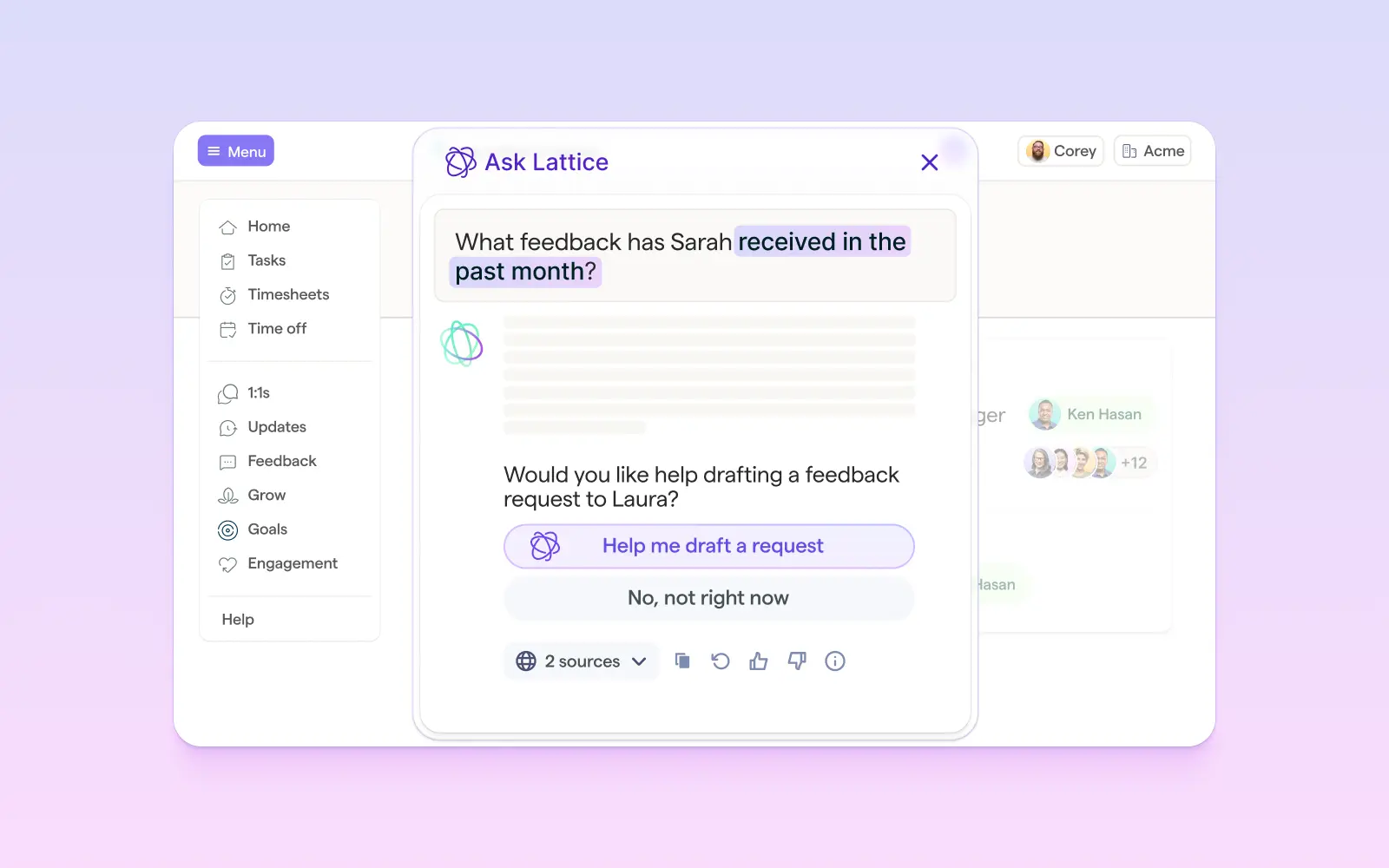
Tools like Lattice Coach help managers lead more effective coaching conversations. By surfacing insights from performance reviews, feedback, goals, and past one-on-ones, Lattice Coach provides personalized coaching recommendations, suggested talking points, and prompts for development-focused one-on-ones. Instead of starting from scratch, managers can walk into each conversation ready to focus on growth.
This not only improves the quality of one-on-ones but also helps scale consistent, high-quality coaching across your organization without adding more lift for your HR team.
4. Align coaching conversations with performance reviews and goals.
Formal career discussions still play a crucial role in employee growth and should complement more routine coaching opportunities. These moments give managers and employees dedicated time to reflect on strengths, identify areas for development, and align on future goals.
From there, employees and managers can work together to build or update an existing individual development plan that guides the employee’s growth throughout the next review period. Managers can then reinforce that plan through ongoing check-ins, using it as a foundation for continuous coaching throughout the year.
5. Use data to identify development opportunities and skills gaps.
Beyond supporting development at the individual level, AI helps HR teams optimize it across the organization. By combining manager input with AI-powered insights, HR leaders can spot patterns across teams — from common skill gaps to emerging development needs. With this visibility, your team can design more targeted training programs, introduce focused learning and development initiatives, and align growth opportunities with evolving business priorities.
Transform managers into coaches with Lattice.
With AI, scaling high-quality coaching is no longer out of reach. Tools like Lattice AI Agent and Lattice Coach give managers real-time visibility into performance, engagement, goals, and feedback — all in one place. Instead of piecing together information, managers get actionable, AI-powered insights that help keep employee growth front and center year-round.
It’s like giving every manager access to an on-demand executive coach. They can ask the Lattice AI Agent questions anytime to learn coaching methodologies, build real-world coaching skills, and gain the coaching experience they need to navigate challenging situations with more confidence. This turns everyday challenges into a continuous learning experience.
This means better feedback, stronger one-on-ones, and more intentional development for both managers and employees. And for HR teams, it creates a scalable way to drive the consistent coaching needed to build a high-performance culture.
Schedule a Lattice demo today to learn how your organization can start scaling effective coaching.
Frequently Asked Questions (FAQ)
How do you train managers to be better coaches?
Start by equipping managers with coaching tools and frameworks to ask effective questions, give actionable feedback, and guide development conversations. Reinforce this training with ongoing support, real-world practice, and AI-powered tools that provide ongoing insights into employee growth and coaching guidance in the flow of work.
What tools help managers coach their teams more effectively?
Tools that centralize feedback, goals, performance data, and engagement insights make coaching more consistent and informed. AI-powered platforms, like Lattice, can also surface real-time insights and suggest coaching prompts, helping managers have more targeted and impactful growth conversations with their direct reports.
How can HR teams scale manager coaching across the organization?
HR teams can scale coaching by standardizing training, embedding coaching into regular workflows like one-on-ones and performance reviews, and using AI to deliver insights and guidance at scale. This combination ensures every manager has the support they need to coach their teams effectively.