
This is not a neutral moment for organizations. Political division, global conflict, and employee polarization have made diversity, equity, inclusion, and belonging (DEIB) work feel more exposed — and in some cases, risky.
“2026 is a different chapter,” said Dani Herrera, independent culture, talent, and DEIB consultant. “The political landscape has introduced a kind of fear we haven’t seen before, and it’s not just hitting the performative companies. It’s hitting companies that were doing real, meaningful work.”
Now is not the time to pull back. Getting that real, meaningful work done means connecting your DEIB initiatives to tangible business outcomes that strengthen decision-making and drive long-term business success.
What’s changed about the business case for DEIB in 2026?
DEIB’s place in organizational strategy has never been under more scrutiny. But while the business case for diversity hasn’t changed in broad terms, the global context has moved on since its peak in 2020.
Same rules, very different reality. And that’s exactly what HR leaders need to bear in mind going into this work in 2026.
“2020 wasn’t one story — it was two,” said Herrera. “Some companies made genuine investments in DEIB because they saw the value, either because employees demanded it or because leadership understood the connection between inclusive systems and better outcomes. And then there were the companies doing performative DEI: the pledges, the statements, the one-off trainings that checked a box but didn’t touch a single system.
{{rich-highlight-1}}
“By 2023, the performative companies started pulling back,” she continued. “As performative DEI doesn’t create sustainable change, they were having a hard time justifying the cost.”
In 2026, Herrera said, the underlying purpose of DEIB hasn’t changed. But the need to build a strong business case is more urgent than ever.
“The shift isn’t really about the business case itself,” she said. “Leaders still care about retention, talent pipelines, employee lifecycle, equitable pay, and manager effectiveness. They just need it connected to those operational priorities.”
How DEIB Impacts Business Performance
By this point, most of us have heard the core arguments about why diverse companies lead to a better work environment for all:
- McKinsey’s 2023 Diversity Matters Even More report found that organizations with a diverse executive team experienced better financial performance, higher job satisfaction, and stronger social impact ratings.
- A 2023 article in Harvard Business Review found that companies with stronger DEIB performance had a higher "change power" — the ability to adapt and navigate change effectively — which was associated with better financial performance, leadership, and employee engagement.
- A 2024 study by researchers at the London School of Economics found that DEIB can also positively impact an organization’s long-term market performance, especially in organizations with ethnically diverse senior leadership teams.
And in our 2026 State of People Strategy Report, we found that this correlates directly with how HR teams invest in this work. Respondents from high-performing HR teams are five times more likely than low-performing peers to prioritize DEIB — even as the landscape and budgets continue to shift.
None of these outcomes are new. But the difference in 2026, said Herrera, is what actually resonates with decision-makers.
“The innovation and performance data haven’t gone anywhere. But what’s changed is what actually gets budget holders to pay attention,” she noted.
“Litigation risk is the new big bad. Legal leaders are increasingly saying that scaling back DEIB could expose companies to more discrimination claims, not fewer. When you remove the structures designed to create equitable outcomes (structured interviews, equitable promotion criteria, bias-aware performance reviews), you’re not creating a fair environment. You're reverting to whatever defaults and biases were already baked in. That’s a real legal concern, not a theoretical one.”
How to Build a Strong Business Case for DEIB
In 2026, the fundamentals of building a strong business case for DEIB still hold true: Identify the systems perpetuating disparity, connect their impact to business outcomes, and frame the solution within the context of how it moves your organization forward.
And if anything, the current context for DEIB requires a more rigorous approach than before. As Herrera put it: “This is not the moment to stop making the case. It’s the moment to make a more robust, systemic one.”
1. Start by diagnosing where the problems are.
Most diversity initiatives fall flat because they don’t deliver actual results. They become symbolic gestures disconnected from the systems that actually lead to tangible business outcomes and a more inclusive environment long-term.
The key is positioning your case around the systems contributing to disparity. Fix those, and you’ll fix the business outcomes they’re impacting.
“The business cases that survive this environment are rooted in operations,” Herrera explained. “If your entire DEI strategy was built on a pledge, a landing page, a ‘diversity hiring’ initiative, [or] a heritage month calendar, it’s going to crumble under pressure because it was performative to begin with, and there was nothing structural holding it up. But if your case is built around fixing real systems, like how you hire, promote, give feedback, and determine pay, then the case makes itself because those are things every leader already agrees matter.”
Start by looking for lagging indicators in your internal data, then segment by demographic data to understand where inequities are hitting underrepresented groups. These are problems that have already shown up — like increased turnover, declining employee engagement scores, or disparities in promotion rates. These can highlight where there are problems in your existing systems.
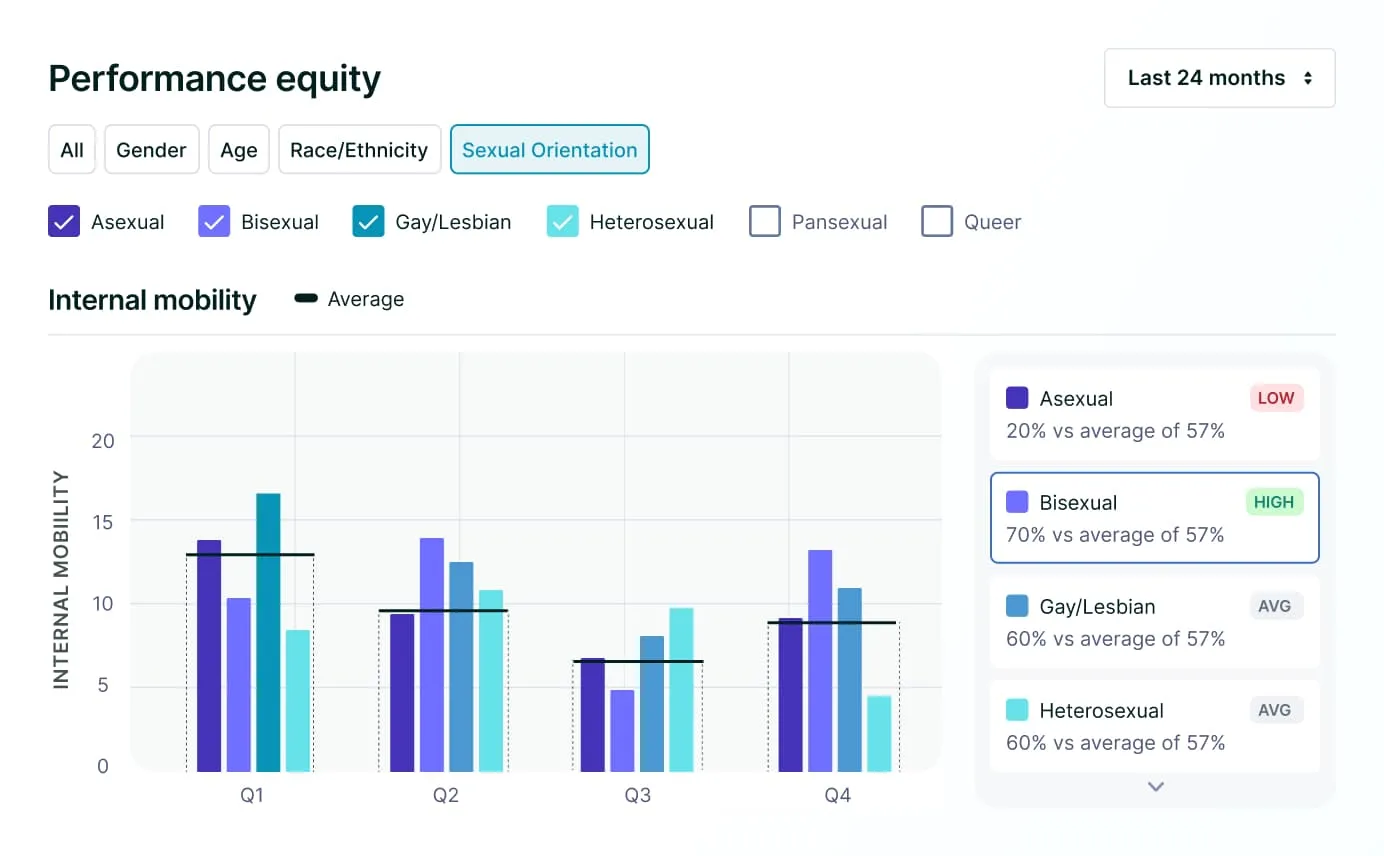
Then, use that information to identify where inequities are emerging across your employee lifecycle. Look at processes like performance management, compensation, and talent acquisition, as well as qualitative data, to identify different perspectives and nuances in where the problem shows up.
It’s the difference between saying turnover among women engineers is at 50%, and identifying that they’re being promoted at half the rate of their peers despite similar performance ratings. In that scenario, what seems like a retention problem on the surface is actually a gender diversity issue perpetuated by a broken promotion pathway.
{{rich-highlight-2}}
2. Frame your case in terms of what your business cares about.
Once you’ve diagnosed where the problems are, you need to translate them into language and messaging that mirrors what your senior leaders and other key stakeholders care about the most.
“Connect the work to what the business already says it values,” Herrera advised. “If your CEO is talking about retention, show them the inclusion data. If your CFO is worried about legal exposure, show them what happens when you remove fair process safeguards. Stop positioning this as a separate budget line and start positioning it as how you do business.”
In practice, this might mean positioning equitable performance management practices as a revenue driver because they retain top performers, or framing pay equity audits as a compliance and risk mitigation strategy. The point isn’t to rebrand the work — but to show it actually contributes to how successful the business is overall.

3. Quantify the impact of acting — or not acting.
Next, it’s time to do the math and back up your case with numbers — and we don’t mean HR metrics, like an X% drop in retention or lower engagement scores. You need to work backwards from your organization’s strategic objectives and translate HR outcomes into business costs, risks, or opportunities that can clearly quantify what those outcomes mean for the business.
For example, if your organization is in retail, a lack of team diversity in product development could impact sales performance and customer retention. If you’re in professional services, you could connect low team diversity to client churn and stalling account growth. You need to be able to quantify the scale of the challenge or opportunity using the metrics of the business.
To work through our previous example in an organization of 500 employees:
- Data: Women engineer turnover is currently at 50%. Engineers make up 20% of our workforce, and women comprise 30% of the engineering department.
- Impact: Based on that data, we can expect 15 women engineers to leave this year. Assuming an average compensation of $150,000 and a conservative replacement cost of 1.5x salary, this would cost the business $3.3 million in direct replacement costs alone.
4. Define your solution, success metrics, and budget.
Time to put your numbers to work. Start by prioritizing which issues are the biggest risk to the business, and break them down into a set of concrete actions that are immediately manageable and can drive measurable results.
Then, select one specific action or initiative to pilot based on its potential impact — and consider how you’ll connect it to results. For example, if you’re proposing addressing employee turnover among women engineers by introducing new, structured promotion criteria and manager training, you could consider:
- How did manager training help reduce time-to-promotion rates or increase total promotions of women engineers?
- How did a new structured promotion criteria improve employee retention or save on backfill costs?
- How did your initiative impact product delivery timelines or time-to-market?
- How did your initiative impact the organization’s technical leadership pipeline and executive diversity?
You’ll also need to outline a budget and a timeline — building a detailed plan that covers rollout, measurement, and ongoing evaluation. This should connect the dots between the business impact of acting or not acting, the anticipated spend of your solution, and the time needed to see results, giving leaders a clear picture of their return on investment.
Common Pitfalls to Avoid
Even the strongest business case for DEIB can become a quagmire if HR leaders aren’t careful about how they position and pitch the work. Here are four traps to avoid — and what to do instead.
❌ Building Your Case on Morality Alone
Don’t get us wrong: Inclusion matters. DEIB is fundamentally the “right” thing to do. But alone, this isn’t enough to gain buy-in and budget from senior leaders or to quantify why this matters to the business and what needs to change.
What to do instead: Lead with the business problems you’re solving or opportunities that focusing on DEIB will unlock — whether that’s improving the bottom line, market share, customer retention, or something else. The moral case can reinforce your argument, but it’s not your entire foundation.
❌ Relying on External Benchmarking to Guide Internal Efforts
External benchmarking can be a really helpful exercise in understanding where your organization is currently in terms of diversity demographics — and it can even give you something to aim for. But pitching all of your DEIB initiatives based on hitting industry averages or matching other organizations means you’re not solving your problems from within.
What to do instead: Your DEIB business case should be rooted in your unique systems, data, and business outcomes. Use your initial root cause analysis to diagnose those problems before matching external standards.
❌ Failing to Match Your Message to the Audience
Your CEO and CFO might sound like they’re similar — but they’re not thinking about DEIB the same way. Pitching a one-size-fits-all case to every audience means you risk not speaking anyone’s language effectively.
What to do instead: Gaining buy-in is all about the right message, right framing, and right person. Understand what each leader prioritizes, and frame your case accordingly. If your CFO is focused on risk and cost control, those are the metrics you need to use. If your CEO is talking about annual recurring revenue and market share, connect DEIB to those.
❌ Proposing Too Much at Once
Once you’ve analyzed your data, you might feel a little overwhelmed. Problems are popping up everywhere like whack-a-mole — and it’s only natural to want to fix everything at once. But huge, shoot-for-the-moon initiatives with no clear focus or end goal are usually the first to get cut when budgets dry up.
What to do instead: Start by prioritizing your problems by their level of risk to the business — and then breaking down each into smaller, more manageable projects and pilots. For example, aim to launch one new initiative or focus only on one department. This will help you focus your efforts and track your success more effectively.
Building a DEIB Strategy That Survives Scrutiny
The business case for DEIB still has the same foundations as it did a few years ago. But the thing that’s changed is its urgency — and how HR leaders now position the work to ensure that programming sticks even when budgets and priorities shift.
Keeping DEIB initiatives in lockstep with business outcomes will help HR teams weather the current environment as it develops — keeping the business focus steady while working to build better organizations for people long-term.
“The companies that come out of this moment strongest are the ones that didn’t panic,” Herrera said. “The ones that stayed intentional, adjusted their language where it made strategic sense, and kept building systems that work for their people.”
And one of the most important tools HR teams have to intentionally build a more inclusive workplace is their data.
Lattice’s centralized platform brings together engagement, performance management, employee growth, and compensation to equip HR leaders with the insights to diagnose organizational disparities and lead actions that create an inclusive culture where everyone feels they belong.
Find out more about how Lattice can support your DEIB efforts by scheduling a demo.
Connect your people data to your business decisions.
Lattice Analytics can help you maximize performance, productivity, and engagement across your workforce with advanced people analytics.
Need some DEIB-specific questions for your next survey round?
We’ve rounded up 30 to choose from, or you can download our free template and get a jumpstart on your next survey.