
Mid-Year Performance Review Template
As part of a comprehensive performance management program, mid-year reviews are a powerful tool for enabling managers and employees to ask questions, address roadblocks, and recognize wins.


Unlock this template for free
By submitting your information, you agree to Lattice's Terms of Service and Privacy Policy. You can opt out anytime.
We've received your submission.
Turn your mid-year reviews into meaningful, forward-looking conversations, not just a checkpoint.
This free mid-year performance review template helps managers and employees reflect on progress, address challenges, and realign on goals halfway through the year. Designed to support development, it provides a structured framework for more thoughtful, productive performance conversations.
What Is a Mid-Year Performance Review?
A mid-year performance review is a structured check-in that takes place halfway through the performance cycle. Unlike annual reviews, which often focus on evaluation, mid-year reviews are designed to support growth, alignment, and course correction.
They create space for employees and managers to pause, reflect, and recalibrate. Instead of waiting until year-end to address issues or recognize progress, teams can make adjustments in real time, when it matters most.
As highlighted in the template introduction, mid-year reviews work best when paired with ongoing check-ins and annual reviews, forming a continuous performance management cycle focused on development and long-term success
Why Mid-Year Reviews Matter
Mid-year reviews occupy a unique place in the performance cycle. They’re typically lower pressure than annual reviews, which makes them especially effective for honest reflection and open dialogue.
When done well, they help organizations:
- Reinforce alignment on goals and expectations
- Identify roadblocks before they impact outcomes
- Support employee growth and development
- Recognize wins and progress in real time
- Increase engagement by demonstrating investment in employees
They also give employees a clearer sense of where they stand — and what they should focus on next.
What’s Included in This Mid-Year Performance Review Template?
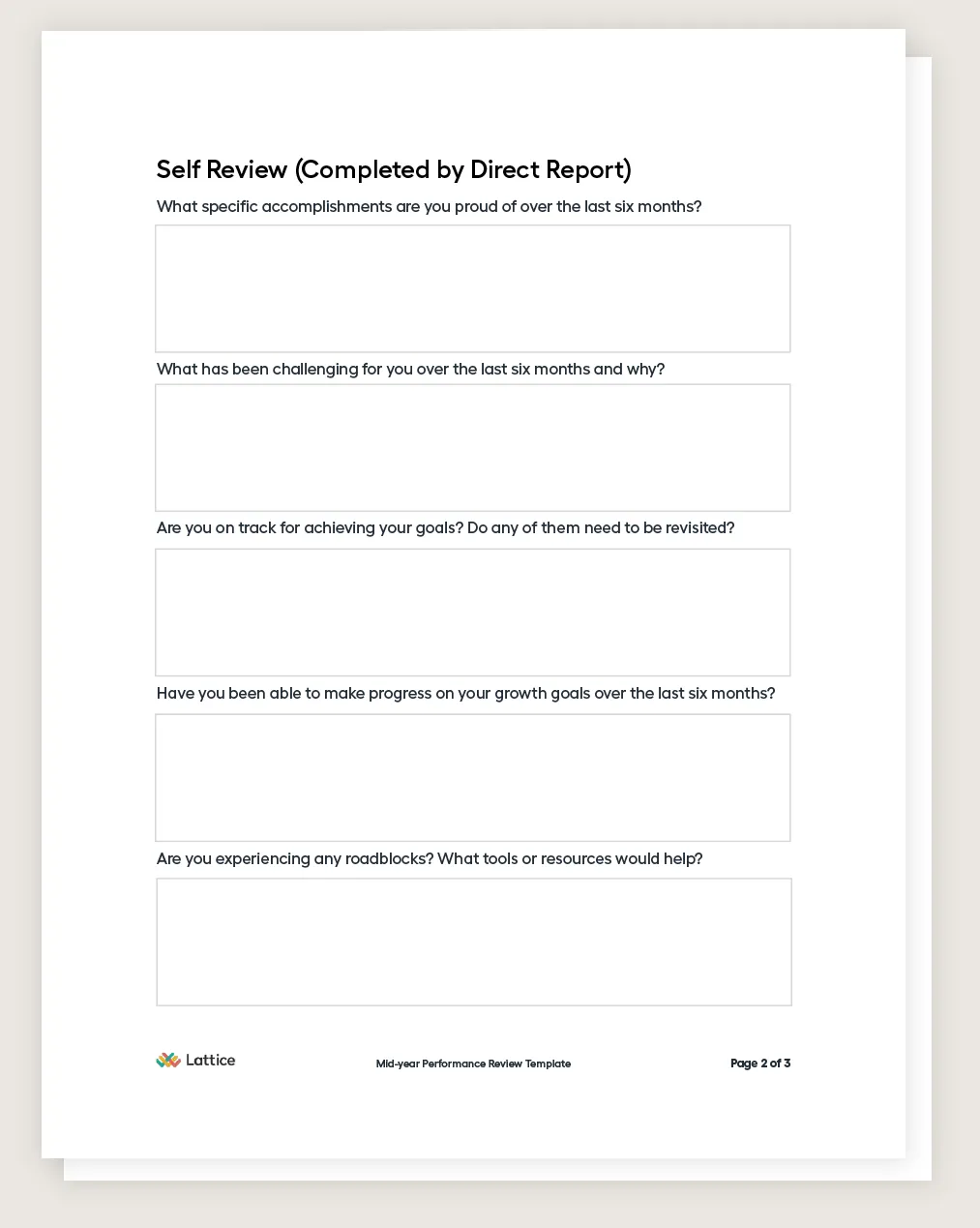
This template is intentionally simple and focused. It includes two core components — a self-review and a manager review — designed to complement each other and create a well-rounded conversation.
Rather than overwhelming participants with too many questions, it emphasizes a small set of high-impact prompts that encourage reflection, clarity, and actionable feedback.
Self-Review Questions (Employee Reflection)
The self-review section gives employees an opportunity to reflect on their own performance, progress, and challenges over the past six months.
Instead of simply reporting on outcomes, the questions encourage deeper thinking about growth, alignment, and support needs.
For example, employees are prompted to consider:
- What accomplishments they’re most proud of
- What challenges they’ve faced and why
- Whether they’re on track to achieve their goals
- How they’ve progressed on development goals
- What roadblocks or resource gaps they’re experiencing
A few sample questions from the template include:
- “What specific accomplishments are you proud of over the last six months?”
- “Are you on track for achieving your goals, or do they need to be revisited?”
- “Are you experiencing any roadblocks? What tools or resources would help?”
This reflection sets the stage for a more meaningful and balanced conversation with their manager.
Manager Review Questions (Performance and Development)
The manager review section builds on the employee’s self-assessment, focusing on performance, progress, and future development.
Rather than acting as a one-sided evaluation, these questions are designed to guide a collaborative discussion about what’s working and what could improve.
Managers are encouraged to reflect on:
- How well the employee has delivered on expectations
- Progress toward career and development goals
- Strengths and behaviors to continue
- Areas of opportunity or growth
- Skills to prioritize over the next six months
Sample questions include:
- “To what extent has this person delivered on expectations in the last six months?”
- “What would you like to see this person continue doing?”
- “What skills would you like to see this person further develop?”
These prompts help ensure feedback is both constructive and forward-looking.
How to Run an Effective Mid-Year Review
A strong mid-year review isn’t just about the template, it’s about how the conversation is facilitated.
To get the most value from this process:
- Treat it as a dialogue, not a formal evaluation
- Focus equally on progress and future direction
- Encourage employees to share openly and honestly
- Use the conversation to remove blockers, not just identify them
- Connect feedback to clear next steps and goals
The most effective mid-year reviews leave employees with greater clarity, confidence, and motivation for the second half of the year.
Who Should Use This Template?
This mid-year performance review template is designed for:
- HR and people teams building structured performance programs
- Managers running mid-cycle check-ins with their teams
- Organizations looking to improve continuous feedback practices
- Companies that want to balance accountability with development
It’s especially valuable for teams moving away from once-a-year reviews toward more frequent, growth-focused conversations.
If you want to make your mid-year reviews more structured, thoughtful, and impactful, this template provides a simple place to start. Download the free mid-year performance review template and support better performance conversations.
Frequently Asked Questions





Your people are your business
Ensure both are successful with Lattice.