
The Best AI Training Courses for HR, Managers, and Employees in 2026

Andy Przystanski
Andy Przystanski
Senior Content Marketing Manager
@
Lattice
@
Andy Przystanski
Andy Przystanski
Senior Content Marketing Manager
@
Lattice
May 1, 2026

HR leaders are increasingly being asked to do two things at once: use AI to run their function better, and help the rest of the organization do the same. That's genuinely a lot to figure out — especially when AI itself is changing so fast that any course you found six months ago might already feel dated.

So we did the legwork for you. Below, you'll find the best AI training available right now, organized by role and function — with honest notes on who each course is actually for and what it costs. The goal is simple: help you meet your teams where they are, without spending weeks researching options yourself.

{{rich-highlight-1}}

AI Training Courses

For Everyone

Before diving into function-specific training, it helps to make sure everyone shares a common language. Think of this as your company-wide onboarding to the AI era — a single course that gives your whole organization something to stand on together.

Google AI Essentials

All Employees

Coursera

Five-module intro covering AI basics, productivity, prompting, and responsible use. Taught by Google's own AI experts — the strongest single course to roll out company-wide.

For HR and People Teams

Artificial Intelligence for HR

HR and People

Academy to Innovate HR (AIHR)

Comprehensive HR-specific coverage: talent acquisition, L&D, performance management, workforce planning, and ethical AI use. Qualifies for global HR recertification credits.

Generative AI for HR Professionals Specialization

HR and People

Coursera

Three-course path covering generative AI fundamentals, prompt engineering, and HR applications across recruiting, onboarding, and performance — with hands-on labs throughout.

AI + HI Specialty Credential

HR and People

SHRM

Three-stage program from AI foundations through a real-world capstone. Earns 30 PDCs that auto-populate in your SHRM certification profile.

Artificial Intelligence for HR Professionals

HR and People

HRCI

Covers AI for core HR tasks — job descriptions, interviews, policy drafting — alongside legal compliance, ethical use, and DEI impact. Eligible for both HRCI and SHRM credits.

For Managers and Leaders

Generative AI for Business Leaders

Managers

LinkedIn Learning

Taught by LinkedIn's Chief Product Officer. Designed for senior executives who want a strategic understanding of generative AI — completable in a single sitting.

Ethics in the Age of Generative AI

Managers

LinkedIn Learning

Covers bias, transparency, data privacy, and building responsible AI frameworks. A strong companion to any other course on this list — the context that makes the rest land.

For Engineers and Developers

Generative AI for Software Developers Specialization

Engineering

Coursera

Three courses covering generative AI basics, prompt engineering, and building apps with GitHub Copilot, ChatGPT, and Google Gemini. No AI background needed — just dev experience.

AI-Powered Software Engineer Nanodegree

Engineering

Udacity

Hands-on program walking engineers through a full AI-assisted project — from first commit to finished product. Includes expert instruction and career coaching.

AWS Certified AI Practitioner

Engineering

Amazon Web Services

Validates foundational knowledge of AI, machine learning, and generative AI in cloud environments. Widely recognized for developers working with cloud platforms.

Azure AI Engineer Associate

Engineering

Microsoft

Validates the skills needed to build AI-powered applications using Azure services. Widely recognized alongside the AWS cert for developers in cloud environments.

For Marketing Teams

AI for Marketers

Marketing

HubSpot Academy

Covers AI for content creation, email campaigns, and CRM-driven workflows. Self-paced, beginner-friendly, and earns an official HubSpot certificate.

AI in Marketing Microcertificate

Marketing

Harvard Extension School

Strategic and hands-on skills across AI tools for content, campaign design, predictive analytics, and consumer behavior. No application required for the first course.

AI Marketing Course

Marketing

Harvard DCE

Focuses on AI-driven segmentation, campaign optimization, and cross-channel orchestration. Designed for senior marketing leaders driving AI transformation in B2B and B2C.

For Finance & FP&A Teams

CFI Certified AI for Finance Specialist

Finance

CFI

Hands-on applications in financial statement analysis, scenario planning, risk assessment, and dashboard creation. No coding background required — most learners finish in 30–35 hours.

AI for Business and Finance Certificate

Finance

Columbia Business School

Eight-week online program covering machine learning, predictive analytics, and generative AI through real-world case studies. Earns a Columbia Business School certificate.

AI for Finance Specialization

Finance

Coursera

Three-course path progressing from AI literacy and prompting to building custom AI-powered tools and workflows. Designed for finance professionals at any level.

For Sales Teams

Generative AI for Sales

Sales

LinkedIn Learning

Covers AI across the full sales process — prospecting, lead generation, email campaigns, scheduling, and data analysis. The first module in a broader Microsoft 365 Copilot learning path.

AI for Sales

Sales

HubSpot Academy

Covers AI tools that improve daily workflows, plus strategic topics for managers: team training, organizational change, and integrating AI into sales processes.

Where to Start

Here's the honest truth: the best AI training isn't the one with the most prestigious name or the longest syllabus. It's the one your team will actually complete.

Completion rates for self-paced online learning are notoriously low (often under 15%) and the courses that buck that trend tend to be shorter, more applied, and tied to a clear use case people already care about. With that in mind, here's how to approach this as an HR leader:

1. Start with a shared baseline, and keep it simple.

Before you go function-specific, give everyone a common vocabulary. Google AI Essentials is the most accessible entry point for a company-wide rollout: it's free, earns a certificate, and covers the concepts that make every subsequent conversation easier. Resist the urge to assign something more sophisticated right out of the gate. Shared language first, depth later.

2. Meet each team at their function.

A finance analyst and an HR generalist need very different things from AI training — not just in content, but in framing. The finance team wants to know how AI improves forecasting accuracy. HR wants to know how it changes the recruiting process. Use this guide to have those conversations with each team lead and let them help pick what resonates. Buy-in goes up dramatically when people feel like the training was chosen with them rather than assigned to them.
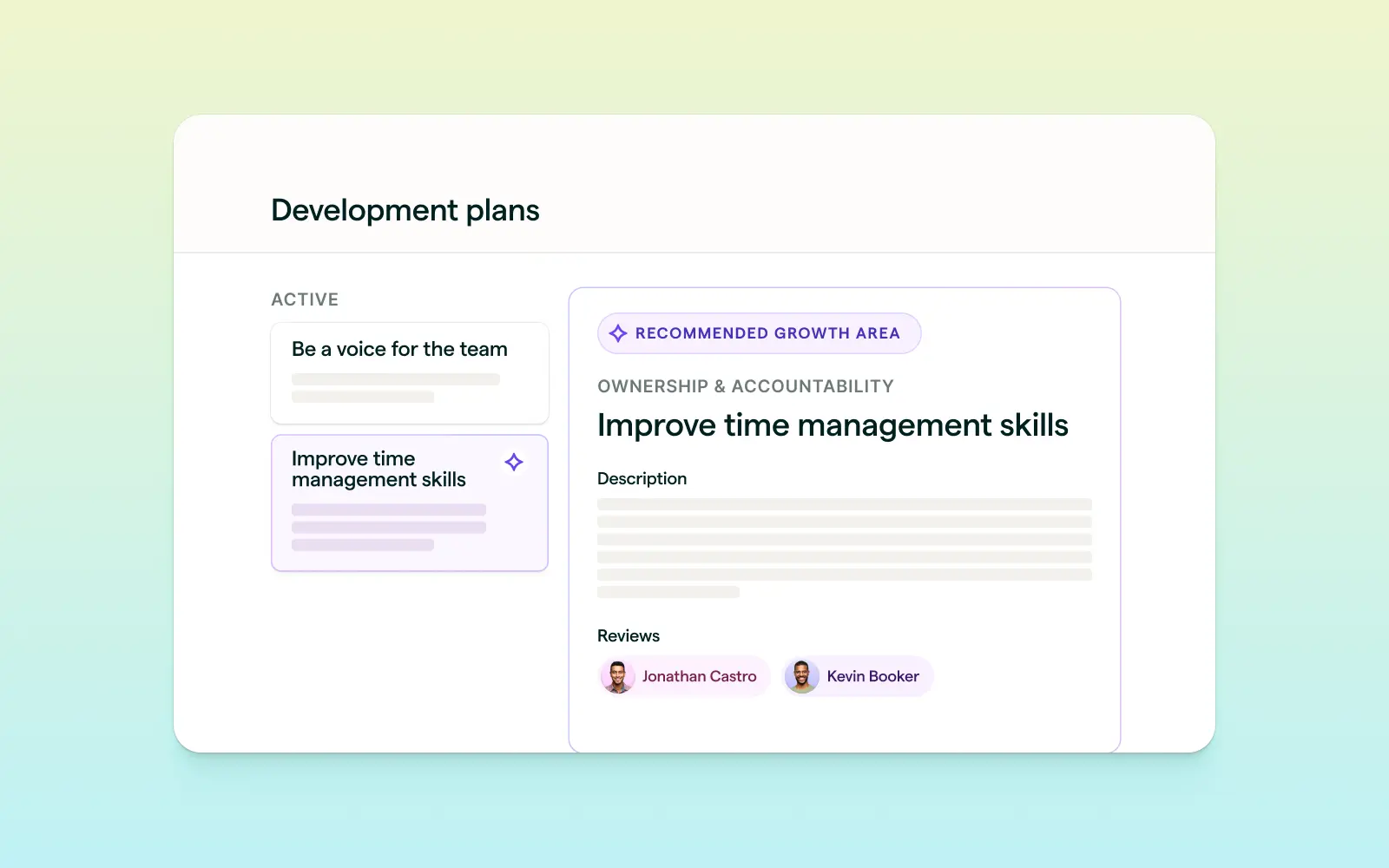
Lattice Grow platform UI showing individual development plans with goal setting.
Pair your learning with a career coach. Lattice's built-in AI knows you well enough to recommend growth areas and next steps.

See Our AI Growth Tools

3. Think about readiness, not just skills.

AI adoption isn't purely a training problem — it's also a culture problem. Some employees are eager to experiment; others are anxious about what AI means for their roles. Before rolling out any course, it's worth taking the temperature of your teams. For people who are nervous, starting with the ethics courses (especially the LinkedIn Learning one for leaders) can do a lot to build trust and address concerns head-on.

4. Pair any course with real conversation.

The real learning happens when people talk about how they're applying what they picked up. Consider adding a monthly "AI learning" session — even just 30 minutes — where employees share what they're experimenting with, what's working, and what surprised them. This kind of peer exchange often does more for adoption than the course content itself, because it surfaces the practical, role-specific wins that formal curricula can't anticipate.

5. Don't optimize for expertise, optimize for momentum.

The goal isn't to build an organization of AI specialists overnight. It's to help your team feel curious, capable, and confident enough to keep learning. Start small, celebrate early wins, and build from there.

The teams that are moving fastest with AI right now aren't the ones who launched the most comprehensive training programs, they're the ones who made it safe to experiment and easy to share what they found.

AI is changing fast, but the teams that will thrive aren't necessarily the ones with the most sophisticated tools. They're the ones who've built a culture of learning, where curiosity is encouraged and no one feels left behind.

The courses in this roundup are a starting point, not a finish line. Pick one. Share it with your team. See what sparks. And if you're thinking about how to build a development culture that supports continuous learning (not just during AI season, but all year long), Lattice can help. Talk to our team and learn how.

Note: Course pricing is approximate and subject to change. Always confirm current pricing and availability directly with the provider before recommending to your team.

Badge of G2's 2026 top 50 HR products
Logo of G2
⭐⭐⭐⭐⭐
3300+ 5-star G2 reviews
Badge of G2's Spring 2026 leader

Your people are your business

Ensure both are successful with Lattice.