
Hiring a new employee is never just about filling a role. It’s about aligning the right person with the right responsibilities and setting them up for long-term success. But too often, teams rush through job documentation or rely on outdated descriptions that don’t reflect today’s workflows, tools, or expectations.
That’s why we created a free job responsibilities template. Designed to bring clarity, consistency, and structure to every role in your organization, this easy-to-use document makes it simple to define job expectations.
Whether you’re leveling roles, growing your team, or launching a temporary project, a standardized template ensures your company’s expectations are clear and consistent — for employees, managers, and HR teams alike.
Job Responsibilities Templates
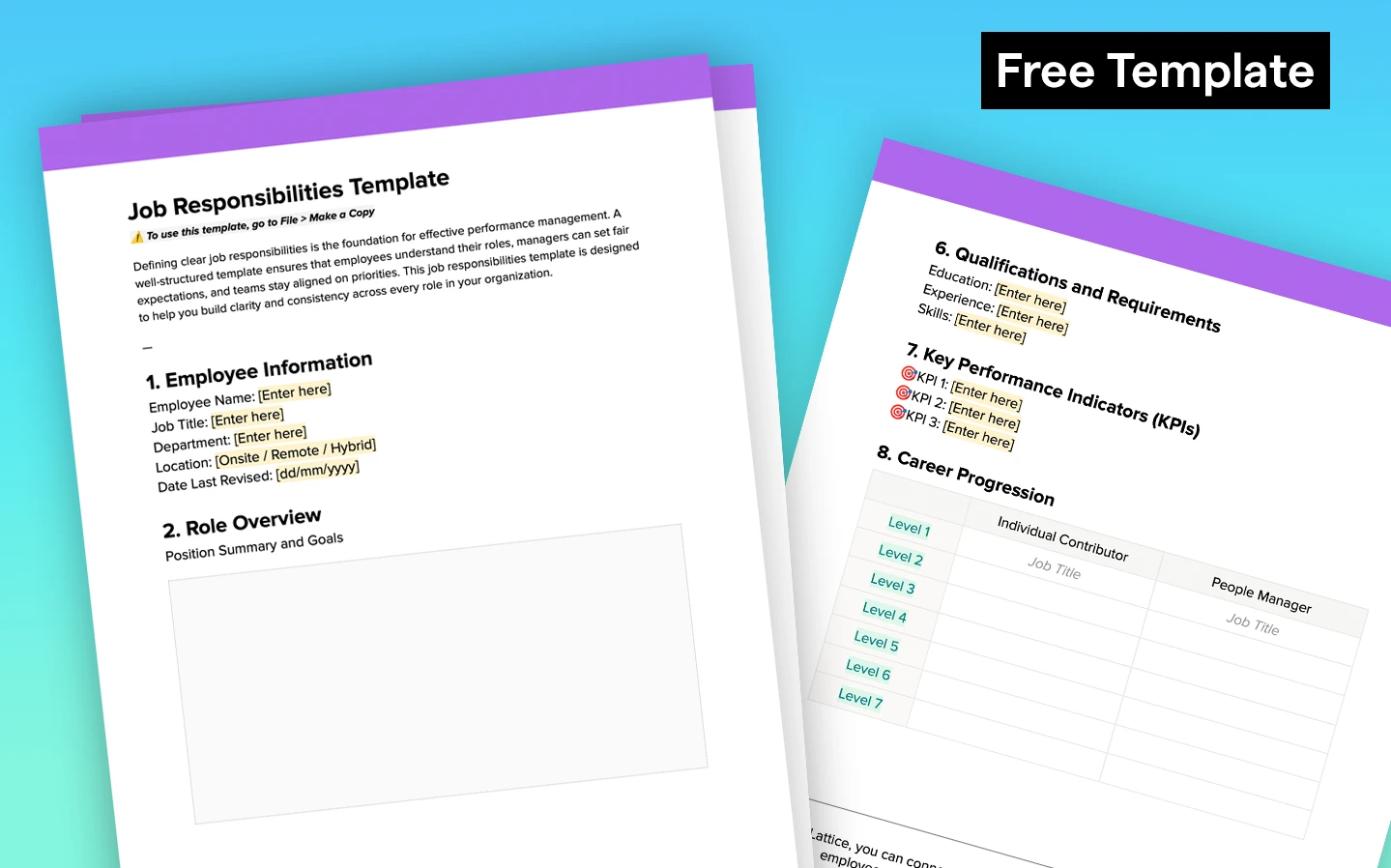
This downloadable resource includes:
- Standardized employee and role information fields
- A structured layout for primary and supporting job duties
- Dedicated sections for reporting relationships, key competencies, qualifications, and KPIs
- Career progression paths for individual contributors and managers
It’s built to support a wide range of job roles, whether for a marketing manager, administrative assistant, or software developer — and designed to help hiring teams create more effective job descriptions and better hiring resources. Download the job responsibilities template here or click below.
What to Include in a Job Description
Every effective job description starts with the same building blocks. Whether you’re hiring a graphic designer, a sales manager, or a software developer, a consistent structure helps define what success looks like. It also ensures alignment across hiring managers, recruiters, and team members.
Here’s a deeper look at each section of the job responsibilities template and how it supports the hiring process, onboarding, and employee development.
1. Employee Information
This section captures the basic logistics:
- Job title: Clearly defined, aligned with internal job architecture, and externally recognizable (e.g., “Digital Marketing Manager” instead of “Marketing Ninja”).
- Department: Helps recruiters, HR managers, and finance teams track headcount and budgets by org unit.
- Location: Specify onsite, remote, or hybrid to set expectations from the start.
- Date last revised: Version control is critical for keeping documentation aligned with real responsibilities.
Why it matters: This metadata powers everything from job board listings to internal workforce planning tools.
2. Role Overview
This is your job summary — a concise statement of the role’s purpose and strategic goals.
- Position summary: Describe what this role does and why it exists.
- Goals: Include 1–2 high-level goals the role supports (e.g., “Drive MQLs through integrated campaigns” or “Improve internal support ticket resolution times”).
Why it matters: This is the elevator pitch you’ll use in job postings, team intros, and performance conversations. It keeps everyone aligned on what this person is here to achieve.
3. Roles and Responsibilities
Think of this as the core of the job description. Break it into:
- Primary duties: The essential tasks and outputs the person is directly accountable for. Use clear, active bullet points (e.g., “Manage product roadmap and facilitate quarterly planning”).
- Secondary/supporting duties: Less frequent or indirect tasks that support team or cross-functional success (e.g., “Assist with hiring and onboarding new engineers”).
Why it matters: This section is key for setting expectations — and for evaluating fit during interviews, reviews, or promotions. When done well, it also helps identify overlapping or unclear responsibilities across teams.
4. Reporting Relationships
Document who the employee reports to, and who (if anyone) reports to them:
- Reports to: Clarify the direct manager or supervisor, and their role in day-to-day oversight.
- Direct reports: List any team members managed by this role.
- Key internal stakeholders: Cross-functional peers the role frequently collaborates with.
- External relationships: Customers, vendors, or agencies the employee works with regularly.
Why it matters: Clear reporting structures help with approvals, accountability, and career pathing — especially in matrixed or fast-growing organizations.
5. Key Competencies
Define the skills and behaviors needed to thrive in the role, across three categories:
- Technical competencies: Role-specific abilities, tools, or platforms (e.g., Salesforce, Figma, SQL).
- Behavioral competencies: Soft skills like adaptability, communication, or emotional intelligence.
- Leadership competencies: For management roles, outline expectations around coaching, decision-making, or strategic thinking.
Why it matters: These competencies support hiring decisions, employee development, and performance evaluation. They're also critical when designing internal training or leveling frameworks.
6. Qualifications and Requirements
This section outlines what a candidate needs to bring to the table:
- Education: Degrees, certifications, or continuing education relevant to the role.
- Experience: Minimum years of experience, including any industry or functional preferences.
- Skills: List both hard and soft skills — for example, “data visualization” or “conflict resolution.”
Why it matters: This gives recruiters and hiring managers a shared checklist for identifying qualified candidates — and helps job seekers decide if a role is a fit.
7. Key Performance Indicators (KPIs)
Set 2–3 specific metrics tied to the role’s responsibilities and impact. For example:
- Customer satisfaction score (CSAT) for support roles
- Qualified opportunities sourced for sales
- Project delivery rate for program managers
Why it matters: Clear KPIs reinforce accountability and transparency — and ensure performance reviews are based on measurable outcomes, not just subjective impressions.
8. Career Progression
Show how this role fits into your internal job architecture:
- Individual contributor path: What’s the next level up, and what changes in responsibilities or expectations?
- People manager path: If this role manages others, what’s the future scope?
Why it matters: Career transparency is one of the most requested elements by employees — and helps support internal mobility, retention, and engagement.
Real-World Examples
Here’s what the template looks like in action — modeled after five different roles, each filled out using the same structure.
{{rich-highlight-2}}
{{rich-highlight-3}}
{{rich-highlight-4}}
{{rich-highlight-5}}
Give employees clarity with Lattice.
Templates are a great starting point, but truly scalable HR teams go further. With Lattice's HR platform, you can:
- Connect job responsibilities to career growth paths in Lattice Grow
- Use responsibilities and KPIs as a foundation for performance reviews in Lattice Performance Management
- Streamline job architecture and leveling across roles, departments, and locations
- Centralize job expectations in one accessible place, so all team members — and new hires — stay aligned
- Eliminate version control issues and manual tracking with easy integrations and automation
Want to see how it all works together? Schedule a demo today.
{{rich-highlight-6}}
Marketing Manager
Department: MarketingLocation: Hybrid — San Francisco
Position Summary and Goals: Own campaign strategy, oversee digital content execution, and collaborate with sales and product teams to support growth goals.
Primary Duties: Develop and manage campaigns, own SEO strategy, lead cross-functional content calendar.
Secondary Duties: Support brand and PR efforts, manage agency relationships.
Reports To: Director of Marketing
Direct Reports: Marketing Coordinator, SEO Specialist
Key Internal Stakeholders: Sales, Product
Key Competencies: Strategic thinking, project management, communication
Qualifications: BA in Marketing, 5+ years experience, HubSpot certification
KPIs: Campaign ROI, lead volume, SEO rankings
Career Path:
Administrative Assistant
Department: Operations
Location: Onsite — Chicago
Position Summary and Goals: Ensure seamless administrative support to the leadership team and day-to-day office operations.
Primary Duties: Schedule meetings, manage travel logistics, order supplies.
Secondary Duties: Coordinate team events, maintain office records.
Reports To: Office Manager
Key Internal Stakeholders: All departments
Key Competencies: Organization, attention to detail, multitasking
Qualifications: Associate’s degree or equivalent experience
KPIs: Task turnaround time, stakeholder satisfaction
Career Path:
Software Engineer
Department: Engineering
Location: Remote
Position Summary and Goals: Develop and maintain scalable backend systems to support the core product experience.
Primary Duties: Write and review code, contribute to sprint planning, troubleshoot bugs.
Secondary Duties: Collaborate with product and QA teams.
Reports To: Engineering Manager
Key Internal Stakeholders: Product, QA
Key Competencies: Problem-solving, proficiency in Python/Go, Git workflows
Qualifications: BS in CS, 3+ years development experience
KPIs: Code quality metrics, sprint velocity, incident response time
Career Path:
Project Manager
Department: Product
Location: Hybrid — New York
Position Summary and Goals: Drive cross-functional execution of key product initiatives from planning to launch.
Primary Duties: Manage timelines, run standups, communicate blockers.
Secondary Duties: Improve sprint workflows, support team retrospectives.
Reports To: Head of Product
Key Internal Stakeholders: Engineering, Design, Sales
Key Competencies: Time management, stakeholder communication, Jira fluency
Qualifications: PMP certification, 3–5 years experience
KPIs: Delivery rate, stakeholder alignment scores
Career Path:
✨ Disclaimer: This content was developed with the help of artificial intelligence, though reviewed, edited, and approved by (real) humans.