Functional Manager Leads
The most hierarchical structure. The primary manager retains most authority. Project managers coordinate and align team members with project goals but don’t directly manage them.



Companies operate in many ways, but most of us are familiar with the traditional hierarchical structure and its clear chain of command. In other words, I am on a team, and that team’s leader is my boss.
But across the spectrum of organizational design, other options for org charts exist, like the flat organization or the matrix organization. Here, we discuss how matrix organizations work, when they’re most useful, and how HR teams can support them.
{{rich-takeaway}}
A matrix organization is a business in which employees report to more than one person, typically a functional manager (like a traditional boss) and a project manager. Instead of following a single, hierarchical chain of command, employees work across multiple reporting lines that connect departments with project teams. For example, a marketing manager may report to a director of marketing while also supporting a launch led by a product manager.
Matrix structures allow organizations to bring together the right skill and expertise without having to constantly restructure the org. They are most common in organizations with a global footprint, or those looking to reconcile competing needs between functional control and business or customer ownership.
For example, the global semiconductor company STMicroelectronics chose a matrix structure to bring it closer to customers and improve communication across R&D, production, marketing, and sales, according to their 2024 semiannual SEC report. Other well-known companies operating this way today include ING and P&G.
The matrix organizational model works well long-term for some companies, but not all. In 2022, Unilever replaced its matrix structure with five category-focused “Business Groups,” each responsible for its own strategy, growth, and profit delivery, noting that the change would make the company “simpler and faster.”
Complexity and speed are two common concerns with matrix orgs, but they aren’t the only complications.
Matrix organizations increasingly reflect the way work gets done today: often cross-functionally, often based on projects, and often within teams that need to be very agile.
But like so much of life, the benefits of a matrix organization come with a flip side. Their flexibility makes them great, but it can cloud clarity around decision-making and ownership. Matrix orgs deliver cross-functional teamwork that can support more agile problem-solving and spur innovation by bringing together diverse skill sets. At the same time, cross-functional teamwork can introduce competing priorities, with employees having to balance direction from project managers and functional managers.
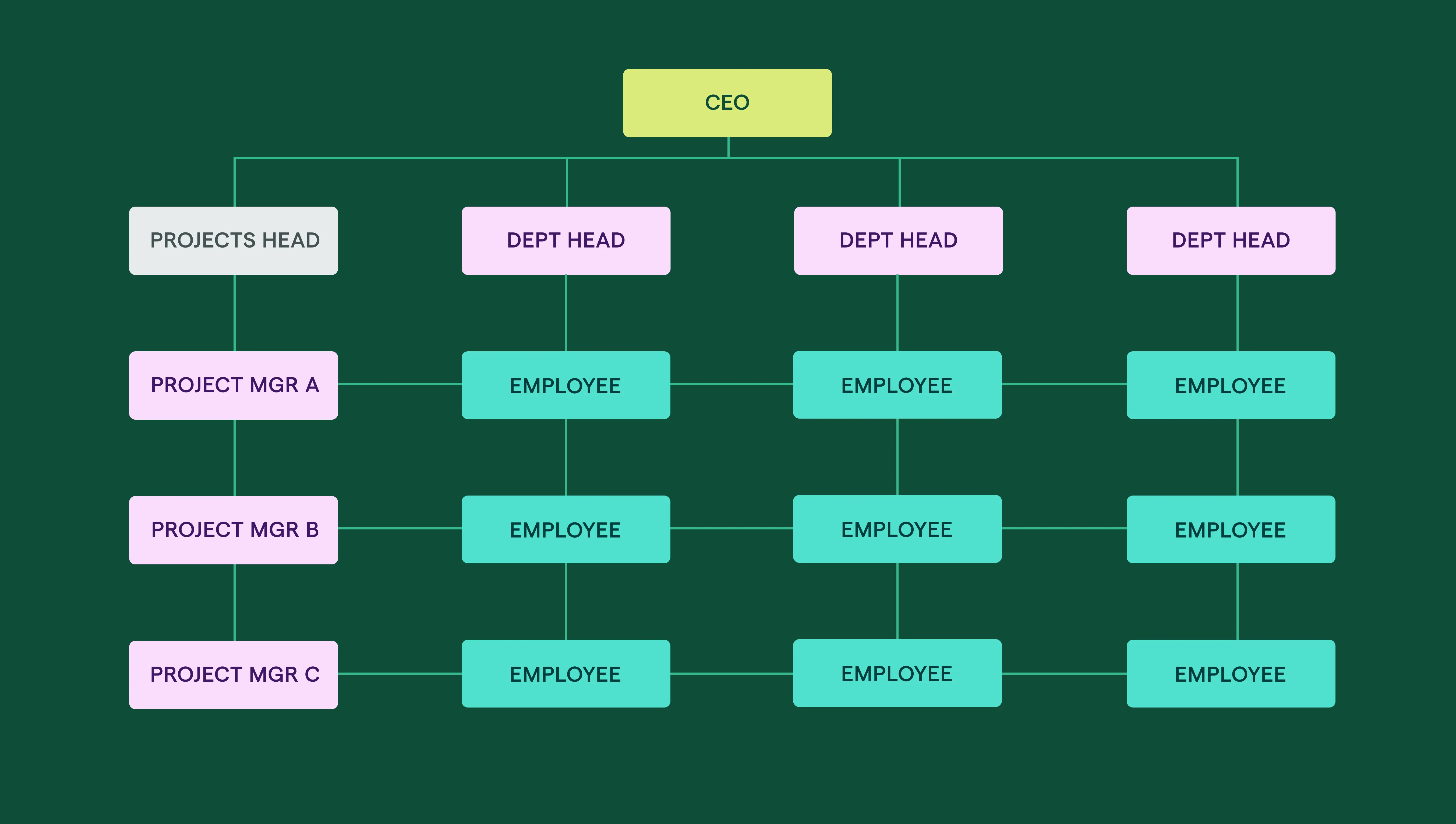
Matrix organizations also lend themselves to flexible resource allocation. Rather than having a fixed headcount on specific teams, leaders can assign individuals based on expertise, experience, and would-be team makeup. However, employees may struggle to prioritize tasks across these competing demands.
Lastly, matrix-style management can improve decision-making by including multiple perspectives. But — as most of us know — more stakeholders can stall decision-making and create ambiguity around ownership. Without a clear reporting structure, it can be tough to know who is accountable for what and when.
Matrix organizations exist along a spectrum. Some are akin to traditional management structures, while others more closely resemble project-based organizations where project managers drive execution.
In practice, many large companies blend elements of these models and therefore don't fit neatly into any of these boxes. P&G, for example, operates through “Sector Business Units,” “Focus Markets,” “Enterprise Markets,” and supporting corporate resources — a model the company says is designed to create “a more empowered, agile and accountable organization.”
When multiple reporting lines exist, ensuring alignment and clarity between managers, employees, and teams requires additional attention. Here’s where matrix structures create the most hurdles.
These challenges require HR-implemented structure and systems to resolve.
For HR teams transitioning their org to a matrix structure, or joining one for the first time, there can be a learning curve. Here are some of the top strategic challenges for HR teams.
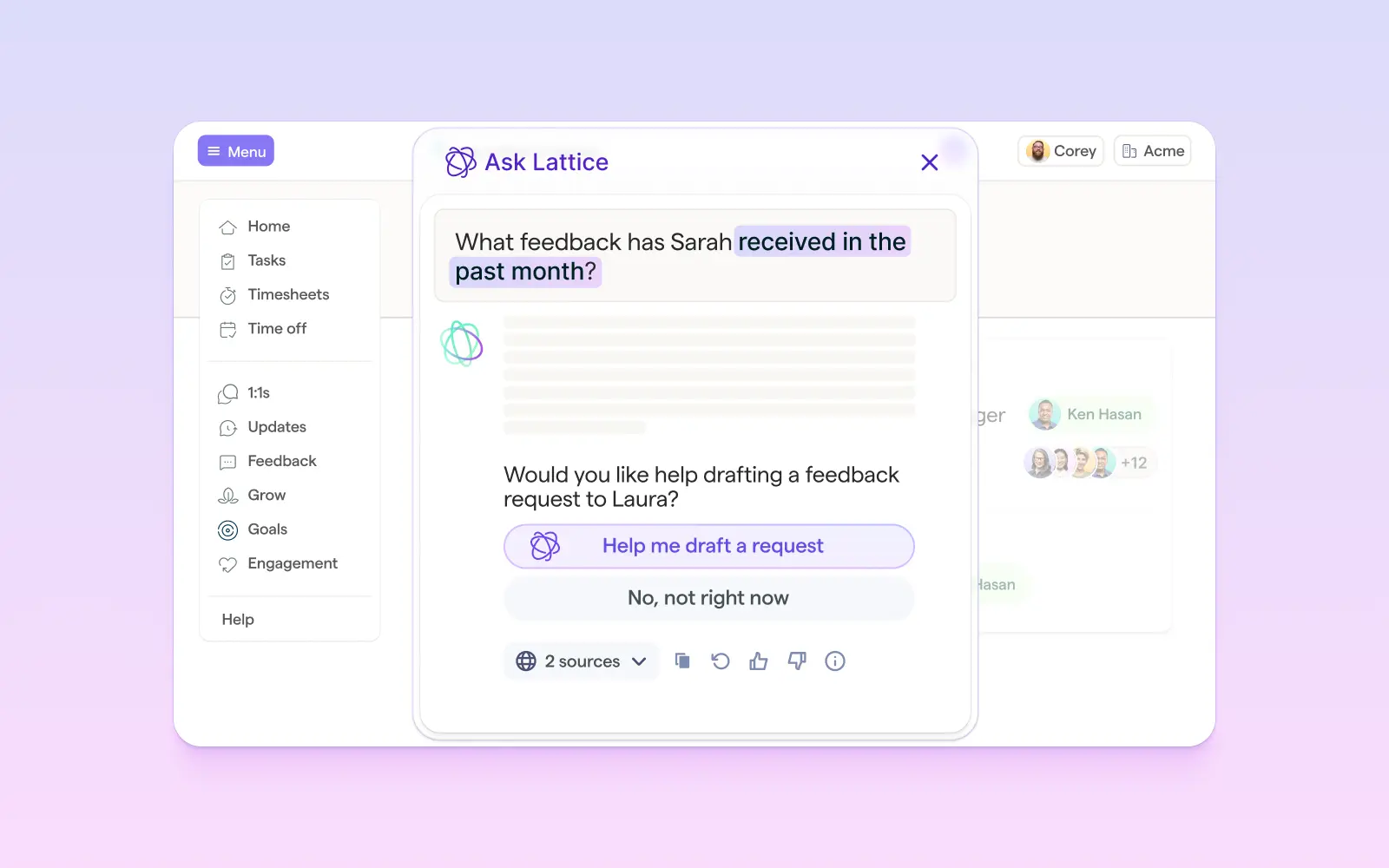
HR teams supporting a matrix organization should focus on clarity, consistency, and communication. In particular:
Matrix management requires more coordination between HR and both project and functional managers than traditional management structures. Without repeatable, scalable systems, this coordination can be tough to support.
Lattice brings performance management, goal setting, and feedback into a single platform, making it easier to operate across reporting lines. HR teams can support dual reporting relationships, align team members across business units, and improve delegation and the decision-making process with shared data.
Discover how Lattice helps HR leaders working in complex org structures by scheduling a demo today.
In a matrix organization, employees report to more than one manager, typically a functional manager and a project manager. Functional managers focus on long-term development and expertise, while project managers oversee day-to-day tasks, timelines, and deliverables tied to specific initiatives. Because employees work across multiple reporting lines, matrix organizations can coordinate work more flexibly across functions.
A matrix structure improves collaboration by bringing together team members from different functions, enabling better problem-solving and innovation. It also allows organizations to allocate resources more efficiently, adapt to changing priorities, and offer employees a wider range of projects and skill-building opportunities.
Matrix organizations can create confusion around reporting relationships and priorities, especially when employees receive direction from multiple managers. This model may also slow decision-making and increase the risk of workload imbalance if responsibilities are not clearly defined.
There are three primary types of matrix organizational structures: weak, balanced, and strong. In a weak matrix, functional managers retain most authority; in a balanced matrix, authority is shared between functional and project managers; and in a strong matrix, project managers take the lead on execution and decision-making.
Companies use matrix structures when they need employees to contribute to both their functional department and to cross-functional projects. This approach is especially useful for organizations operating across geographic regions, business units, or complex initiatives that require collaboration between multiple teams.
Matrix organizations require human resources teams to clarify roles and reporting relationships, standardize performance management across multiple managers, and ensure consistent communication and culture across teams. HR also needs access to strong people data to monitor employee engagement, workload, and performance in a more decentralized environment.



Ensure both are successful with Lattice.