

Employees want fair pay, yet organizations often struggle with compensation strategy and clarity. As pay transparency laws become more widespread, companies face increasing questions about how salaries are determined.
Salary bands address these challenges by providing a clear framework for setting pay.
“Salary bands are structured ranges for base pay established for specific roles or job levels within an organization,” Denise Liebetrau, Founder, CEO, and Principal Compensation Consultant at Prosper Consulting LLC in Denver, Colorado, said. “At their core, they create a framework for consistent, equitable, and market-aligned compensation decisions.”
This article explores why companies use salary bands, how to create them, plus ways to use them effectively.
{{rich-takeaway}}
How Salary Bands Work
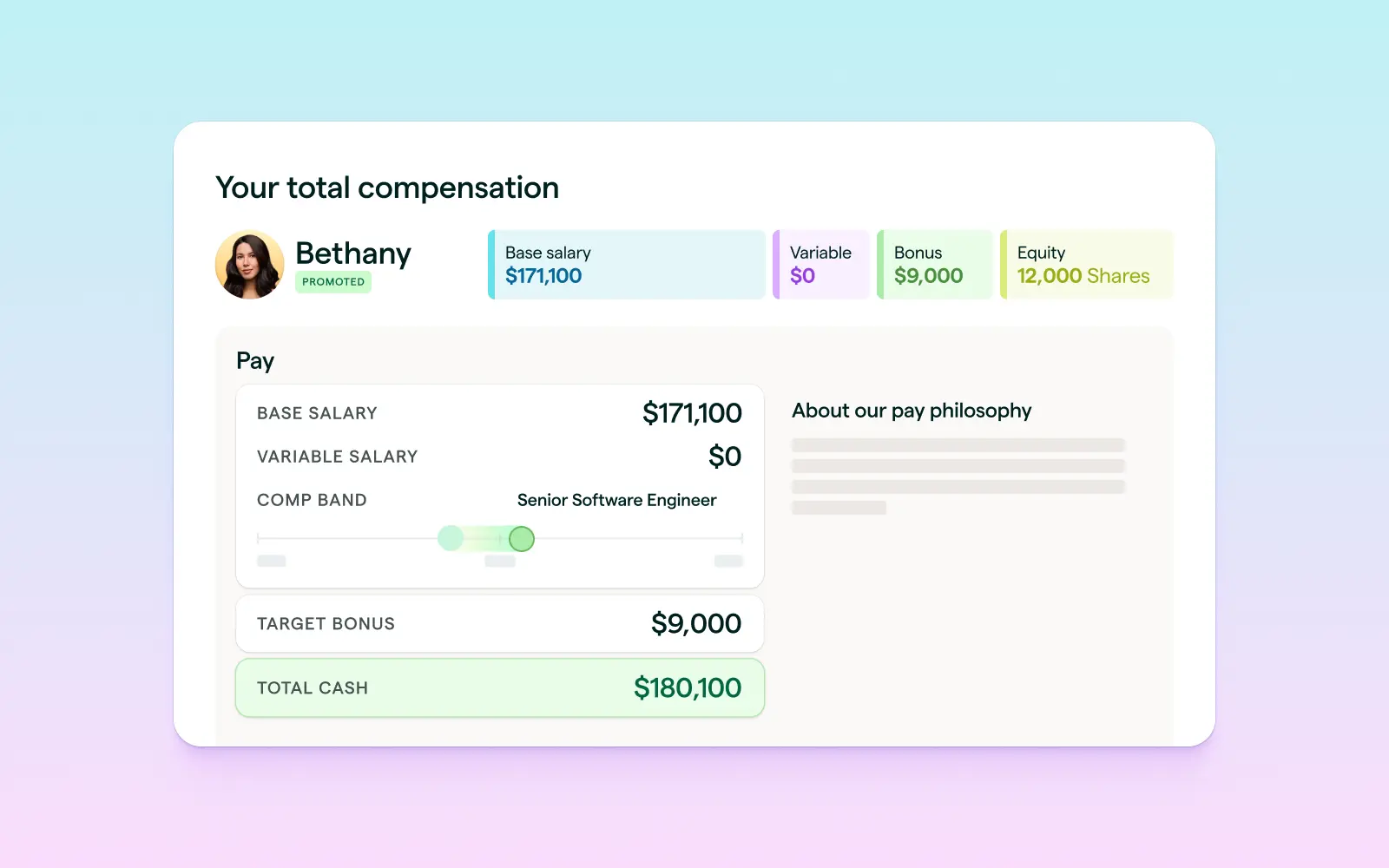
Salary bands, also called pay bands or salary ranges, define the minimum, midpoint, and maximum pay for specific job roles, job families, or similar positions. The midpoint is typically set based on market benchmarking, reflecting competitive pay levels offered by other employers for comparable roles.
If the market midpoint for a software engineer is $90,000, companies with similar roles typically set that as their midpoint to stay competitive.
Employee placement within a salary band is a thoughtful process that considers factors such as experience, performance, and tenure, and sometimes geographic location. A new hire with limited experience might start near the minimum, while a high-performing employee with several years in the role could be placed closer to the midpoint or above. This approach rewards growth and encourages retention by showing clear progression paths.
To get salary bands right, you first need a clear picture. “Before you can put a number on anything, you need to understand what the role actually is,” said Amie Greco, Founder and Managing Director of North Talent Group in Toronto, Canada. “What’s the scope of responsibility, what level of decision-making authority it carries, whether they’re leading a team or operating as an individual contributor, and what experience and skills are genuinely required.”
With transparency around job progression, “Employees understand how compensation grows with increased responsibility and impact,” she said. This framework helps manage employee expectations.
Why You Need Salary Bands
“Salary bands matter because they turn compensation from a series of one-off decisions into a system,” Liebetrau said. “That system is what enables fairness. Without it, pay equity becomes reactive rather than intentional. With it, organizations can proactively identify gaps, correct inconsistencies, and explain decisions in a way that builds credibility and trust.”
These bands boost transparency and help companies comply with expanding pay transparency laws.
Without them, employees in similar jobs might receive widely different pay due to salary negotiation skills or manager discretion. Bands standardize compensation practices by linking pay ranges directly to job titles.
When employees understand how pay is determined and what progression looks like, they are more likely to trust the company and stay engaged, reducing uncertainty and frustration around compensation.
By following consistent salary bands and scalable pay practices aligned with business goals, companies can attract and retain top talent.
Salary Bands vs. Other Compensation Structures
Salary bands are different from pay grades and spot salaries. A pay grade shows where a role fits within the broader organization, while a salary band sets the range of pay for that role. Spot salaries, on the other hand, are fixed amounts without any range.
Spot salaries often suit roles with structured responsibilities — like entry-level customer service or administrative positions — because they simplify pay management. “Spot salaries can work for standardized roles where there isn’t much variation in experience or scope,” Greco said. “The downside is that they become harder to manage consistently as organizations scale.”
In contrast, mid to senior-level roles benefit from pay ranges that reward different levels of contribution. “For mid to senior roles, where you’re competing for talent and experience levels vary more, you need a range to stay flexible,” she said.
How to Create Salary Bands
Effective salary bands require a thoughtful approach grounded in the company’s compensation philosophy. Once the market and job structure are clear, the next step is to set pay ranges that reflect both internal roles and external factors. This means organizing roles into families (e.g., engineering, marketing), levels (e.g., junior, mid-level, senior), and clear job descriptions. A senior engineer might be defined as someone who leads projects and mentors others, while a junior engineer focuses on learning and executing tasks.
Key steps to defining job architecture include:
- Understand the role: Define scope, decision-making authority, levels of responsibility, leadership expectations, and skills required.
- Conduct market research: Benchmark pay against industry standard salary surveys and competitive compensation.
- Define job architecture: Organize roles into families and levels (e.g., Junior, Mid, Senior).
- Ensure internal equity: Review pay across functions and career levels to maintain fairness and consistency within the organization.
- Set salary ranges: Establish minimum, midpoint, and maximum salaries reflecting experience and performance.
- Adjust for geography and market variations: Account for cost of living differences and remote work considerations.
- Align with business goals: Set salary bands that reflect the company’s financial capacity and long-term strategy to support sustainable growth.
Reliable data and clear job architecture are essential for effective pay structures. “Before you can attach compensation to anything, you need clarity on how roles relate to each other,” Greco said. “Job architecture is what makes pay decisions consistent and defensible.”
{{rich-highlight-1}}
Maintaining and Updating Salary Bands
Salary bands aren’t set-it-and-forget-it tools. To stay effective and competitive, they require regular review and adjustment. That means checking how your pay ranges compare to the market, factoring in inflation and changes in the labor environment, and making sure pay remains fair without wage compression issues. If inflation rises by 5%, compensation packages should be reviewed to ensure pay remains competitive and fair for current employees.
{{rich-highlight-2}}
Common Challenges and Pitfalls
Despite best intentions, organizations face many challenges when managing salary bands. Here’s to look out for:
- Bands that are too wide or too narrow can create confusion or limit flexibility.
Risk: A very broad band from $60,000 to $120,000 might make it unclear what differentiates a mid-level from a senior employee. Conversely, a narrow band might prevent rewarding exceptional performers adequately.
- Misalignment with current market levels leads to uncompetitive or inequitable pay.
Risk: If a company’s salary bands are based on outdated surveys, they might lose talent to competitors offering higher pay.
- Weak communication and lack of transparency undermines trust.
Risk: Employees who don’t understand how pay decisions are made may assume unfairness, even if the system is equitable.
- Neglected pay compression and internal disparities affect morale and retention.
Risk: If entry-level hires are earning near the maximum of a band while veterans remain near the minimum, it signals a compression problem. Likewise, pay gaps have negative effects.
Regular updates to salary bands help prevent problems like pay compression and ensure internal equity remains intact as roles and markets evolve. “The biggest issue is not design,” Liebetrau said. “It is discipline. Even well-designed pay bands fail when organizations don’t consistently use them.”
{{rich-highlight-3}}
Best Practices for Communicating Salary Bands Effectively
Transparent communication is essential. HR leaders and managers should be trained to discuss salary bands confidently, providing employees context about their placement and its link to career growth and salary increases.
It’s the kind of foundation we need to go from a 300-person to a 900-person company, and beyond.
Ashley Tocci, former Senior Manager of Employee Engagement at ivision
Here are four ways HR and managers can be in lockstep about communicating pay decisions and policies to employees:
- Explain how bands are built, including external market data, job levels and their definitions, business strategy, and goal alignment. Managers should clearly explain these elements to help employees understand the foundation of pay structures.
- Role-play conversations about pay increases to prepare managers to explain decisions clearly and empathetically. This practice builds managers’ confidence and ensures consistent, compassionate communication.
- Clarify the factors that drive employee pay movement within a band, such as performance, skills, experience, training, tenure, and education. Employees are more motivated and engaged when they understand the requirements for job progression.
- Provide context around compensation decisions, not just numbers. When managers explain how market trends and company goals affect salary decisions, employees see the bigger picture.
“Employees are more likely to trust the organization when they understand how decisions are made, even if they don’t always agree with the outcome,” Liebetrau said. “Transparency also reduces regrettable turnover by addressing one of the most common drivers of disengagement: perceived unfairness.”
When managers can explain pay decisions seamlessly, they prevent perceptions of inconsistency.

{{rich-highlight-4}}

Get clear on competitive pay.
In this workbook, we’ll walk through the compensation benchmarking process from end to end — helping you evaluate your pay policies, compare them to industry standards, and ensure you’re paying employees fairly.

See how your salaries stack up.
Download Lattice’s free Compensation Analysis Template to help you assess and optimize your pay structures for fairness and competitiveness.

Don’t have a compensation strategy? We can help.
Lattice’s free ebook template makes it simple: identify your comp philosophy, design salary bands that integrate with job levels, and develop a transparent, equitable approach to employee pay.
How Lattice Compensation Supports Salary Bands
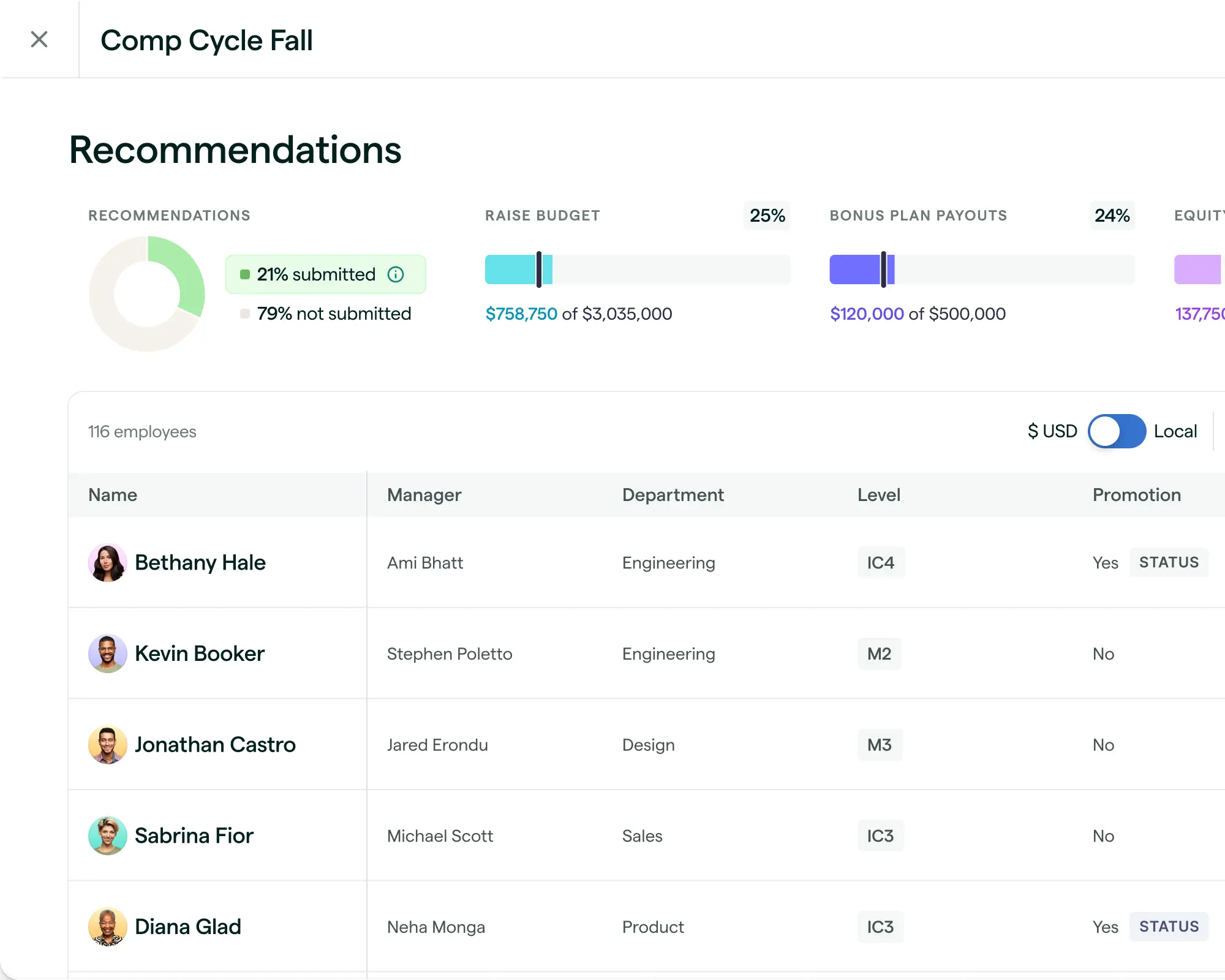
Lattice Compensation streamlines salary band management by centralizing data, providing real-time visibility into pay ranges, and integrating performance and growth metrics. This allows pay decisions to be tied directly to benchmarks or employee achievements, making pay increases more transparent and justifiable.
Anna Roe, former Chief People Officer and VP Operations at Mind Foundry, shared how Lattice Compensation transformed their process: “Lattice Compensation has given us a much slicker process, with salary bands aligned to frameworks, and data from performance reviews empowering managers to think more holistically around recognition, reward and compensation. I no longer dread compensation cycles — this is a big win!”
Tools that help employees, managers and HR teams get on the same page make a difference for organizations. “Technology doesn’t replace strategy, but it significantly improves execution and consistency,” Liebetrau said.
Looking ahead, Liebetrau said that HR leaders should focus on building flexible salary structures, strengthening job architecture, investing in pay transparency, using data proactively to monitor and correct inequities, and aligning talent and compensation strategies. “The organizations that succeed won’t just have better salary bands,” she said. “They’ll have systems that are understood, trusted, and consistently applied.”
Tour Lattice Compensation to see how it helps HR teams design, manage, and communicate salary bands with clarity and confidence — and to schedule a demo to see it in action.
Key Takeaways
- Salary bands create a clear, fair system for setting pay that aligns with market rates and company goals.
- Defining roles and levels clearly is key to making salary bands consistent and easy to explain.
- Salary bands need regular updates to stay competitive and avoid pay issues like compression.
- Being open about how pay works helps build trust and motivates employees by showing how they can grow.