
How to Prevent and Treat Workplace Burnout
Burnout is on the rise. Understand how the problem emerges and how to develop strategies to identify and prevent it.

Download this ebook for free
By submitting your information, you agree to Lattice's Terms of Service and Privacy Policy. You can opt out anytime.
Burnout has become one of the most searched terms in HR, and for good reason. More than half of American workers say they're experiencing it, and the number keeps climbing. But despite how common the word has become, most companies are still reacting to burnout after the fact rather than building workplaces that prevent it in the first place.
This guide is for HR leaders and managers who want to get ahead of it. You'll find the latest research on what's driving burnout today, a clear breakdown of why it should be on every business leader's radar, and five concrete strategies for addressing it before it costs you your best people.
Before you dive in, take two minutes with the diagnostic below. Five questions, no wrong answers.
What Is Burnout, and Why Does It Matter?
The World Health Organization (WHO) classifies burnout as an occupational phenomenon in their International Classification of Diseases. Defined as "a syndrome resulting from chronic workplace stress that has not been successfully managed," burnout is characterized by three key dimensions:
- Feelings of energy depletion or exhaustion
- Increased mental distance or cynicism related to one's job
- Reduced professional efficacy
As a reflection of the broader employee experience, workplace burnout is directly tied to employee engagement, which Gallup describes as a basic psychological need for performing work well. Engagement can reduce stress while increasing productivity, retention, and overall job satisfaction. Unengaged employees are more likely to experience burnout, but companies can address burnout-related issues proactively.
The Causes of Burnout
Burnout occurs when the demands of work consistently outpace an employee's ability to recover, often for reasons outside their control. In most cases, it stems from systemic issues within the business rather than any individual's shortcomings.
- At the organizational level, burnout is most prevalent in companies that expect long hours and overtime while compensating employees inadequately and discouraging time off.
- At the team level, burnout is most likely to emerge when employees are forced to balance heavy workloads with tight deadlines, or face unclear expectations and a lack of healthy boundaries from management.
According to Grant Thornton's 2024 State of Work in America survey, the top causes of burnout among employees are mental and emotional stress (63%) and long hours (54%) — a reminder that the problem is as much about emotional load as it is about hours logged.
The Burnout Crisis
Burnout is no longer a fringe concern — it's a widespread workforce reality. SHRM's 2024 Employee Mental Health research found that 44% of U.S. employees feel burned out at work, 45% feel emotionally drained, and 51% feel "used up" by the end of the workday. The Aflac WorkForces Report found that burnout is affecting nearly 3 in 5 American workers. And Grant Thornton found that 51% of employees experienced burnout in 2024, a 15 percentage-point jump from the prior year.
The research consistently points to one consequence above all others: employees who burn out leave. SHRM found that burned-out workers are nearly three times as likely to be actively searching for a new job.
A Growing Generational Divide
Burnout isn't distributed evenly across the workforce. The 2024–2025 Aflac WorkForces Report found that millennials (ages 28–43) are experiencing moderate to high burnout at a rate of 66%, compared to 55% for Gen X and 39% for baby boomers. Mid-level employees, caught between senior leadership's expectations and their direct reports' needs, consistently report the highest burnout rates of any group.
The pattern matters for people teams: the employees most likely to burn out are often the ones carrying the most institutional knowledge and the heaviest workloads. Losing them is costly in more ways than one.
The "Always-On" Accelerant
The rise of hybrid and remote work has added a layer to burnout that didn't exist a decade ago. Research consistently shows that burnout rates are similar across remote, hybrid, and in-person workers — which means the work setting itself isn't the protective factor many assume it to be. What matters more is the quality of management and whether employees have genuine permission to disconnect.
According to the APA's 2023 Work in America Survey, 95% of employees say it's very important to work for an organization that respects the boundary between work and personal time. The gap between what employees need and what most workplaces deliver is where burnout lives.
A note on AI anxiety. Burnout's drivers are evolving. Grant Thornton's 2024 survey found that 28% of workers believe their jobs are likely to be reduced or eliminated by AI, a new stressor layered on top of the perennial pressures of workload and long hours. HR teams navigating burnout today need strategies that account for this psychological weight, not just the operational ones.
Why Burnout Is Worth Your Attention
For Businesses
A poor employee experience doesn't stay secret. When your people feel burned out, they're more likely to share their frustrations with potential recruits, hurting your employer brand. Public criticism of your culture also affects how clients and consumers perceive your business.
The financial toll is real and measurable. A 2024 study published in the American Journal of Preventive Medicine found that employee disengagement and burnout costs employers an average of nearly $4,000 per employee per year in lost productivity and missed workdays. Multiply that across a workforce, and burnout stops being a wellness issue and becomes a business risk.
For Managers
Employees can't do their best work when they're running on empty. Managers rely on their teams to deliver quality results, so it's in their best interest to create a dynamic where people can consistently show up at their best. Allowing burnout to spread also puts teams at risk of losing top performers.
Managers are not immune, either. A Harvard Business Review analysis found that over 53% of managers report feeling burned out themselves — and those experiencing cynicism are three times more likely to leave their company. The ripple effects through a team can be severe. Tools like engagement surveys and one-on-ones can help managers gauge what their people actually need before it becomes a crisis.
For Employees
When people develop a negative mindset at work, they're more likely to disengage from the company mission and their own goals. Burnout makes it harder to think creatively, problem-solve, or advocate for your own development. Employees should feel empowered to flag workload concerns in one-on-ones and treat their well-being as a legitimate work priority — not an afterthought.
How to Prevent Burnout at Work
1. Listen to your employees.
The problem: It's easy for big wins and rapid growth to eclipse signs of burnout brewing in the workplace. Businesses don't immediately recognize if their communication practices are causing stress or if their ambitious quotas are fostering an overly competitive atmosphere. Unless they're actively seeking employee feedback, it's unlikely that companies will detect early traces of burnout — let alone understand and address its root causes.
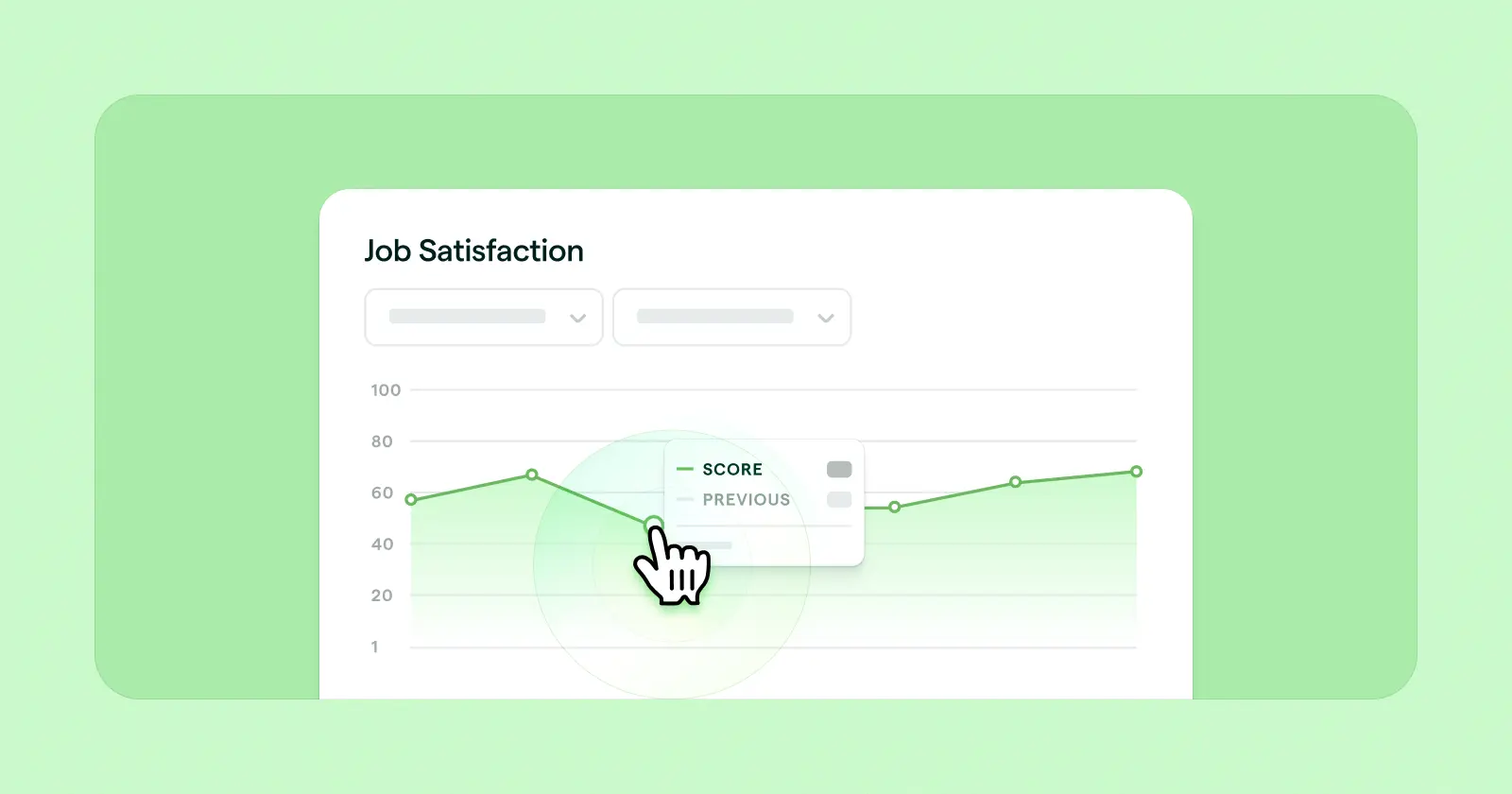
The solution: Running an engagement survey is the perfect starting point if you suspect you have a burnout problem. A well-designed engagement survey gives HR teams insight into the employee experience and helps kick off positive changes that improve retention, job satisfaction, and day-to-day morale.
Once you've finished running your survey, look for low scores on topics related to workload, work-life balance, fairness, and management styles. When reviewing your data, consider:
- Who is burned out? If your high performers are the ones burning out, you may have a culture that inadvertently rewards overwork.
- Are certain projects linked to higher burnout? Those areas may need more support or more realistic deadlines.
- Is there a correlation between burnout and employee tenure? New hires aren't the only ones who need support. Create structures for tenured employees too.
- Do certain departments have lower satisfaction levels? Consider leadership training for managers in high-risk departments.
After identifying patterns, share findings with the company at large. This signals to employees that they're being heard and reinforces the value of participating in surveys. Periodic pulse surveys can track the effectiveness of anti-burnout initiatives between major engagement cycles.
For more advice on running engagement surveys, check out the Ultimate Guide to Employee Engagement Surveys.

2. Set clear expectations.
The problem: Burnout isn't necessarily correlated with poor performance. An engaged employee can begin to struggle when they feel lost or paralyzed by unclear expectations. Employees are more prone to burnout when they lack clarity on:
- Which functions fall under their responsibility
- Which projects to prioritize
- What benchmarks for success look like
- When to be available for work
Lack of clarity often surfaces in performance reviews. When looking at 360 reviews, pay attention to how aligned an employee's self-assessment is with their manager's perspective. A significant gap usually points to a disconnect in expectations or a lapse in communication that needs to be addressed — before it becomes a burnout driver.
The solution: Companies can prevent confusion by using goals and continuous feedback to keep employees in the loop. Goals ensure people know exactly what to prioritize and what standards they'll be evaluated against. Continuous feedback gives employees insight into how their work is perceived before it becomes a surprise in a formal review. Together, they enforce clarity and consistency so employees know whether they're getting the right things done in the right ways.
Check out HR's Complete Guide to Goal Setting to learn how to set goals that are clear and actionable.
3. Don't reward burnout behavior.
The problem: Even when an employee takes on too much, they may be receiving positive reinforcement for doing so. Praising people for working late or consistently going above and beyond can signal that overwork is the path to recognition — and employees with healthy boundaries may feel undervalued as a result. Examples of burnout-reinforcing behaviors in company culture include:
- Encouraging employees to work from home instead of taking sick days
- Expecting constant availability outside of work hours
- Rewarding employees who work harder rather than those who produce better results
- Showing favoritism to employees who attend more optional work events
The solution: If recognition only flows toward above-and-beyond behavior, you're inadvertently signaling that overworking is the best way to get noticed. Effective performance management celebrates not just what employees accomplish, but how sustainably they do it. Businesses should invest in their employees' well-being by tracking development, celebrating milestones, and recognizing people for setting healthy boundaries — not just for going the extra mile.
4. Train your managers.
The problem: When performance metrics are the only thing managers look at, it's easy to miss the early signs of burnout. Numbers don't paint a full picture of the employee experience. Managers may also be sending mixed signals because they feel caught between leadership's expectations and their direct reports' needs — or because they're burned out themselves.
The solution: Management training is one of the highest-leverage investments a company can make against burnout. According to Gallup, employees who believe their employer genuinely cares about their well-being are 71% less likely to report burnout. Translating that into practice means training managers to recognize the early warning signs and act on them.
Psychological signs of burnout include difficulty concentrating, irritability, low self-confidence, anxiety, and withdrawal. Physical signs may include disrupted sleep, low energy, frequent illness, and difficulty communicating.
A few tools that help managers stay ahead of burnout on their teams:
- Regular one-on-ones create consistent space for managers to check in on what's beneath the surface. Questions like "What are you most worried about right now?" or "Do you feel like you have bandwidth for your own development?" can surface issues before they become crises.
- Engagement huddles give managers and their teams a structured way to act on survey results at the team level — where change can happen faster than at the company level.
- Weekly updates ("snippets") let employees reflect on their week and give managers a regular signal on where people are struggling before it snowballs.
- Pulse surveys track fluctuations in team sentiment between major engagement surveys, so initiatives can be course-corrected quickly.
5. Build purpose into how people work, not just what they read.
The problem: Employees want their work to mean something. When they can see a clear connection between their daily contributions and a larger mission, purpose becomes a renewable source of energy. But when businesses focus on output over mission — or when values are vague, unmemorable, or inconsistently modeled by leadership — employees lose that thread quickly.
This is especially common in fast-growing companies, where rapid change can feel disorienting and the "why" behind decisions gets lost in the pace of execution. Grant Thornton's 2024 research identifies lack of advancement opportunities as one of the top factors driving employee exits — second only to compensation — and it's closely tied to employees feeling like their work doesn't lead anywhere meaningful.
The solution: The key word here is integration. Purpose doesn't land through a values poster in the break room or a paragraph in the employee handbook — it lands when managers connect individual goals to team objectives, when performance conversations acknowledge mission alignment alongside results, and when recognition calls out how someone contributed, not just what they delivered.
Practically, HR teams can build purpose into existing workflows by:
- Ensuring company OKRs are tied to a clear narrative about why they matter — not just what the targets are
- Training managers to connect individual goal-setting conversations to team and company mission
- Using recognition moments to explicitly name the values being embodied, not just the output being celebrated
- Asking employees directly in surveys: Do you understand how your work contributes to company goals? Low scores here are an early indicator of burnout risk
Purpose-driven work isn't a soft benefit, it's a structural buffer against burnout. When people understand why their work matters, the hard days feel sustainable in a way they simply don't when work feels disconnected from anything larger.
Conclusion
Burnout isn't a personal failing, it's an organizational signal. When it spreads through a team or a company, it's telling you something about how work is structured, how expectations are communicated, and whether your people feel seen and supported. The good news is that the same systems HR teams use to drive performance — goals, feedback, engagement surveys, one-on-ones — are also your most powerful tools for preventing burnout before it takes hold.
Addressing burnout doesn't require a full culture overhaul. It requires listening carefully, acting on what you hear, and building the kind of management culture where people can do their best work sustainably — not just in a sprint, but over the long term.
Lattice gives HR teams the tools to do exactly that: engagement surveys that surface what's really going on, one-on-one tools that keep managers connected to their teams, and performance management built around continuous feedback rather than annual surprises. See how it works.



Your people are your business
Ensure both are successful with Lattice.